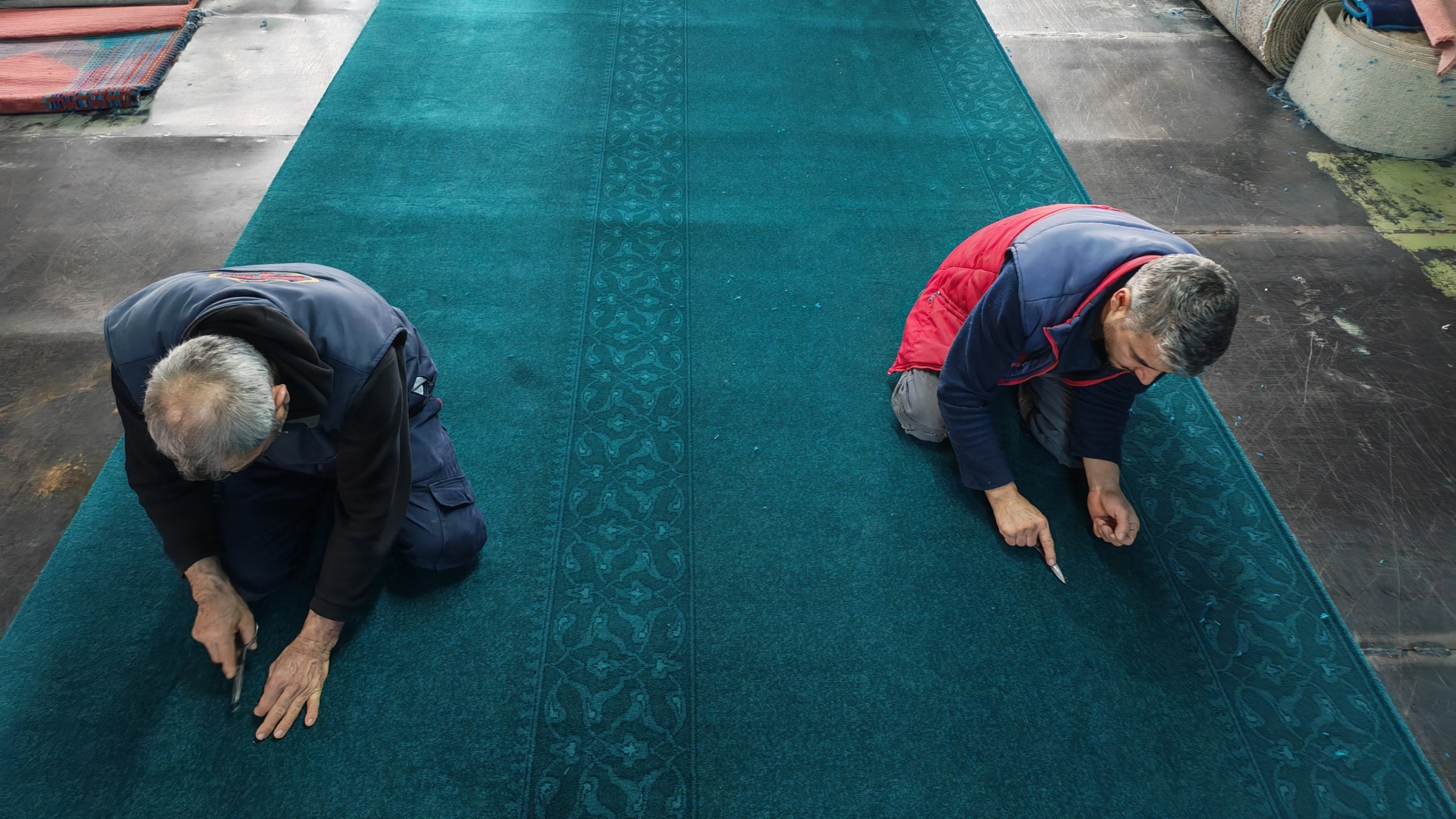
New handwoven carpets featuring Ottoman-era rumi motifs have been produced in the Demirci district of Manisa Province in western Türkiye for the Tokyo Mosque, originally built in 1938 in Japan’s capital.
A carpet company in Demirci completed the work after receiving a request from the mosque to replace carpets it had installed 26 years ago. The project, which took about 18 months, has now been finalized.
The 800-square-meter (about 8,600-square-foot) carpet, crafted entirely by hand using traditional weaving techniques, has been delivered to Tokyo. Installation at the mosque began in order to have the carpets in place before the start of Ramadan.
Company owner Ali Rıza Özkul said the new carpets were designed to closely resemble the originals woven more than two decades ago and feature the Ottoman rumi pattern.
“The dominant color is teal green, while burgundy was preferred in the areas where worshippers step,” Özkul said. He added that reactive dyeing techniques were used in coloring the wool.
Özkul noted that carpets produced in Demirci have earned a strong reputation for quality. “Our products are made of 100% wool and entirely natural materials,” he said. “For the carpet used in the Tokyo Mosque, 4.5 kilograms (about 10 pounds) of wool were used per square meter. These carpets, blended with New Zealand wool, have been preferred for years because of their ideal weight and durability.”
He also said carpets woven in Demirci have been installed in historic places of worship such as the Hagia Sophia Grand Mosque and the Süleymaniye Mosque in Istanbul.
“Thanks to the special wool used and our weaving system, our mosque and hotel carpets are flame-resistant and nonflammable,” Özkul said. “In addition, due to the way the wool is blended and our specific weaving methods, the carpets are resistant to moth damage and continue to adorn mosques and hotels for many years.”