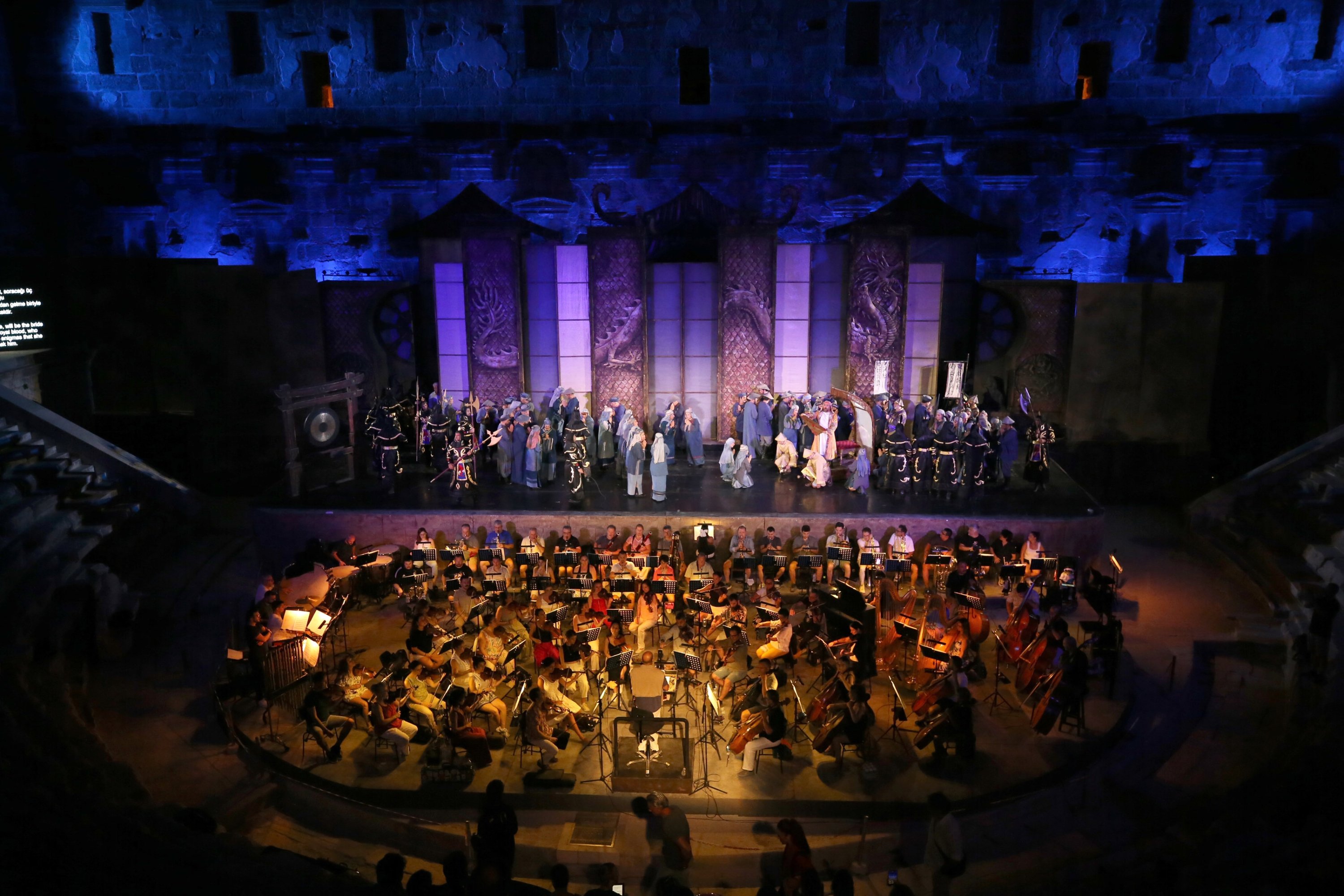
The latest Aspendos Opera and Ballet Festival – the 32nd – organized by the Directorate General of State Opera and Ballet of the Ministry of Culture and Tourism of the Republic of Türkiye opened in the restored classical open-air theater of Aspendos on the overly warm Antalya night of Sept. 14 with a production of the Giacamo Puccini opera "Turandot." This highly dramatic opera is the last work of Puccini, and parts of the final act were even left unfinished at the time of his death in November 1924, although it was fully, though perhaps not harmoniously, completed by Franco Alfano on the basis of notes left by Puccini. The first-ever performance was staged in Milan almost a century ago, in April 1926. This latest production in Antalya was conducted by Lorenzo Castriota Skanderberg.
The story of the opera originates in a tale that forms part of the 12th-century poem Haft Peykar, or "The Seven Beauties," by the great Persian-language poet Nizami Ganjavi of Azerbaijan. However, the libretto by Giuseppe Adami and Renato Simoni is not a close following of the Nizami tale but rather an adaptation of a very loose adaptation of it by the 18th-century French writer François Petis de la Croix.
The story of the opera, which is set in Peking, runs as follows. Turandot is the daughter of the Emperor of China and appears to be his only heir. Yet, there is little chance of the ruling line continuing, as, in revenge for an outrage committed against her female ancestor a millennium earlier, Turnadot has effectively sworn herself to perpetual chastity. Because while ostensibly open to the idea of marriage, she has set a seemingly impossible condition on her suitors – the answering of three apparently formidable riddles. Her outstanding beauty, perhaps not unmixed with their ambition, still leads princes to this court to try their luck at solving them, but has only resulted in numerous deaths. The latest victim is the Prince of Persia, who at the beginning of the opera has failed to answer the riddles correctly and is executed off stage toward the end of Act I.
Calaf is the son of Timur, who has long been in exile following the usurpation of his throne. Calaf and Timur have long lost contact, and Timur even believes his son has died. Timur’s only support in his impoverished exile is the loyal Liu, who happens to be in love with Calaf, though it is unreciprocated. In Act I, though, Timur and Liu are reunited with Calaf, who is in disguise like them. There is understandably great joy in their reunion. Yet, this does not last for long, as Calaf soon after catches sight of Turandot and is so smitten by her that he decides to enter the riddle-solving contest himself. Although Timur and Lui attempt to dissuade him, and even courtiers, and later the emperor and Turandot herself also try to stop him from attempting the riddles, all of them are ignored.
Riddles can be thought of a little like magic tricks or crossword clues – once the solution is known, they seem incredibly obvious. As I already knew the riddles and their answers before seeing the opera, I cannot fairly judge their difficulty. That being said, they do, though, seem very obvious, meaning that the princes who have attempted to woo Turandot must be dimwits, but perhaps had I seen them without this knowledge, I would have proven as dim-witted myself.
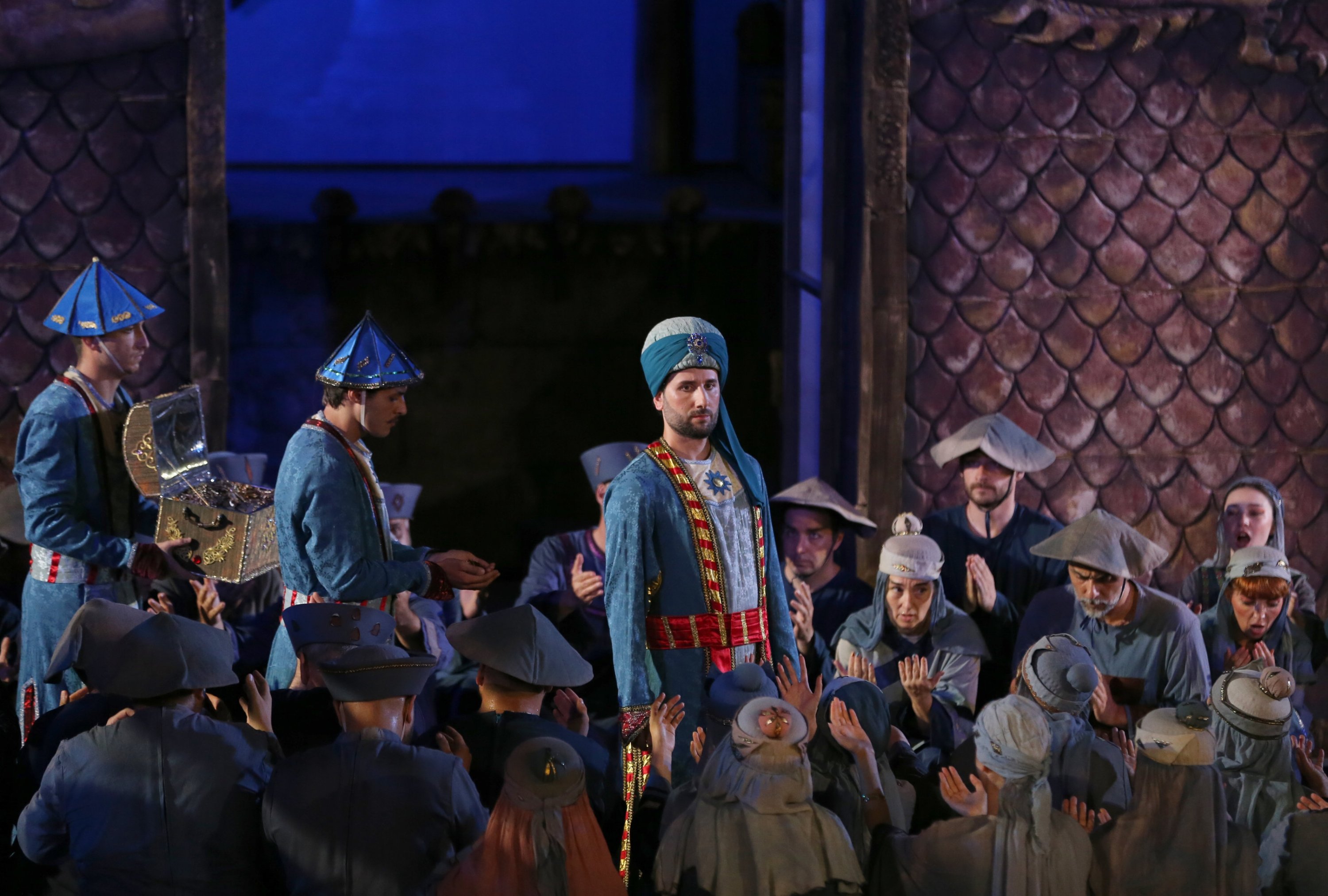
In case any reader wants to exercise themselves with these riddles, I will not give them here, as they can easily be found online. All I will say is that Calaf easily answers the first two. The third, which seems the most obvious, temporarily stumps him, though. Suddenly, however, he realizes the answer, passes his test and can claim his bride. Only Turandot is distraught. Feeling “defeated,” she has no desire to give herself up to this man and begs her father to prevent this from happening. The emperor’s response, though, is that “the oath” being “sacred,” Turandot has to marry Calaf, a theme picked up by the crowd as well. Turandot then asks Calaf if he will “have” her “by force, reluctant and enraged?” Calaf responds that “I want you ardent with love” and now gives her an opportunity to properly focus on him in the hope she will warm to him. He does this by turning the tables and giving her a riddle to solve, which if she does successfully, he will give himself up to death, but if not, she must submit to him. The riddle is his own name.
Turandot sets the whole city on the task of discovering this name. Although none of the populace know it, Liu and Timur are brought before Turandot, as they have been seen with Calaf and are presumed to know the secret. In the hope of extracting the name, torture of Timur is begun, and Liu, fearing for this frail old man, announces that only she knows the name, so she is put to the torture in his stead. Turandot cannot understand how Liu is able to withstand the pain, and Lui tells her that it is due to her love for the man in question, a love she predicts Turandot herself will soon feel. Once she realizes she has reached her limit, she grabs a dagger from one of the guards and kills herself. Turandot, who has watched all this, is affected by it.
Turandot, still unaware of the name, is later alone with Calaf. Calaf then reveals his name to her to make any love between them free, and thus obviously also places his life in her hands. Then, at the end of the opera, in public and before her father, Turandot dramatically reveals that she now knows his name, but instead of revealing it as Calaf, she declares that it is “love.” The pair is then united under the emperor.
Although she is not one of the leads, the outstanding figure of this production was the Turkish Tuğba Mankal as Liu. Her renditions of the arias “Signore ascolta” and “Tu che di gel sei cinta” were beautifully moving. The Russian Olga Maslova was also an impressively icy Turandot, and her presence was magnetic even when she was not the focus of the action but, for instance, had her back to the audience in part of Act III. However, I feel that the Italian Riccardo Massi as Calaf made less of an impact. Although his performance for the most part was fine, the highlight of the opera is surely the world-famous aria “Nessun dorma” and this powerful piece, as rendered by Mass,i would hardly have raised the roof in the Aspendos theater had it had a roof to raise. This was especially unfortunate in that throughout this opera, the orchestra produced what may be the most intense music I have ever heard in any Aspendos production.
The dance by the executioner in Act I was also striking. And I have to commend the use of colour on the stage, from the beautiful costumes, including the blue veil or white flowing dress of Turandot and the chorus in their bright East Asian apparel, to the lighting. The latter was used to great effect to heighten the power of the drama. For instance, the frigidity of Turandot was set off by the use of a cold cyan blue, and when Liu dies, the stage is strikingly flooded with a deep blood red.
The power of any opera comes from its merging of drama with music to intensify the impact of the former. In order to give sufficient room for the music to produce its spellbinding effect on the audience, dramatic storylines taken from plays, novels or stories have to be simplified to the level of the fairytale. The stories of the opera are therefore not to be critiqued for their simplicity unless one critiques the need for this dramatic form at all. That being said, simple does not need to equate to disturbing or incomprehensible, and there are elements to the simple story of Turandot that are one or the other or both.
To fully appreciate the problems of Turandot and its continued popularity in spite of them, it is necessary to realize that despite their aforementioned connection in opera, music and lyrics themselves enjoy an uneasy relationship. The critic George Steiner argues that “the two forces, that of music and that of language,” which “meet in the human voice when it sings,” are “quintessentially conflictual.” This conflict is consequently present in any opera. In Turandot, however, it is especially stark, for its music, as the opera critics Arthur Jacobs and Stanley Sadie note, is “resplendent” and the opera has “objectively the richest (that is, the biggest and most complex in sound) of Puccini’s scores” with a “harmony” that “is more advanced than that of any of his previous works.” As for its story, though, these same critics affirm that “on any normal consideration, the story is perhaps the most repulsive that any opera audience is regularly called on to enjoy.” It is the music that prevails in the conflict between the two, for these critics also feel that “it is not difficult in the theatre to let moral scruple be overpowered by the force of Puccini’s resplendent score.” That being said, I still wish to look at some of the problematic elements of its story in more detail.
The overall message to be taken away from Turandot is an odd one. Turandot seems to be the opera for anyone who chooses to ignore sound advice from a variety of different trustworthy sources that only desire to help and instead stubbornly continue on their own path. It may work out in this opera, but it is unlikely to often in real life. But this is not the core issue with Turandot. Rather, it is that even in the sense that Calaf does achieve what no one thought he could achieve, it is undeniable that in doing so, he leaves a trail of devastation in his wake.
The figure of Calaf is extremely problematic. Although Asia is known for its veneration of filial piety, Calaf proves little more than a source of anguish to his father. Calaf is only reunited with the doting Timor for a few minutes before his intention to seek Turandot throws the latter into severe anxiety. Furthermore, when Timur attempts to talk him out of his pursuit of the princess, Calaf remains inflexible. It may be possible to excuse Calaf here, for it could be argued that the power of love, especially as it affects the young, cannot be gainsaid. Yet, even if Calaf has the intelligence to answer the riddles correctly, he lacks the foresight to see that when he puts his own riddle to Turandot, he places the only two people who care for him, his father and Liu, in danger, their being the only ones in Peking who could answer it. Calaf’s action here indirectly causes the death of Liu, his father’s mainstay in old age. Moreover, in the first act of the opera, Calaf’s lack of self-awareness and refusal to take responsibility for his actions is revealed when, in his determination to pursue Turandot, he declares that “I’m following my destiny” but he is in fact simply making a completely free choice to follow his own desires.
His lack of responsibility becomes particularly repellent when Calaf, as a fairytale prince, a type who is expected to be virtuous, is able to stand by and watch Liu being tortured when he could put an end to it all and sacrifice himself instead by immediately announcing his name.
Though this may have escaped the notice of the first audiences of the opera back in the 1920s, there is also something deeply disturbing about Calaf’s supposed “love” for Turandot. Even in Act I, he declares his intention “to conquer in her beauty” and that he wants to “triumph,” verbs associated with smiting and not being smitten. Moreover, for anyone who has bothered to look behind the sublime music of “Nessun dorma” and see what Calaf is actually singing may well see an aggressively predatory message there. Also, in Act III, when he is alone with Turnadot, Calaf behaves in an abusive manner. The way he pulls off Turandot’s veil looks like sexual assault, as well as his attempt to kiss her despite her repulsed rejection of him. Her message to him is clear when she declares, “Do not profane me,” and regards Calaf’s actions as “sacrilege.” Then, when he does brutally force a kiss on her, and she is left quivering, his interpretation is “what a joy, you are shaking in my arms,” though it would be surely more legitimate to read this as her having a profoundly negative emotional reaction to him and what he has done.
In the end, it is Calaf’s ego that does indeed “triumph” over that of Turandot. She feels humiliated, declaring that “no one must see me. My glory is ended," though her then inexplicable and new feelings of love for him soon resolve that issue, giving the opera its supposed “happy ending.” I, however, was left wondering whether his having lived so long as a deposed prince in disguise has so humiliated Calaf that he sadistically feels a need to take revenge upon somebody.
As for the reason for Turandot seeking revenge on men, it is simply incomprehensible. Even assuming that the adage “revenge is a dish best served cold” is true, in this case, the dish would long ago have turned to dust, considering the centuries that have passed since the outrage committed on Turandot’s ancestor. Even when Turandot is explaining her reasons for her actions, the crowd retorts to her about her ancestor that “she’s slept for centuries in her huge tomb!” The reason this nonsensical idea is even in the opera is presumably to provide a motive for Turandot’s cruelty and pride, her declaring at the commencement of Calaf’s riddle contest that “no one will ever possess me” and her “reason” for this is “the pride of that purity,” though it disturbingly goes on to seemingly revel Calaf’s abasing of the latter..
Liu is described by Jacobs and Sadie as “the only character of the story who shows any positive action for good,” as well as being “one of Puccini’s most touching characters.” She is a very pathetic figure in the literal sense of the word, in that she sacrifices her life simply because of a “smile” she once received from Calaf. However, it is also the case that she sacrifices herself for Timur as well, and it is their relationship, a platonic one between an elderly man and a young woman, that is really the only one that produces any tug at the heartstrings.
All in all, though, Jacobs and Sadie are right in that as a musical spectacle, Turandot is resplendent, and the production at the Aspendos Theater in Antalya for the most part reflected this, resulting in a highly memorable evening.