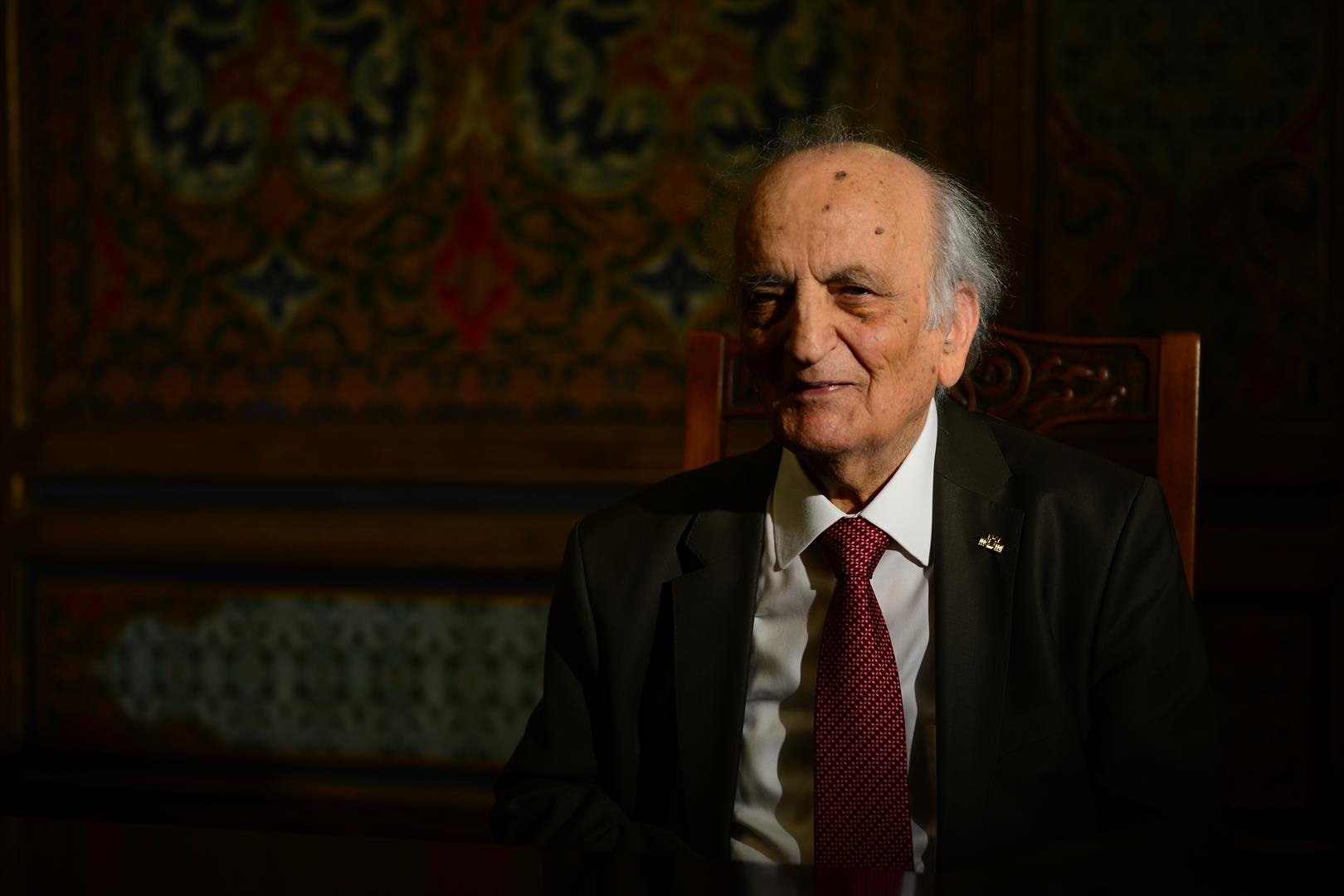
I first met Fuat Sezgin on a snowy Istanbul night. At the time, he was heavily engaged in work between his institute in Frankfurt and his museum in Istanbul. With the support of the esteemed Mecit Çetinkaya, we invited him to Istanbul for a gathering with students. He stayed at a hotel near Gülhane, a building that was formerly used as a prison and has since been renovated. The next morning, when I arrived to pick him up, I asked how his night had been. He smiled and said, “The room was far too comfortable. Comfort disturbs me sometimes.” He had even opened the window despite the snow outside. That was a bold decision for someone of his age – but for Sezgin, it felt natural. To him, scholarship was not comfort but a trial. True scholarship is forged through sweat, solitude, fatigue and repeated effort – and he did not merely advocate this; he lived it.
Recently, the launch event of the book titled “Fuat Sezgin’s Legacy: Building Bridges through Science Diplomacy,” organized by the Presidency’s Directorate of Communications, marked a significant milestone in Türkiye’s long-standing struggle over cultural identity. Fuat Sezgin, a renowned historian of science recognized worldwide, asserted a powerful and deeply intellectual stance against Western-centric narratives of the history of science, through a lifetime of work. His years of scholarly activity in Frankfurt culminated in the establishment of the History of Islamic Science and Technology at the heart of Gülhane Park in Istanbul. Although he passed away in 2018, his legacy continues to live on in Türkiye’s scientific and cultural agenda as well as within the broader Islamic world.
This museum is not just a window into the past, but into the future. The newly released book does more than document Sezgin’s exceptional legacy; it stands as a testament to Türkiye’s efforts to rebuild its intellectual confidence in the context of science diplomacy. At the book launch, Necmettin Bilal Erdoğan, member of the board of trustees of the foundation that ensures the museum’s and research’s continuity, emphasized that Sezgin had worked almost as if “digging a well with new tools” long before the era of artificial intelligence, leaving behind an immense scientific legacy. He added that imagining where that legacy would have reached had AI existed in Sezgin’s time is hardly conceivable.
The Presidency's Directorate of Communications, represented by its head Fahrettin Altun, also highlighted Sezgin’s role as a “messenger of civilization and advocate of cultural diplomacy.” As Altun noted, his efforts were not confined to producing science; they created an epistemic foundation that enabled a society and a civilization to reexpress themselves. Sezgin’s scholarship went far beyond mastery of dozens of languages – Arabic, Persian, Latin – it was defined by his unyielding pursuit of truth.
After the 1960 coup, Sezgin endured pressure and felt compelled to leave Türkiye, yet he continued his work without bitterness. He dedicated his life to illuminating the overshadowed, ignored and forgotten areas of Islamic scientific history. His motivation was to challenge the Western-centric claim that Muslim civilizations contributed nothing to science. He responded not only with ideas but with tangible works – documents, perseverance and uncompromising precision. His multi-volume writings conclusively dismantled that ideological narrative.
Sezgin’s rediscovery by Türkiye was not by chance; it was the result of the vision and collaboration of a small, determined group of people. Leading the effort was Mecit Çetinkaya, who showed a special interest in ensuring that Sezgin’s entire body of work was made visible in a museum in Istanbul. Bilal Erdoğan personally witnessed Sezgin’s scholarly depth and the importance of bringing his narrative to Türkiye during visits to Frankfurt. Their combined efforts were decisive in the founding of the museum.
Today, the Museum of Islamic Science and Technology in the center of Gülhane Park continues to connect Fuat Sezgin’s intellectual labor with visitors – both local and international. Gülhane isn’t just a park: it’s where the Tanzimat Edict -Imperial Edict of Reorganization - was publicly proclaimed. It stands as the symbolic birthplace of our modernization efforts and a place where we continue to reflect on its meaning. The Alay Köşkü there, once perched behind which the sultan watched foreign envoys, now operates as the Ahmet Hamdi Tanpınar Literature Museum Library – a shift from displays of power to spaces of knowledge. Steps away lie the Istanbul Archaeological Museum, the institutional expression of historical reckoning; Soğukçeşme Street, which preserves traditional Turkish architecture; the Sepetçiler Pavilion, now the headquarters of the Green Crescent, where our social challenges unfold; and Sirkeci Station, the Ottoman gateway to Europe.
Together, these structures form something like a civilization atlas. That is why Sezgin’s museum belongs there – and why it was meaningful that he opened the window of his room at dawn to a park in that very location. Gülhane sits at the very heart of Türkiye’s cultural struggles, modernization pains and efforts to reconcile with its own heritage. Nazım Hikmet’s line, “I am a walnut tree in Gülhane Park,” is rooted in its soil; Cem Karaca’s song immortalized the park in the public’s collective memory. Today, Gülhane is once again speaking through science, culture and historical memory.
Fuat Sezgin left behind not just a museum, not just a library or an academic legacy – he left a monumental gift of self-confidence for Türkiye and for the Islamic world. He showed that this confidence must be built not on nostalgia, but reality – on genuine accomplishments. Through volumes of work, he proved that he spoke not only to the past, but to the future. His life is the story of how one person, standing firm, can resist a full-on assault on civilization. And his story continues to unfold today.