Not long ago, after a wonderful dinner with my family at Tersane Istanbul, I stood by the railing and looked out over the quiet waters of the Golden Horn. Around us, visitors were enjoying the evening view, framed by historic industrial architecture now reimagined as a modern waterfront of shops and restaurants.
Yet as I gazed across the water, my mind was occupied by a man whose name appears nowhere on the site, though he spent decades of his life working on the very ground beneath our feet: Frost Pasha, also known as James Maurice Frost – a man who gave so much of his career to these shipyards has become, at the very place he served, entirely silent.
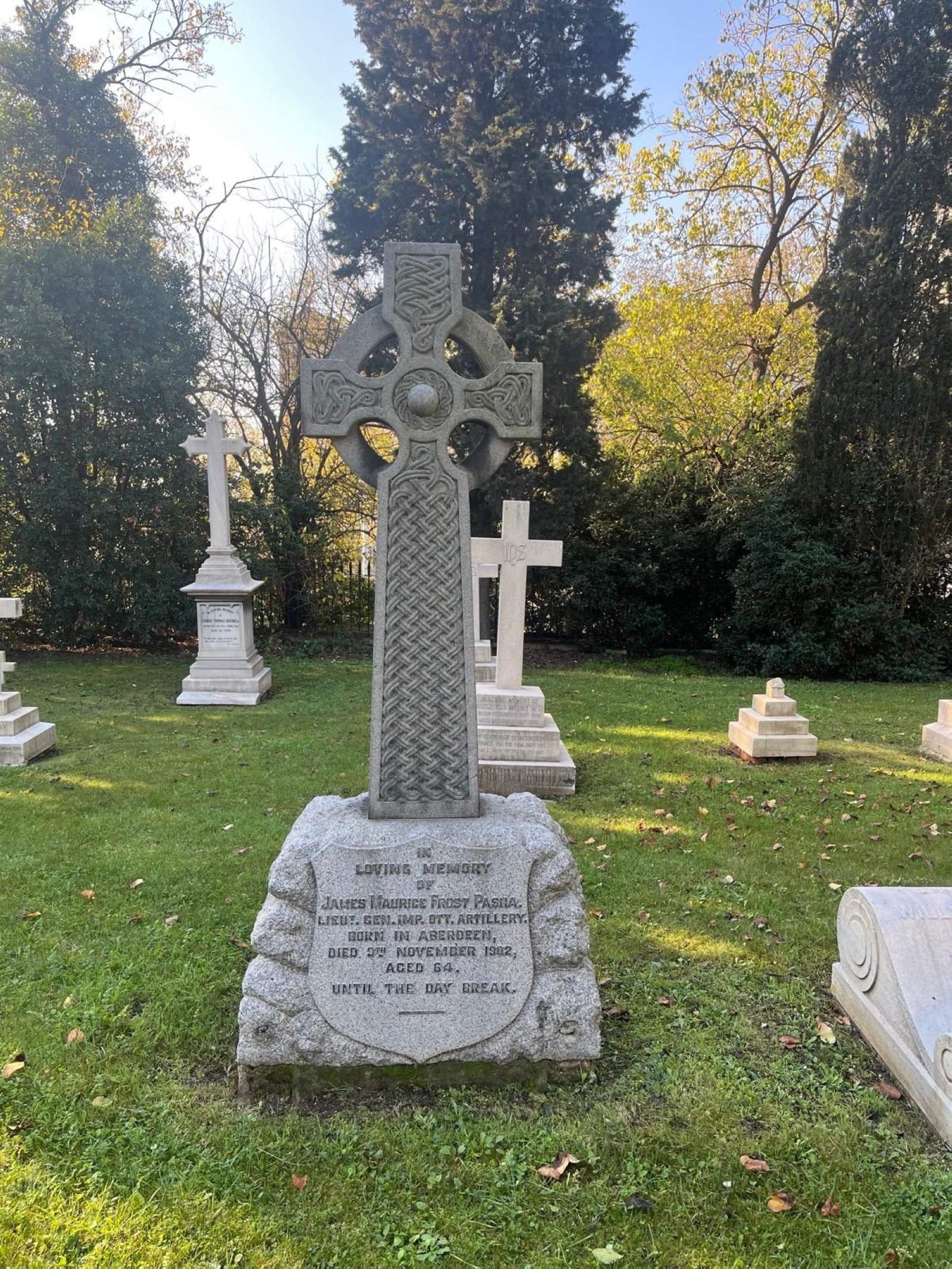
My path to him had actually begun a year ago this August, among the quiet rows of headstones at the Haydarpaşa Cemetery. Among those markers, each holding a life story woven into Istanbul’s British heritage, his stood apart. It was carved from a heavy, polished granite unlike any local marble – unmistakably foreign. I had no archival proof at the time, but the stone itself told me where it had traveled from. It had come from Aberdeen, perched on the remote, wind-swept northeastern coast of Scotland at the far edge of the North Sea, alongside the man it now marked.
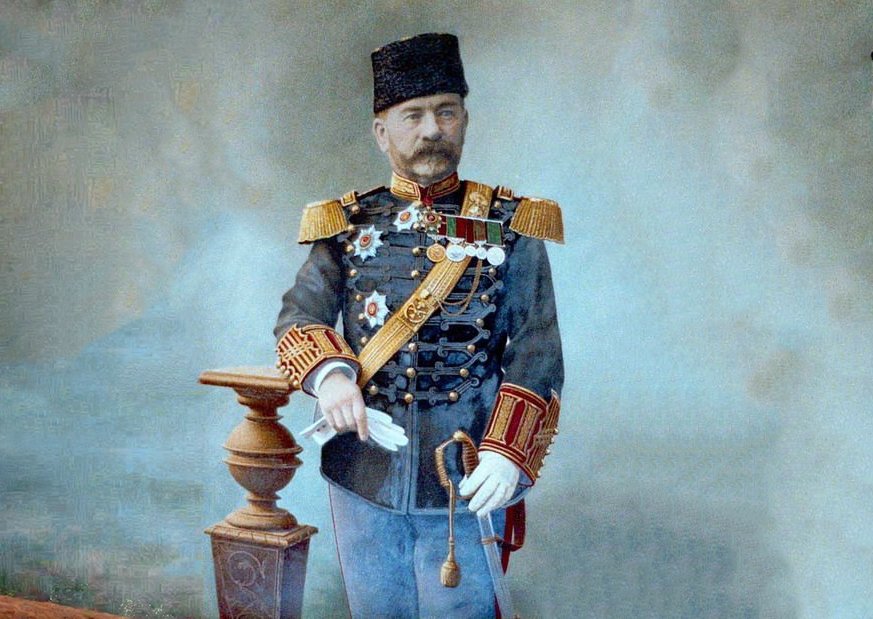
Frost Pasha rose to the rank of brigadier general within the Ottoman military hierarchy, an engineer by training and by temperament. He followed a path already carved by other British officers, among them Admiral Hobart Pasha, who once commanded the Ottoman navy. Such careers were not unusual for the era. The Ottoman Empire needed to modernize its fleet and its defences, and Britain, for a time, was a natural ally. So long as no direct conflict of loyalty arose, serving a foreign state was not seen at home as a betrayal. After the Crimean War, the Empire had already opened its ranks to a wider circle: Hungarian revolutionaries, European engineers, men whose skills mattered more than their origins and who were never asked to convert.
Frost Pasha was stationed at Tersane-i Amire, the Imperial Arsenal, right here along the Golden Horn. There he served as an artillery general, and his engineering brought real tactical advances, fitting Ottoman warships with guns that changed outcomes in battle. His career carried him beyond Istanbul too, into naval operations on the Black Sea coast during the Russo-Turkish War at Plevne, a campaign close enough to his life that he later named a son after it. He earned Ottoman medals and honors across his long service, and those artefacts eventually returned to Scotland with his sons. Today they are held by the Aberdeen City Archives.
While researching my forthcoming historical novel, "The Silent Briton" – a prosopographical narrative that weaves together various lives stretching from Bath to Istanbul – I wrote to the Aberdeen City Archives to ask whether any of his descendants could still be traced. They pointed me toward genealogical records rather than living relatives. It was the return visit to Haydarpaşa, not the archives, that gave me the clearest sense of the man: that heavy granite headstone, so plainly not of this city, standing among the others as if still keeping watch over the water he once worked.
These forgotten figures interest me because history is never a single flat layer. It accumulates in strata, and in periods of transition, as alliances shift and old arrangements dissolve, many of the people who built those arrangements are quietly set aside. To remember someone whose grave still stands in this city is to remember more than an individual. It is to remember an era: its possibilities, its limits and the human ties that briefly bridged two very different worlds.
Today those ties look nothing like they did in Frost Pasha’s time. Turkish naval architecture and warship construction no longer depend on outside expertise the way the Empire once depended on men like him, and the main naval shipyard itself has long since moved beyond the Golden Horn. What has changed is not only geography but capacity and alliance. Just last week, Türkiye signed the Mecca Joint Defense Agreement with Saudi Arabia and Pakistan, a reminder that the country now builds its security partnerships on its own terms, in its own region, rather than importing them from abroad.
I had already sensed this shift, in a smaller way, before I understood it in those terms. In the first draft of "The Silent Briton" that I sent to my publisher, one of the key fictional scenes was already set at Tersane Istanbul: a quiet breakfast involving Frost Pasha himself, imagined at the place where his real life once unfolded.
Night fell over Tersane Istanbul, and the day drew to a close. I found myself imagining a modest marker at the site, something that might one day bridge Aberdeen and Istanbul for the visitors who pass through without knowing what the ground once held. The sun set over the city, and it would rise again the next morning, carrying with it a history that is still, in places, waiting to be told.