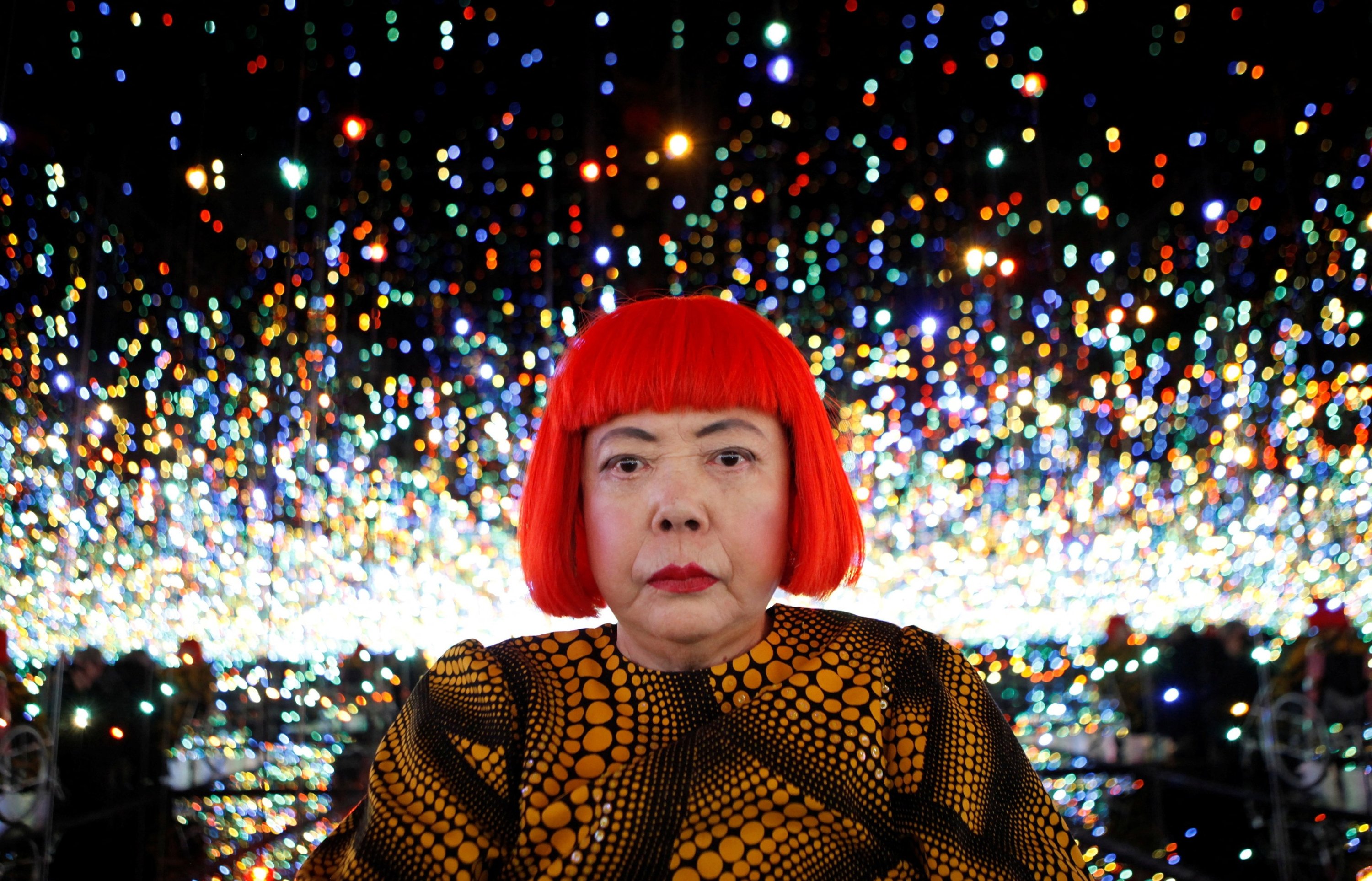
There are artists whose deaths seem to close a chapter in art history, and there are others whose departure produces almost the opposite sensation: that the language they created has become so thoroughly absorbed into our collective visual consciousness that their physical absence is difficult to comprehend. Yayoi Kusama, who died in Tokyo on Aug. 14 at the age of 97, belongs emphatically to the latter category. Her studio announced her death on Aug. 27 with an almost unbearably appropriate final detail: that she had continued painting until her last days, never setting aside the brush through which she had spent nearly a century exploring infinity, eternal love and the possibility of an existence beyond the boundaries of the individual self.
It would be easy, following her death, to remember Kusama through the spectacular surfaces that made her one of the most recognizable artists on the planet: yellow pumpkins colonized by black dots, rooms multiplied into apparent infinity through mirrors and light, monumental flowers, obsessive nets, dazzling colors and environments into which visitors disappear only to rediscover themselves reflected hundreds, perhaps seemingly thousands, of times. Yet to remember her merely through the visual vocabulary that eventually made her famous would be to mistake the seductive surface for the considerably more complicated structure beneath it.
Behind those cheerful pumpkins and hypnotic polka dots lies one of the stranger, darker and ultimately more instructive stories of modern and contemporary art. It is a story of a Japanese woman who entered the overwhelmingly male New York avant-garde at the end of the 1950s, developed ideas that anticipated or evolved alongside minimalism, pop art, installation, feminist performance and immersive art, watched several male contemporaries achieve historical recognition faster than she did, returned to Japan as international attention receded and voluntarily entered a psychiatric hospital. Decades later, she experienced one of the most extraordinary reversals of fortune in recent cultural history, becoming simultaneously an art-historical figure, an auction phenomenon, a fashion collaborator, a social-media sensation and, perhaps most paradoxically, a global brand built around an artistic practice born from an intensely private struggle to prevent the self from disintegrating.
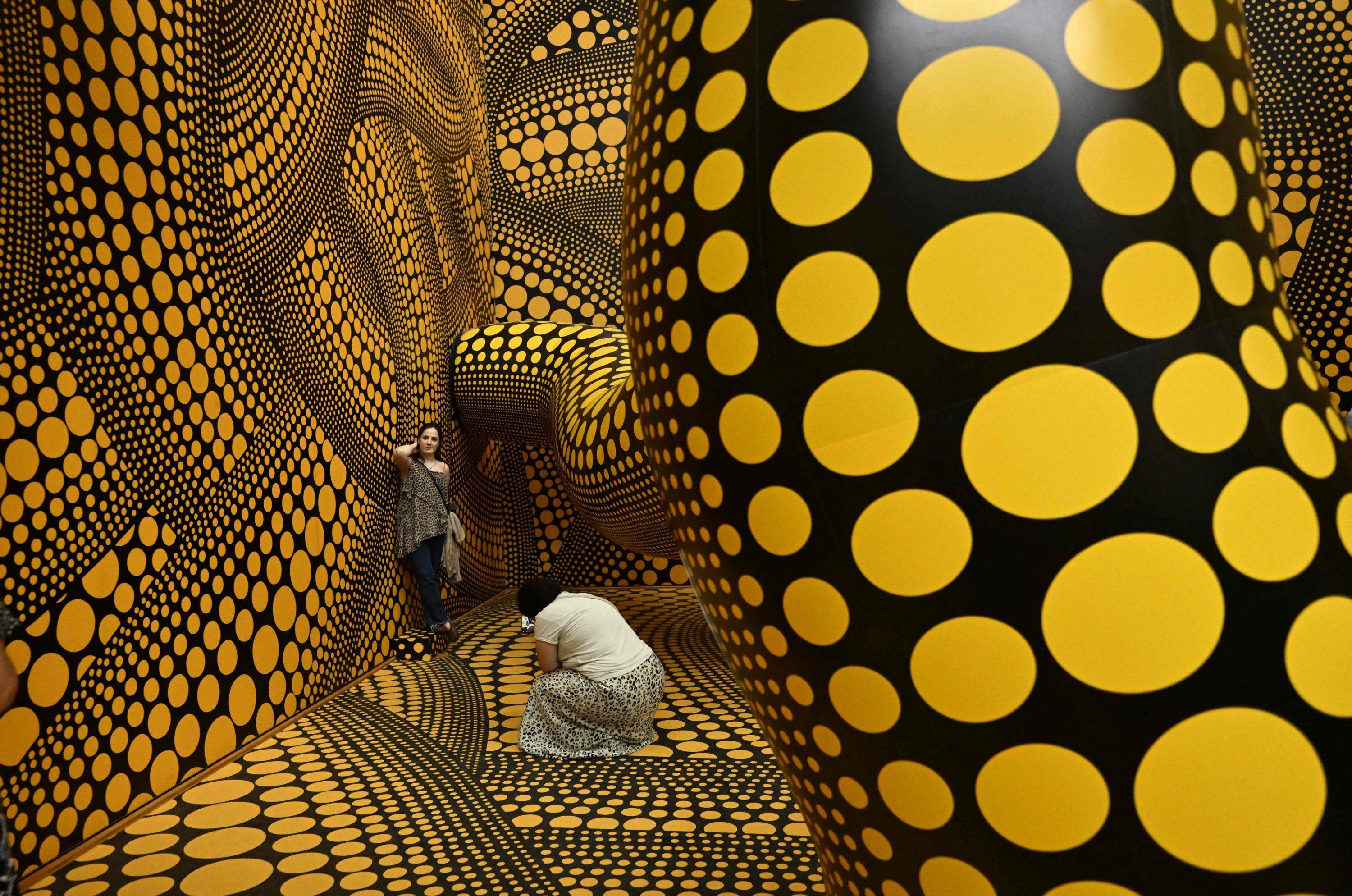
Kusama’s biography therefore resists the comforting linearity of the conventional obituary. Her life cannot adequately be narrated through the familiar progression from youthful talent to struggle, recognition and eventual triumph, because recognition came, disappeared and returned under dramatically altered cultural circumstances; nor should her work be reduced to the equally familiar mythology of the “mad genius,” a seductive label that romanticizes psychological suffering while diminishing the extraordinary intellectual and physical discipline required to transform involuntary experiences into a coherent artistic language.
Her art was not produced despite her psychological world, nor can it simply be diagnosed as a symptom of it. Its significance emerged through the difficult conversion of that world into form.
Born in Matsumoto, Japan, in 1929, Kusama began experiencing visual and auditory hallucinations while still a child, encountering proliferating patterns, flowers, dots and fields that seemed capable of swallowing the boundaries between her own body and the environment surrounding it. She began making art at an early age and would later describe creativity as inseparable from those experiences, meaning that the nets, accumulations and polka dots now instantly recognizable as “Kusama” were not initially conceived as stylistic signatures for an international market but as methods of giving external structure to an internal reality. That distinction becomes particularly important now that the dots themselves have become commodities.
Before there were Kusama handbags, shop windows, monumental public sculptures, branded objects and queues stretching around museums, there was repetition as compulsion; before the pumpkin became one of contemporary art’s most marketable icons, there was a woman attempting to negotiate the frightening instability of her own perception.
Art history has always been tempted to romanticize psychological suffering, particularly when suffering can conveniently be folded into the mythology of genius. Vincent van Gogh’s ear becomes inseparable from the reception of his paintings, Edvard Munch’s anxiety becomes an interpretive key through which an entire oeuvre is read, and biography frequently becomes an explanatory device through which difficult works are rendered more accessible. With Kusama, however, the relationship between psychological vulnerability and creativity requires greater precision, because her practice demonstrates something subtler than the familiar cliché that suffering produces great art. Suffering, by itself, produces nothing; what matters is the transformation.
Kusama converted repetition, fear, obsession and hallucination into structure, disciplining chaos into pattern and transforming the terrifying possibility of losing the boundaries of the self into an aesthetic philosophy she described through the concept of “self-obliteration.” The disappearance of individuality into dots, nets, mirrors or the cosmos could certainly be frightening, but it could simultaneously become liberating: if the self is merely one element within an immeasurably larger universe, then perhaps its anxieties, vanities, wounds and compulsions can also temporarily dissolve.
When Kusama arrived in New York in 1958, she entered a cultural environment whose mythology celebrated radical freedom while its institutional structures remained profoundly unequal. Abstract Expressionism had established the heroic male painter physically commanding, existentially tormented and dramatically gestural as one of the defining archetypes of postwar American culture. Into this world arrived a young Japanese woman carrying a proposition fundamentally different from the masculine theater of the individual gesture.
Her early Infinity Nets rejected spectacle in favor of obsessive accumulation. Instead of the explosive mark of the heroic painter, Kusama offered thousands upon thousands of tiny repeated gestures, painstakingly distributed across large canvases until the surface appeared to possess neither beginning nor end. These paintings occupied a fascinating territory between the declining dominance of abstract expressionism and the emerging languages of minimalism, while refusing to belong comfortably to either: repetitive yet handmade, systematic yet psychologically charged, apparently impersonal yet produced through almost obsessive physical labor.
That Kusama’s position within this history remained less secure for decades than that of several male contemporaries should surprise no one who has examined the mechanisms through which the modern canon was constructed.
Art history is not simply a neutral record of who produced the most significant ideas. It is also a history of museums, galleries, critics, collectors, personal networks, geography, nationality, race, gender and, above all, the distribution of attention. Some artists enter the canon almost immediately, while others wait decades for institutions to reconsider evidence that had been visible all along. Women have disproportionately belonged to the second category.
Kusama’s career provides a particularly revealing case because her experiments with accumulation, seriality, repetition and environments developed alongside artistic languages that would subsequently become central to the histories of minimalism and pop. Her soft sculptures, in which ordinary furniture and domestic objects became covered with proliferating phallic forms, also anticipated conversations surrounding gender, sexuality, domesticity and the politics of the body that would become central to feminist art.
The temptation today is to correct earlier neglect by reversing the narrative completely, transforming Kusama into the secret inventor of everything while famous male artists simply appropriated her ideas. Art history rarely works so neatly. Movements develop through networks of observation, rivalry, friendship, influence, parallel discovery and shared cultural conditions rather than through a clean sequence of invention and theft. Yet rejecting an oversimplified accusation does not require us to ignore the structures that historically enabled certain artists to become synonymous with ideas that others – particularly women, immigrants and artists outside dominant cultural identities – were simultaneously developing.
Kusama’s eventual triumph therefore represents more than the rediscovery of one overlooked artist. It belongs to a broader rewriting of 20th-century art history, one that has gradually learned to ask not only, “Who became famous?” but the far more revealing question: “Who was actually present when the language was being invented?” Kusama was very much present.
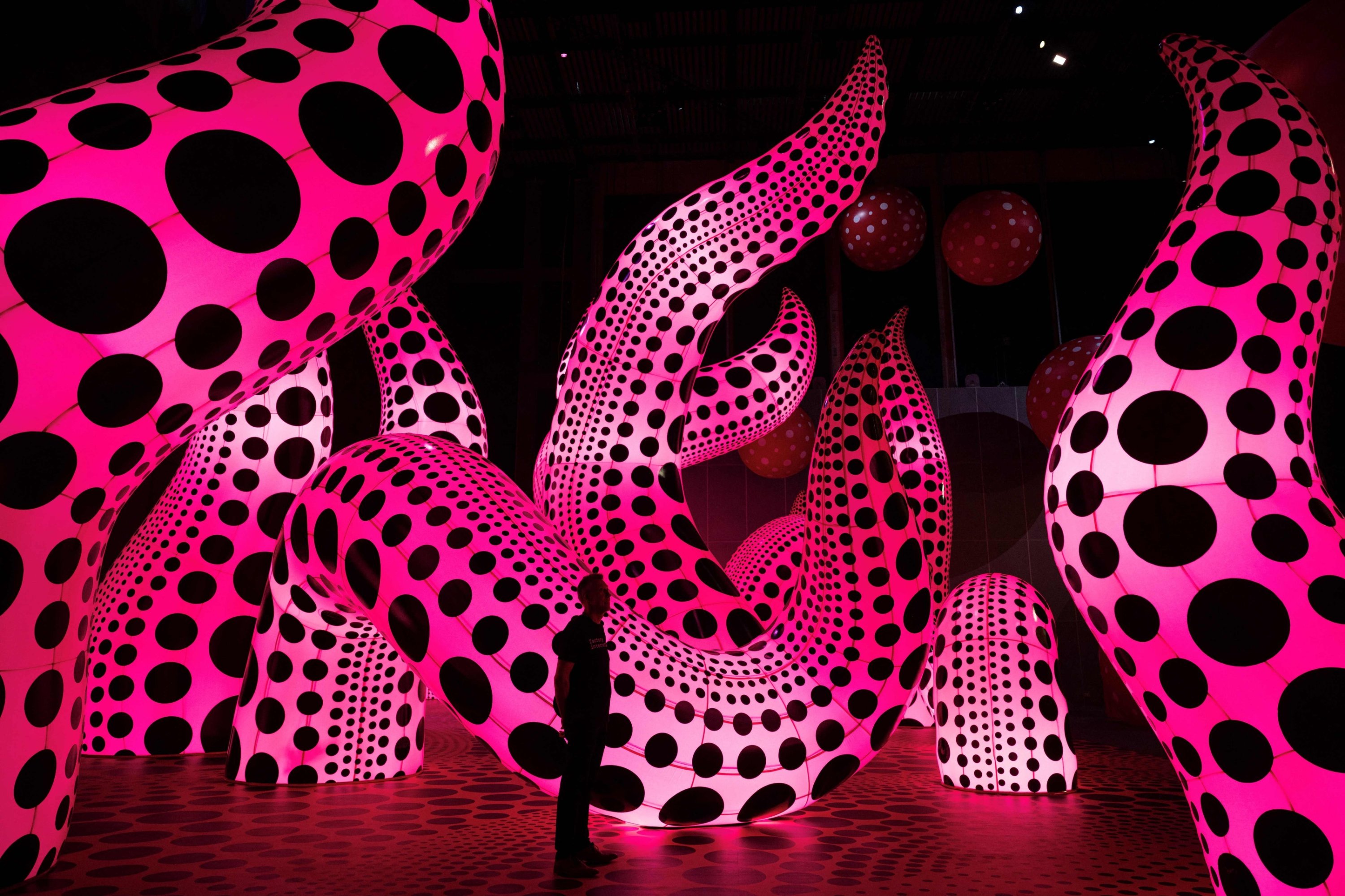
By the 1960s, painting alone could no longer contain her ambitions. She moved between sculpture, installation, fashion, film, performance and public intervention with a freedom that now feels remarkably contemporary, staging provocative Happenings in which naked bodies, painted dots and theatrical disruption became tools through which the politics of the body could confront the politics of authority.
This is also where the Kusama remembered through Instagram risks obscuring another, considerably more political Kusama: the anti-war artist. Against the background of the Vietnam War, she organized anti-war performances and body festivals in New York, turning nudity and collective action into gestures against militarism and violence. Her politics could be theatrical, utopian and deliberately outrageous, yet beneath the spectacle was a conviction that the human body, vulnerable, desiring, exposed and unarmed, might function as a counter-image to the machinery through which states organize destruction. For Kusama, therefore, love was never merely sentimental; it could also become political.
The language of love, peace and self-obliteration that recurred throughout her career proposed, however idealistically, an alternative to the aggressive assertion of individual, national and masculine power. If the boundaries between bodies could dissolve, if individuality could be absorbed into a larger field and if the isolated ego could cease to regard itself as the center of existence, perhaps the divisions through which human beings organize hatred might also temporarily lose their authority.
Seen from our own century, in which wars continue to destroy cities, families, cultural memory and human bodies with terrifying efficiency, such idealism may appear naïve. Yet perhaps the persistence of war does not make the artistic desire for peace naïve; perhaps it makes that desire more necessary. There is something profoundly moving about an artist who spent almost a century returning to infinity, love and peace while living through a historical period that provided abundant evidence for their opposites. The most dramatic chapter of Kusama’s career, however, may be the one that initially resembled defeat.
After returning permanently to Japan in the 1970s, she gradually disappeared from the center of the international art world and in 1977 voluntarily entered a psychiatric hospital in Tokyo, from which she would maintain a working routine centered upon her nearby studio. The rhythm of her existence became almost monastic: hospital, studio, work, return.
There is a lesson in this period that sits uneasily beside contemporary culture’s obsession with visibility, instant recognition and the constant public performance of success.
For years, Kusama continued producing without anything resembling the global celebrity that would eventually surround her. The image is difficult to reconcile with the artist whose exhibitions would later attract hundreds of thousands of visitors: a woman working persistently while much of the international art world looked elsewhere, without any certainty that history would eventually turn around and come looking for her.
Recognition returned gradually, with her participation as Japan’s representative at the Venice Biennale in 1993 becoming a decisive milestone, followed by museum exhibitions that increasingly restored her position within postwar art history. By the 21st century, however, something even more extraordinary had occurred: the artist who had once struggled for visibility had become almost impossible not to see.
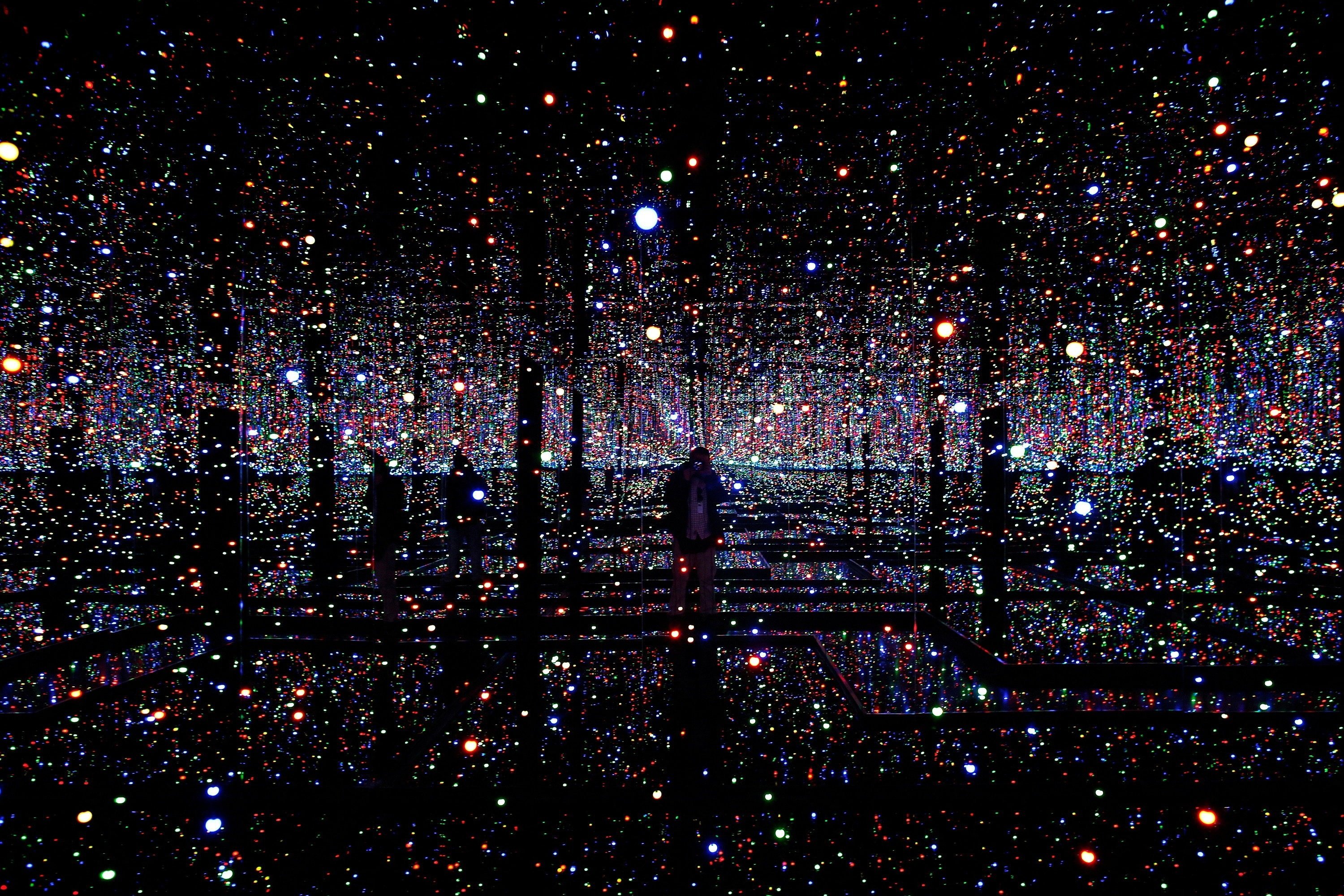
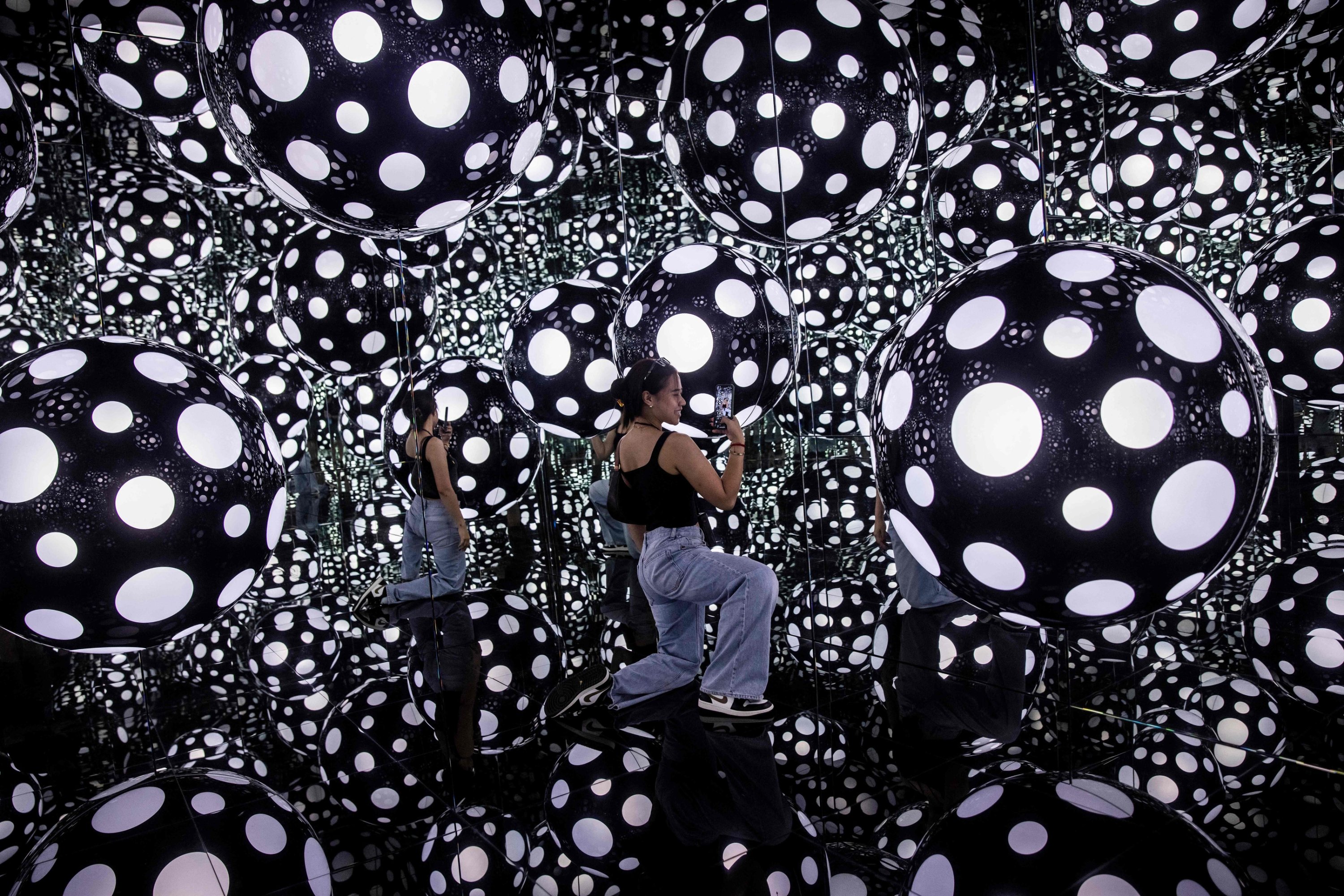
Then came the mirror rooms. Few works of contemporary art could have adapted more perfectly to the visual economy of the smartphone than Kusama’s "Infinity Mirror Rooms," although the chronology is essential: she began experimenting with mirrored environments decades before Instagram existed and dismissing them as products of social-media culture would therefore be historically absurd. What social media transformed was not their origin but their reception. Inside these spaces, spectators no longer merely stand before an artwork. They enter it, become multiplied by it and, crucially, can photograph themselves inside it. The museum visitor simultaneously becomes viewer, subject and image. The consequences extend far beyond Kusama.
Contemporary museums increasingly operate within an attention economy in which exhibitions compete not only for critical relevance but for circulation and immersive installations, monumental spectacles and photogenic environments move through digital platforms with extraordinary speed. The museum visit becomes content; the spectator becomes both audience and distributor; cultural participation is transformed into an image that can be uploaded, shared and measured through engagement.
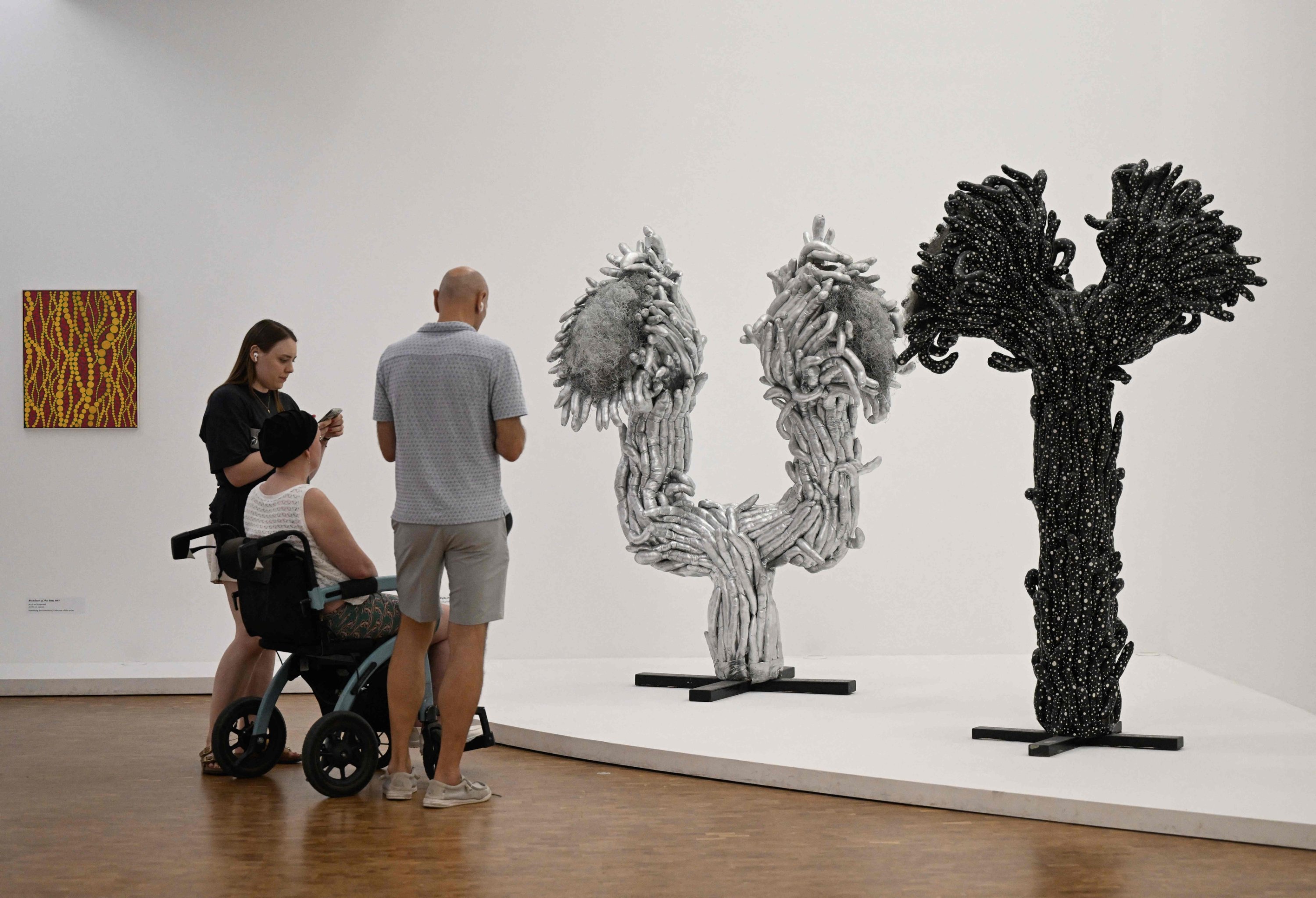
Kusama did not invent this economy, but she became its accidental queen. The irony could hardly be more perfect: an artist whose philosophical vocabulary repeatedly concerned the obliteration of the ego created some of the most desirable environments in which millions of people would photograph themselves. Self-obliteration met the selfie.
Her blockbuster exhibition at the National Gallery of Victoria in Melbourne, which ran from December 2024 to April 2025 and presented around 200 works, drew more than 570,000 visitors, becoming the most attended ticketed exhibition in the institution’s history a remarkable indication of the scale to which an avant-garde practice originating in the anxieties of one individual consciousness had evolved into a mass cultural phenomenon. Yet it would be too easy and somewhat condescending to dismiss these enormous audiences as superficial consumers of Instagrammable art. A photograph does not necessarily prevent an aesthetic experience, just as popularity does not automatically invalidate artistic seriousness. Indeed, Kusama’s achievement lies partly in her ability to operate simultaneously at radically different levels: a child can respond instinctively to the joyful immediacy of her dots and pumpkins, a casual visitor can surrender to the optical spectacle of an infinity room; an art historian can locate the same practice within postwar abstraction, minimalism, feminist art, performance and installation; while someone familiar with her biography can encounter beneath these surfaces an extraordinarily complicated meditation on fear, mortality and the instability of the self. Accessibility and complexity are not necessarily enemies.
The art market, predictably, understood the power of that accessibility. By the final decades of her life, Kusama had become one of the most commercially successful women artists in history. In May 2022, her 1959 painting "Untitled" at Phillips in New York sold for $10.496 million, establishing a world auction record for her work, an extraordinary reversal for an artist whose early New York paintings emerged from circumstances of financial precarity and cultural marginality. There is a form of historical justice in that reversal, although the art market’s version of justice is inevitably complicated by money.
For the market does not merely recognize artists; it manufactures scarcity, hierarchy and desire around them. Kusama’s pumpkins became collectible objects at almost every imaginable scale, while collaborations with luxury fashion pushed her visual language far beyond museums and galleries, until her dots inhabited handbags, dresses, storefronts, public façades and consumer objects across the world, rendering the boundary between artwork, merchandise, fashion and branding increasingly porous.
Was Kusama still an artist, critics occasionally wondered, or had she become a brand?
Perhaps this is the wrong question.
Picasso became a brand. Dali consciously cultivated one. Warhol turned the collapse between art, celebrity, commerce and mechanical reproduction into the very substance of his practice, while artists from Damien Hirst to Jeff Koons later demonstrated how thoroughly artistic identity itself could function within a commercial system. To demand that Kusama remain untouched by commerce in order to preserve her authenticity would impose upon her a purity that art history has rarely demanded from successful male artists.
The more interesting question is how a visual language born from private psychological necessity became one of the most commercially reproducible aesthetics in contemporary culture.
The dot was perfectly suited to this transformation because it could migrate endlessly: from canvas to pumpkin, from dress to building, from handbag to human body, from museum installation to shop window, without losing its identity. Kusama had created not simply recognizable images but an infinitely transferable visual code. Capitalism, like Kusama herself, understands repetition extremely well. Yet the market could never entirely domesticate the darkness beneath the pattern. The pumpkins may appear playful, the colors exuberant and the mirrored lights magical, but Kusama’s fascination with infinity always contained the shadow of its opposite: mortality.
Infinity matters to us precisely because we are finite.
Endless repetition hypnotizes us because human life cannot repeat indefinitely; mirrors multiply the body because the body itself will disappear; the infinite net extends beyond the limits of the canvas because our own existence cannot extend beyond its biological boundaries.
Death, in other words, was quietly present inside Kusama’s infinity all along.
This is what makes the announcement of her death feel strangely consistent with the art she leaves behind. Few artists spent so much of their lives attempting to imagine what it might mean for the self to dissolve into something larger than itself, and few constructed such an elaborate visual vocabulary around the desire to exceed the limits of an individual lifespan.
Her death consequently invites us to reconsider what artistic immortality actually means.
We often say that great artists “live forever through their work,” a phrase repeated so frequently after death that it risks collapsing into sentimentality, yet Kusama’s career gives this cliché an unusually literal visual form. Walk into an Infinity Mirror Room and a single body becomes innumerable bodies, one light becomes thousands and a finite architectural space appears without boundary. The individual disappears into repetition while simultaneously becoming ubiquitous.
Is this not, in some sense, what history does to an artist after death?
The biological individual disappears; the images multiply. The woman who once struggled to be seen becomes everywhere. Perhaps this is the final irony of Yayoi Kusama’s extraordinary life. She spent decades developing the concept of self-obliteration only to become one of the most recognizable artistic selves of our age; she pursued disappearance and achieved ubiquity, transforming hallucination into pattern, fear into repetition, psychological vulnerability into discipline, marginality into historical significance and an intensely private language into a global visual phenomenon.
The woman who might once have been written out of art history ultimately painted herself so insistently into its surface that removing her became impossible.
Her death should therefore prompt us to remember more than pumpkins, dots and dazzling infinity rooms, just as the spectacular commercial success of her final decades should not be allowed to flatten the complexity of everything that preceded it. We should remember the young Japanese woman arriving in New York in 1958 and confronting an art world whose celebrated freedoms were not distributed equally, the painter covering enormous canvases with tiny loops while heroic male gestures dominated American painting, the provocateur using exposed bodies to protest a war that transformed bodies into casualties, the artist returning to Japan as international attention faded, the psychiatric patient who continued moving between hospital and studio and finally the elderly woman whose private vocabulary became so universally recognizable that exhibitions of her work could draw crowds on a scale once reserved for the canonical giants of Western art.
Above all, however, we should remember the persistence, not the romantic persistence of motivational slogans, but the quieter and considerably less glamorous persistence of returning to the studio when recognition is uncertain, when one’s own mind is difficult to inhabit, when history appears to be looking elsewhere and when there is absolutely no guarantee that the world will eventually understand what one is making.
Kusama continued.
After the museums, biennials, luxury collaborations, record-breaking exhibitions, millions of photographs, queues, market speculation and the transformation of a once-private visual vocabulary into one of the most recognizable artistic languages on Earth, there remained an old woman and her brush.
She was still painting.
Beneath the mythology of Yayoi Kusama, beneath the red wig, polka dots, pumpkins, mirrors and meticulously constructed public persona, remained a proposition about art that was simultaneously simple and enormous: creation can become a method of surviving oneself.
Now Yayoi entered the infinity. She put three final dots after her final sentence and became unforgettable for millions.