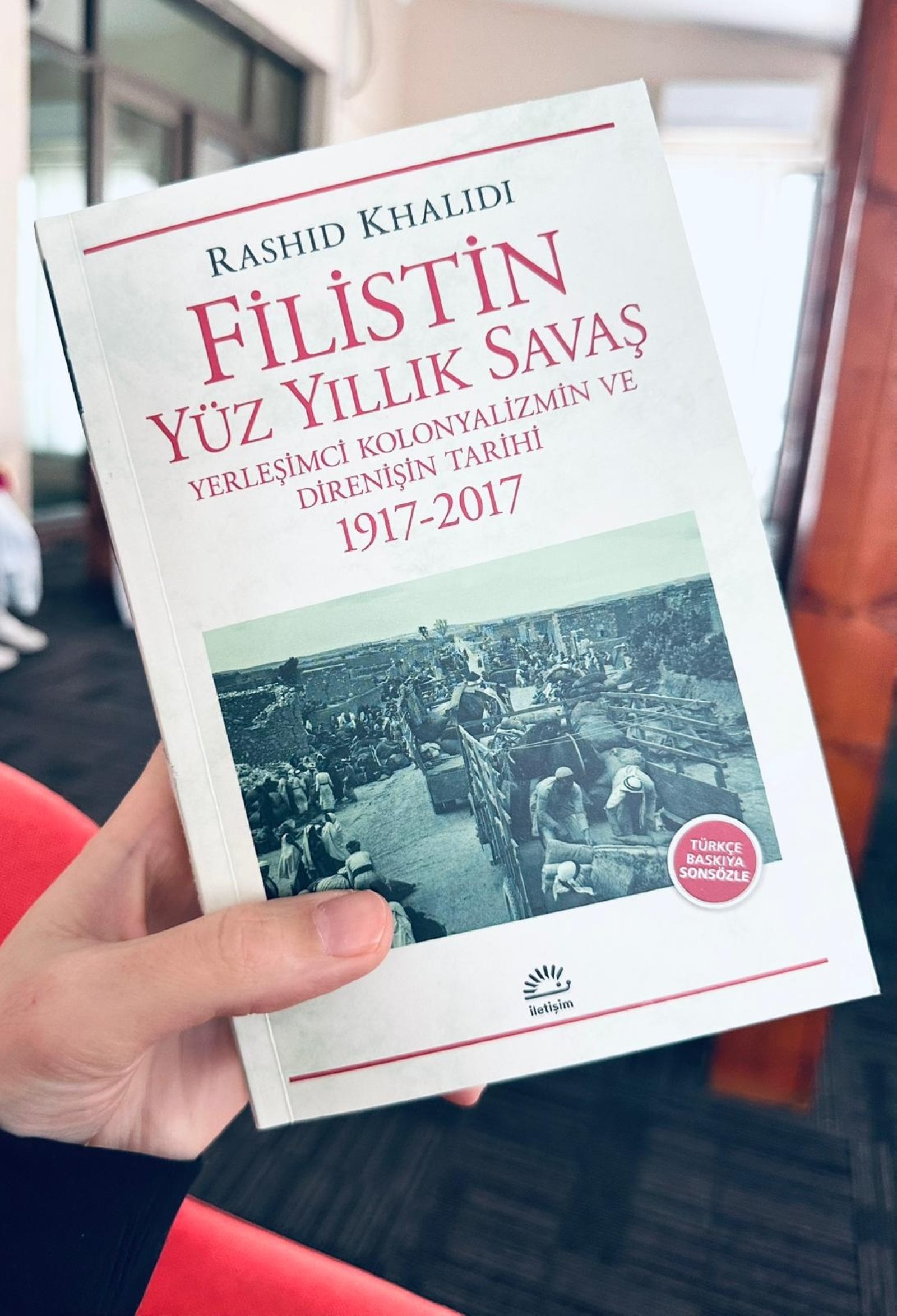
"The Hundred Years’ War on Palestine," written by Rashid Khalidi, is a powerful historical intervention against narratives that depoliticize the Palestinian issue. Khalidi's central argument is clear: What is happening in Palestine is a long-term, systematic colonial project supported by international backing. This framework challenges established discourse on the issue and directly objects to conceptualizations that obscure the power relations on the ground. Translated by Utku Özmakas and published in 2025, this work presents a powerful study that unsettles established texts on Palestine by combining scholarly depth with personal testimony.
Rashid Khalidi, an emeritus professor of the Edward Said Chair of Arabic Studies at Columbia University, is one of the most influential figures in the field of Palestinian studies, with an academic background spanning from Yale to Oxford. He has taught at institutions such as the American University of Beirut and the University of Chicago, served as editor of the Journal of Palestine Studies and was president of the Middle East Studies Association. This background directly shapes the methodology and perspective of the book. Khalidi does not approach the Palestinian issue like an outsider historian; rather, he approaches it through a multi-layered reading constructed from archives, local testimonies and political processes. This approach transforms his work into a historical, political and critical analysis.
One of the most striking examples of this approach is the correspondence between Yousef Ziya Khalidi, a former mayor of Jerusalem, and Theodor Herzl. Khalidi's warning that "others also live in Palestine" reveals the simplest truth of the matter. Herzl's approach, however, reveals a mentality that either ignores this existence or assumes it will disappear over time. According to Khalidi, colonial projects are not built upon something that does not exist; they are imposed upon an existing society, transforming it or eliminating it. The idea of "cautiously directing the indigenous population beyond the borders," found in Herzl's letters, shows that the mass displacements that would later occur were not accidental, but the result of a specific mental and political perspective.
This example demonstrates that Khalidi's analysis points to a historical continuity. When the process beginning in 1917 is considered together with the ruptures of 1948 and 1967, it becomes clear that the Palestinian issue has a structure that has continued and reshaped itself in different phases. This structure has been reinforced by military interventions, diplomatic initiatives and interventions by major powers. The support network, particularly extending from the U.K. to the U.S., reveals that this process has taken shape on an international level.
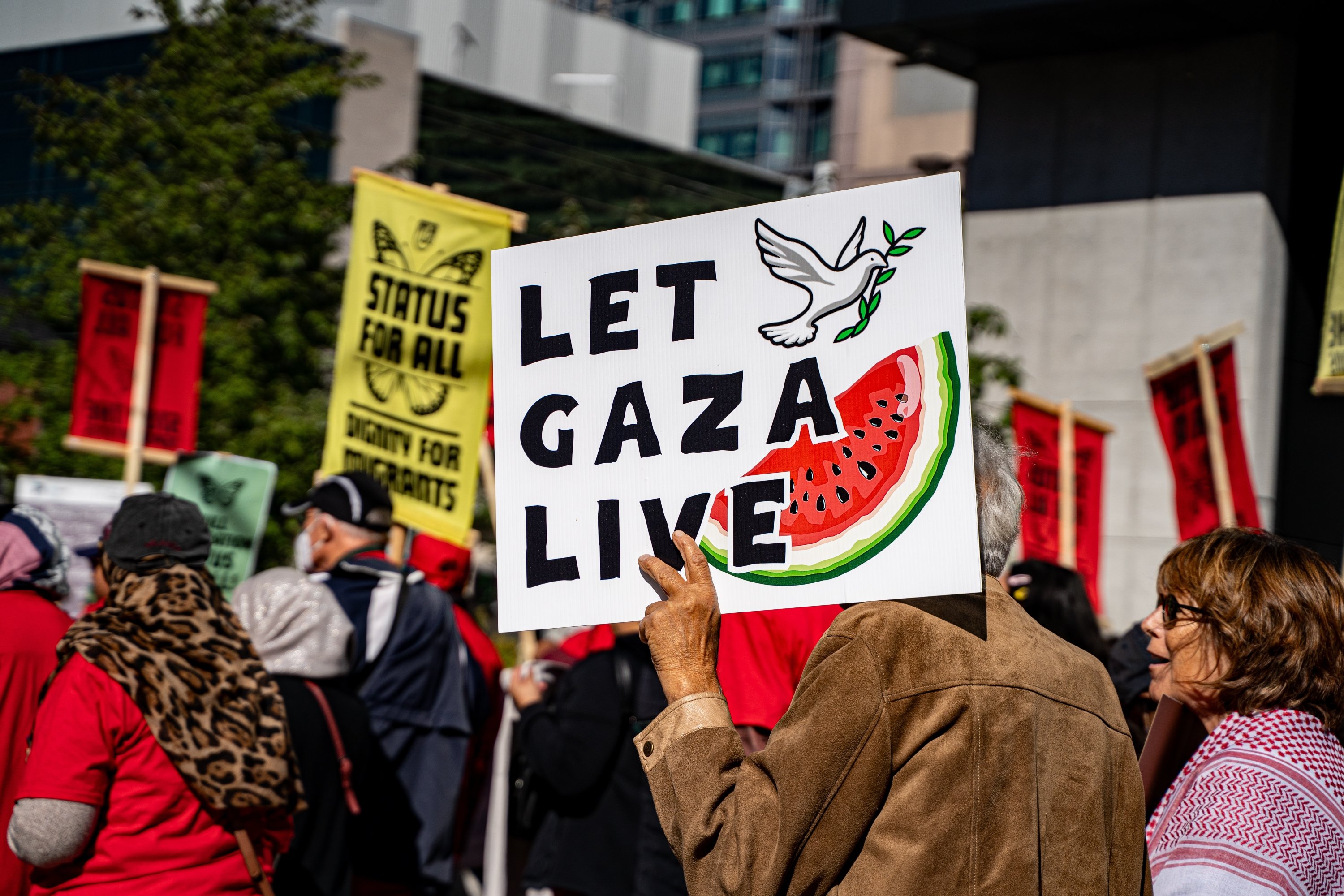
This continuity entered a new and much harsher phase after Oct. 7. As Khalidi emphasized, the scale of the destruction that unfolded in Gaza in such a short time was unprecedented. Approximately 70,000 people have been killed in the last 18 months. Some 190,000 people have either died or been injured. This shows that almost one-tenth of the population of 2.2 million has been directly targeted.
Destruction on this scale cannot be explained solely by military means. As detailed in the book, the systematic dismantling of infrastructure, the cutting of water and power lines, and the targeting of hospitals, schools and civilian residential areas reveal that this process was carried out within the framework of a specific military and political doctrine. Indeed, Khalidi notes that the approach once described as "mowing the lawn" is being pursued today on a far more destructive scale. This situation points to a deepening legitimacy crisis on an international scale.
This legitimacy crisis is not limited to the interstate level; it also transforms the perceptions and attitudes of global public opinion. The images that circulated, particularly after Oct. 7, led to the breaking of a long-suppressed perception; real-time images of destruction spread through social media transcended the boundaries of the mainstream narrative, allowing millions of people to see the issue directly and unfiltered. However, the real rupture occurs at the psychological threshold created by these images. As the gap between Israel's security rhetoric and the reality on the ground becomes visible, this rhetoric is losing its persuasiveness on a global scale; it is transforming into a mental and moral rupture, especially for younger generations. The issue is no longer simply who is right, but what can be considered legitimate. This reaction is more than a temporary sensitivity; it is a sign of a more permanent shift in consciousness.
This transformation also reveals the limitations of political strategies. Khalidi's observation, particularly regarding the post-Oslo period, is one of the book's most critical turning points. The diplomatic strategies adopted by the Palestinian side did not produce a result that would change the balance of power on the ground. Although the Oslo process was presented internationally as a hope for a "solution," it effectively produced a new form of governance instead of ending the occupation. Similarly, forms of armed resistance have also failed to achieve lasting gains. Neither diplomacy nor armed struggle has been able to produce a decisive outcome within the existing order. This situation cannot be explained solely by the failure of political actors; the real problem is a product of an unequal order established from the outset. Therefore, the issue must be understood as a structure that is continuously reproduced.
The role of the U.S., in particular, is critically examined by Khalidi. The author argues that despite positioning itself as a mediator, the U.S. effectively acts as one of the parties involved, shaping the process accordingly. This is crucial for understanding why peace processes often fail to achieve lasting results.
This impasse will not remain merely a regional issue, but will also pave the way for the emergence of a new political and moral landscape on a global scale. In recent years, support for Israel has significantly decreased in Western public opinion, particularly in the U.S., while support for Palestine has increased, especially among young people, minority groups and academics. Political discourses that were once almost unquestioningly accepted are now being seriously questioned.
The most tangible manifestation of this transformation is seen in the living conditions on the ground. The current reality in Palestine only makes sense within this historical context. What is happening in Gaza and the West Bank is the contemporary manifestation of a long-running process. In Palestine today, people are deprived of even the most basic human needs. In an environment where access to water is restricted, food is controlled, and healthcare is inadequate, life has become a direct struggle. The issue is no longer just land, but human life itself.
Khalidi's work transcends being merely a historical narrative and instead engages the reader in an ongoing process. The dedication at the beginning of the book lends a powerful human depth to the text: “I dedicate this book to my grandchildren, Tariq, Idris and Nur – all born in the 21st century, and whom I hope will see the end of this century-long war.” This sentence reveals the reason for writing the book. Khalidi does not merely record the past; he makes a clear call for responsibility towards the future. This call is directed not only to Palestine but to everyone who knows and seeks to understand history.
It is no longer possible to view this process, which has lasted for over a century, as a temporary crisis, a solvable dispute, or a balanced confrontation. Khalidi's approach clearly shows that today is merely a continuation of this long process. Therefore, the Palestinian issue is the result of a system built on structural inequalities. As long as this system remains unchanged, every attempt at a solution will only continue to produce a new impasse. The Palestinian issue is not a closed chapter in history; it is an ongoing process within the international order, witnessed by all people in the world.