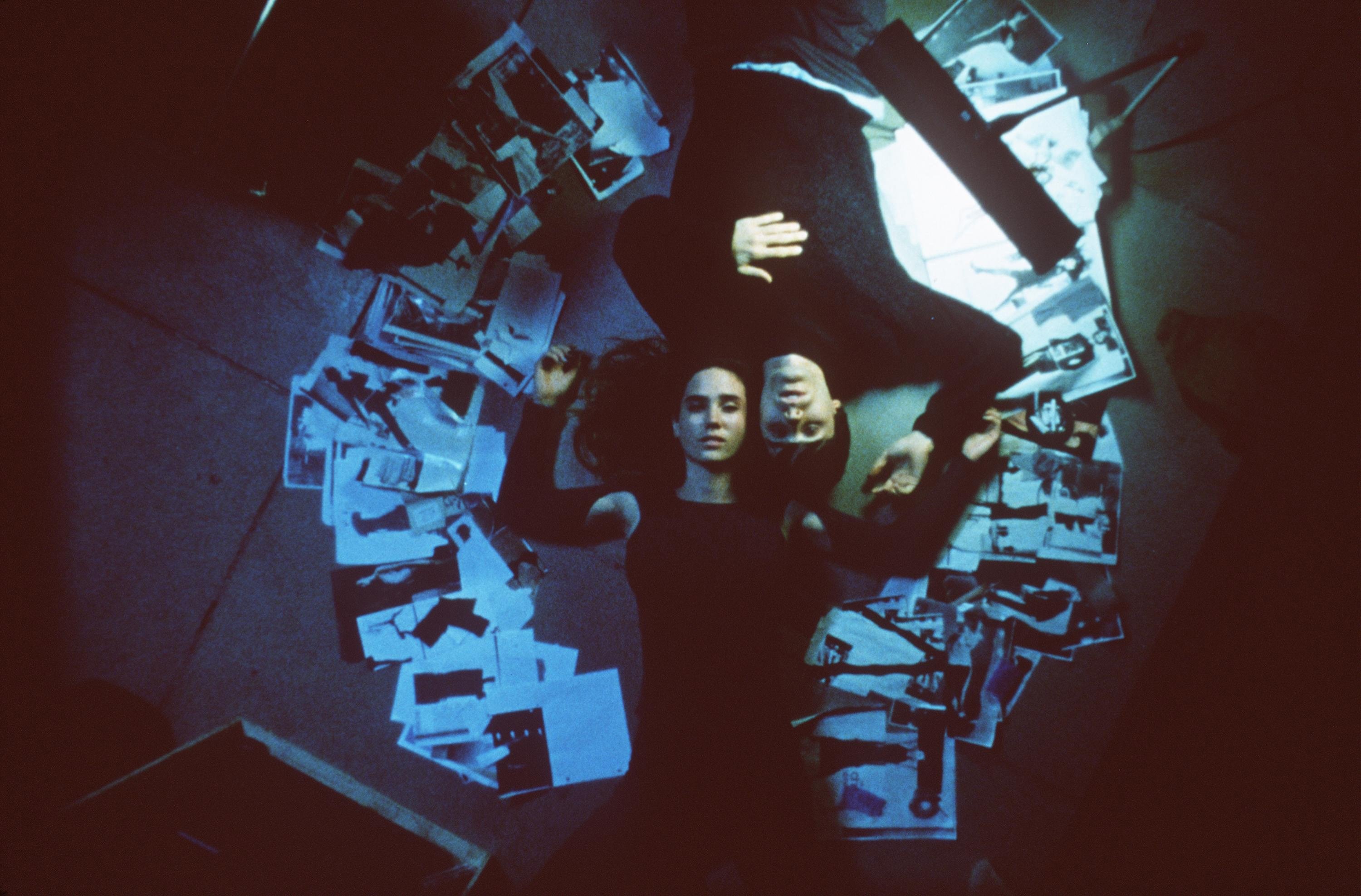
Few films in the history of cinema hold court in the viewer's inner world, holding a mirror up to one's own darkness, hidden desires and emptiness. Darren Aronofsky's "Requiem for a Dream" is precisely this kind of work: it transforms the viewer from passive witness into the rhythm of addiction, the trap of desire and the unbearable weight of emptiness. The film goes beyond the theme of addiction to reveal the vulnerabilities etched in the modern individual's psyche, the invisible pressures of society, and the philosophical tragedy of existence. Every scene, every repetitive montage, every striking close-up reveals not only a story but also the inherent insatiability of human beings — the thin line between pleasure and nothingness.
Aronofsky's universe is constructed around four characters: Sara Goldfarb, her son Harry, her lover Marion and their friend Tyrone. All four have different addictions, but they are all essentially dragged into the same void. Sara's eyes are fixated on the television screen, Harry's hopes to buy Marion a white dress, Marion seeks self-fulfillment through art, and Tyrone yearns for the affection and approval he cannot find in his mother’s embrace. All are united by the same line of fate. Because addiction is often linked to the possibility of something different — a better life, a pathological belief in being seen, loved and approved. Therefore, from a clinical psychological perspective, the film goes beyond viewing addiction as a symptom and presents it as a sign of a profound existential void.
Sara Goldfarb's story is one of the film's most unsettling strands. A lonely woman longs to wear her red dress, dreaming of appearing on a television show. But for her, the red dress becomes not a memory of her youth, but a shroud for a body drifting towards death. Sara's addiction to television is, in fact, a naked critique of modern society; reality dissolves into the screen and representation itself becomes truth.
Sara is no longer a mother dreaming of reuniting with her son; she is merely an image melting under the spell of television. While destroying her body with weight-loss pills, she is actually trying to mask the profound emptiness of her soul. And we, the audience, don't see her drifting into hallucinations merely as a psychotic breakdown; we watch a grotesque farce of the modern world unfold: the announcer's laughter, the food attacks, Sara's delirium. These are not just individual collapses; they are the illusions of television, consumer culture and the myth of youth and beauty.
These illusions eventually turn into laments. Hidden behind bars, the television is actually a metaphor for a prison — but Sara doesn't recognize it as such because, for her, the screen is the only window to the outside world. Sara's addiction isn't solely to weight-loss pills, but to the "need to be seen."
Psychologically and even sociologically, this scene reveals the pathologies of consumer society. Sara's hypnotization in front of the television recalls Baudrillard's concept of "simulacra": on the television screen, reality gives way to false representations; representations replace reality. Each representation is essentially the lament of a dream. At this point, addiction is not just a matter of chemicals but the magic of the image, the false promises offered by society. This scene strikingly whispers to us the human desire to be witnessed: "I am here, see me."
As Harry and Marion embrace, they dream of a dream — a white dress, a better life. But in the eyes of capitalist society, even love is purchasable. Love has become a commodity, fit for a store window.
The story of Harry and Marion, however, unfolds in a different rhythm. When the two embrace, we see not only love in the scene, but also hope for the future blossoming amid poverty. At this point, a white dress emerges as a symbol of pure desire. But this dress quickly becomes a metaphor for how the capitalist world exploits relationships: even love is reduced to something that can be purchased.
Marion dreams of existence through art, but the system offers her only one path: to be the object of desire. While trying to build a future with the man she loves, she finds herself in a predicament where she is forced to sell her body. This scene is a harsh critique of the narrow paths offered to women by the patriarchal order and capitalist consumer culture.
Marion's body renders her soul invisible; she no longer exists on the stage of her own desire but on the stage of others' desire. Marion's downfall is therefore inevitable.
Tyrone's failure to hold
Tyrone's brief but striking memory — his mother’s embrace — shapes his entire life. He is not dependent on material things; he is dependent on the profound void of approval that was lacking in his childhood.
Every shadow that wanders the streets of the ghetto embodies the invisible injustices of the system. Tyrone's downfall is not individual, but social; it is written with inequality, rootlessness and the traumatic legacy of invisibility.
A brief childhood memory of Tyrone's informs his motivation throughout the film. The tenderness he felt in his mother’s embrace becomes an illusion he pursues for the rest of his life. Tyrone's addiction is not to material things but to an unacknowledged childhood. His downfall is not an individual moral failure, but the result of social inequalities, ghetto culture and an invisible justice system.
Through Tyrone's story, Aronofsky captures not just the drama of an individual but a snapshot of a world where a young Black person is systematically ignored. The stories of Harry, Marion and Tyrone reveal how youth's quest for self-actualization is lost in shortcuts, false promises and easy escapes. Their substance abuse isn't merely a chemical intoxication; it is actually a refuge for a soul unable to grasp the future, a consciousness that finds the present unbearable.
Beyond the harm inflicted on their bodies, the motivations derived from fleeting pleasures reveal a self-enclosed, impatient soul unable to postpone its longings, seeking fulfillment externally.
The collapse of each character into a fetal position at the end of "Requiem for a Dream" is more than just a sign of withdrawal or despair; it is a visual allegory of a truth that wanders barefoot at the very edge of existence. Heidegger's concept of "being-toward-death" signifies living with foreboding anticipation of the ultimate horizon of one's own existence — the inevitable end: death.
The fetal position embodies this very intuition: at the point where the dream they fled collapses, each confronts the inevitability of death, trapped in the finitude of their own existence. Sara's shrinking under the television lights signals a turn toward death, reminded of by aging and lost youth; Harry's writhing with his gangrenous arm signals the body's decay; Marion's writhing in a cycle of drugs and humiliation marks the loss of love encountering the nothingness of existence; Tyrone's delirium of his mother in his prison bed echoes his yearning for the uterine safety of death.
Their shrinking is not merely a longing for childhood, but a Heideggerian sense of a being's bodily grasp of finitude in the shadow of "death."
Søren Kierkegaard's concept of "anxiety" also becomes almost palpable in these scenes. For Kierkegaard, anxiety is that indescribable shock, devoid of any concrete object, arising from a human encounter with freedom and nothingness. For the film's characters, anxiety is like a hum suppressed through addiction but never disappearing: Sara's emptiness at the sight of her rapidly fading youth, Harry's dreams slipping away, Marion's inability to find love and security, and Tyrone's loss of identity under society's racial and class oppression. All echo an objectless terror, an existential void.
Finally, the collapse into the fetal position is the ultimate manifestation of anxiety: each has touched the foundation of existence — nothingness — and attempts to offset this shock with only the most primitive, womb-like refuge.
From a literary perspective, this collapse is a visual lament for humankind's deepest truth: no matter how hard one tries to cover it up with dreams, fantasies, drugs and screens, one is ultimately left alone with the naked finitude of existence, the terror of anxiety, the silence of nothingness. The fetal position conveys both the inevitability of being-toward-death, as Heidegger put it, and the mysterious touch of anxiety, as Kierkegaard described, keeping one constantly awake.
Deep analysis from a psychologist's perspective
Darren Aronofsky's "Requiem for a Dream" reveals, with extraordinary harsh reality, how individual pathologies are not merely clinical manifestations but also reflections of the social order, cultural expectations and the insatiable economy of desire imposed by modernity. Each character, while seemingly a victim of personal weakness, is actually a representative trapped within societal ideals, consumer culture and a system in which the individual is constantly forced to desire more.
Sara Goldfarb's dream of appearing on a television program might superficially seem a simple narcissistic need, but psychologically, it manifests Sara’s pathological connection to loneliness, invisibility brought on by old age, and society's obsession with "being visible." Her desire to fit into her red dress is not merely an aesthetic concern but also an attempt to validate her existence — to be seen by society and regain youth in an aging body. It symbolizes obsessive longing for beauty and validation.
Sara's addiction to amphetamines is a deadly metaphor for the quick fixes and false salvations offered by society; the happiness promised on the television screen gradually turns into a psychotic illusion, leading to a visible meltdown in her body and detachment from reality in her mind.
The addiction journeys of Harry, Marion and Tyrone merge with the gradual decay of youthful ideals, love, friendship and the desire for success. Here, at a psychodynamic level, we observe the resurgence of emptiness, worthlessness and repressed traumas underlying addiction.
Harry's bond with his mother operates as an invisible line of tension. As a young man desperate for his mother's approval and unable to establish autonomy, Harry turns drugs to compensate for his mother's lack of love and fill the void with temporary pleasures.
Marion attempts to fill cracks left by childhood traumas and lovelessness through love and substance abuse; her body becomes the bargaining table of spiritual deprivation, showing addiction as both physiological and narcissistic and object-relational.
Tyrone's story highlights a sociological undercurrent: ethnic identity, class exclusion, and systematic deprivation progressively erode survival defenses; addiction is not individual weakness but the psychological cost of social inequalities.
The final contortion of the characters into the fetal position is the ultimate expression of regression; it symbolizes the individual's desire to return to uterine security by resorting to a primitive protective mechanism in the face of unbearable anxiety, guilt and helplessness.
Sociologically, this position represents the ultimate failure of all the artificial pleasures, ideals and false salvations offered by modern society; when individuals fail to achieve socially promised happiness, they withdraw into themselves, returning to the very beginning: the silence of "unbornness."
Philosophically, Heidegger's "being-toward-death" becomes concrete: the characters writhe with the awareness of finitude while silently preparing for the certainty of death. Kierkegaard's "vertigo of freedom" is reflected as characters simultaneously experience infinite possibilities and the emptiness of unattainable desires.
Ultimately, Requiem for a Dream exposes addiction’s biological, cognitive, and psychoanalytic dimensions while portraying existential fragility, social loneliness, and modernity's hell of insatiable desires. This film is not only a case study for clinical psychology students but also a dark window into humanity's collective unconscious.
For the viewer, this evokes not only the characters' tragedy but also inescapable questions about one’s own existence:
"What are we running from? Where are we taking refuge? And is the only womb in which we will all ultimately be trapped, in fact, the darkness of death?"
"If we can't accept emptiness, are we truly free? Or are we all curled up in our own little addictions, writing an invisible elegy?"