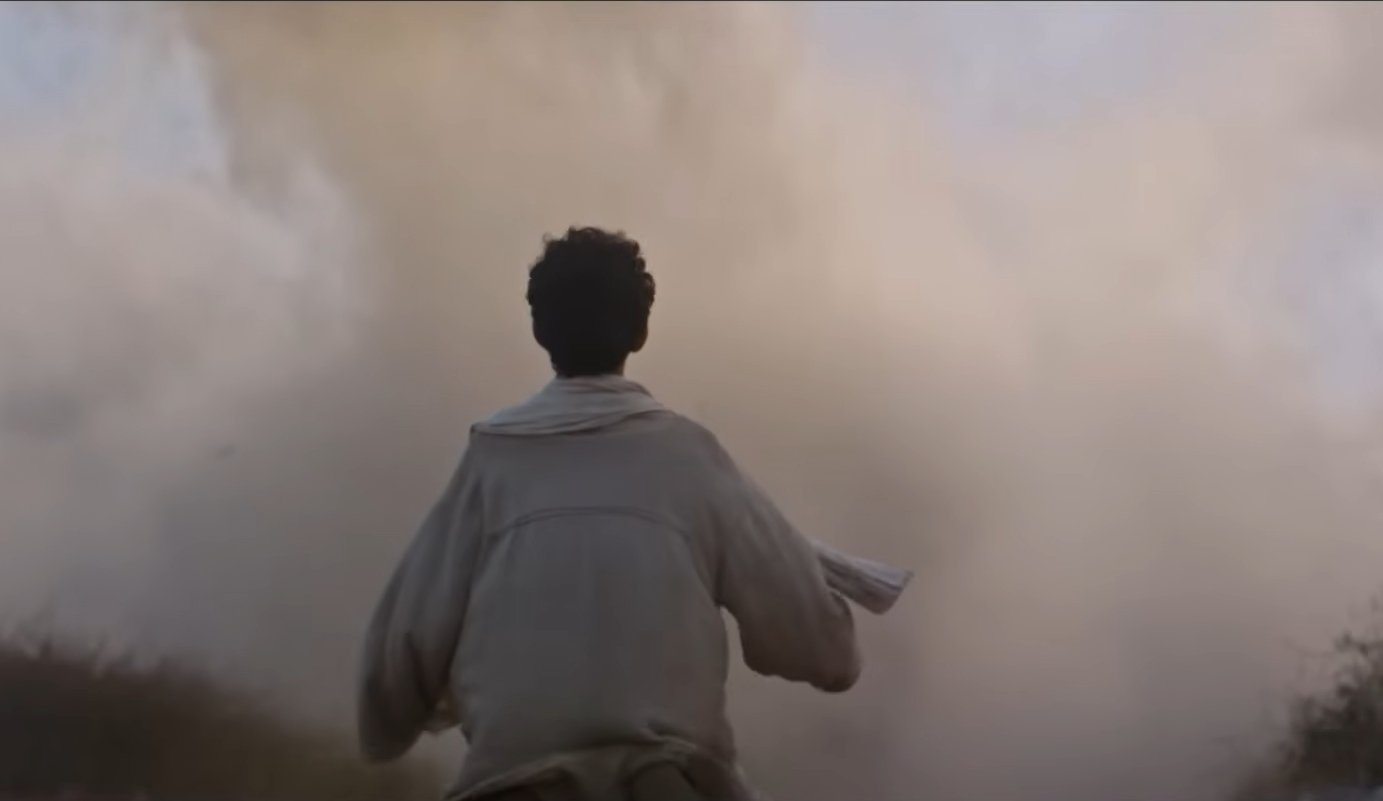
Annemarie Jacir’s film "Palestine 36" was released in 2025 but I only just got the chance to see it this summer on a rerelease in my local cinema in Afyonkarahisar. One striking overall impression that I took from it is its strong resemblance to Farah Nabulsi’s 2023 film "The Teacher." I found this highly disturbing. Not, of course, in that two films set in the same place have a similar subject matter, but rather that "The Teacher" is a contemporary film whereas "Palestine 36" is set in the interwar British Mandate period of Palestine, and that taken together, the two films show that the Palestinians have been enduring now severe oppression for generations.
In fact, in a sense, "Palestine 36" is a prequel to the whole long sad recent history and current condition of this poor benighted people. Because while it may seem natural to associate the dispossession and oppression of the Palestinians with the creation of the State of Israel in 1947 and all that has occurred since, this film shows that the issue has even deeper roots. Indeed, it shows the creation of the conditions for the creation of Israel and its treatment of the Palestinians is itself a handiwork of the British.
For though, as with "The Teacher," there is a scene in which a Palestinian is shot without consequences by Jewish settlers in "Palestine 36," the state oppression of the Palestinians is here actually carried out by the British occupying forces. While the British are destined to leave Palestine after the end of the film, the tactics that they use to oppress its native population are those that will be refined by their Israel successors including murder, collective punishment, judicial theft of land, proposals for the “forcible transfer" of the Palestinian population, the provocation of the Palestinians into violence and then tarnishing them as a violent people, mistreatment of women and children, the levelling of property, arbitrary imprisonment, censorship, curfews, and, encompassing everything, a refusal to recognize the political rights of this people, all of which is brought about through their simple dehumanization, the British viewing them “like animals.”
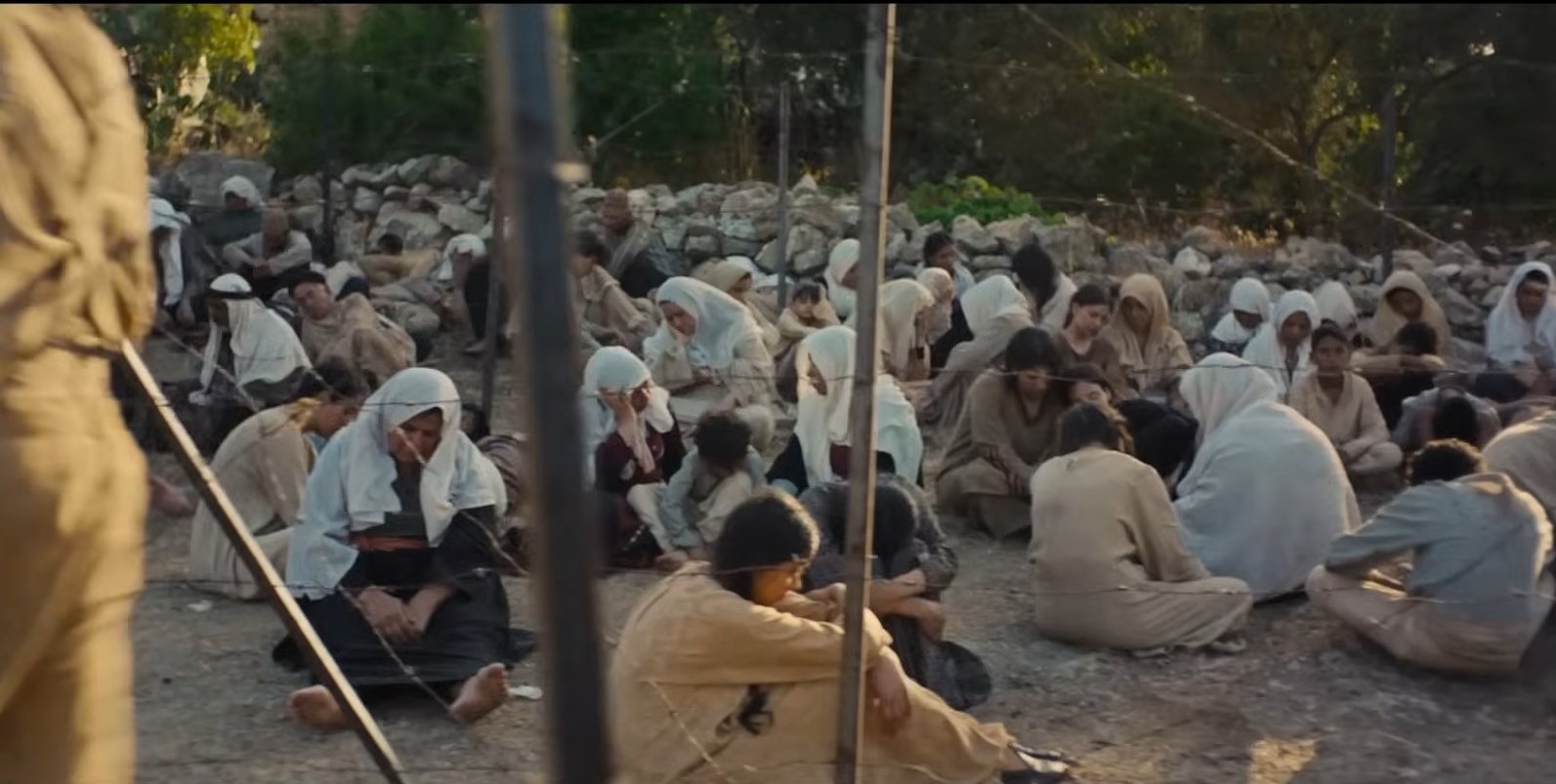
There is also a sense in which it can perhaps be understood that the British authorities themselves have not changed in the intervening decades. For there is a scene in the film which is disturbing in itself but is made more so by contemporary echoes. The character of Yusuf, played by Karim Daoud Anaya, discovers his fellow villagers Afra (Wardi Eilabouni), her mother Rabab (Yafra Bakri) and Um Kareem (Yumna Marwan) behind barbed wire in a British open-air prison. Afra tells Yusuf she is thirsty and asks him for water, which he gets and hands to her in a clay jar. British forces turn up, and their commander, the brutal and ideological Wingate (Robert Aramayo) who wants to see the “first Jewish entity in two thousand years arise,” roughly barks “no water” at Yusuf, though Yusuf continues to let Afra drink. The echo of the former British Prime Minister Sir Keir Starmer who declared that Israel had the right to “cut off” water to Gaza back in 2023 – that is to commit war crimes – even though he had previously been a human rights lawyer is palpable here. In the film, when Yusuf fails to comply he is savagely struck by Wingate.
The film is set in the late 1930s, a period of transition in which camels and motor cars are shown competing for space on the crowded streets of Jerusalem. This period is significant in the history of Palestine for two interrelated reasons. The film is centered on them, their being the Arab Revolt in Palestine of 1936-9, and its cause – the British-enabled large-scale Zionist Jewish migration into Palestine and the British plans for this country.
The increased Zionist population in Palestine at this time is shown, for instance, through a long list of kibbutzim is seen at the beginning of 1937. The film shows through newsreel that German persecution of the Jews has caused this growth. When Afra asks her mother Rabab why Jewish settlers are coming to their country she is told that their people do not want them. When Afra then wants to know why, Rabab says she does not know. In this way the film both shows the real persecution of Jews in Europe at that time while also making clear that it has nothing to do with the Palestinians at all. So much does it not, in fact, that they do not even understand what is going on.
Of course, the British concern for the fate of the Jews of Europe in the 1930s is admirable. Their main solution to this problem in enabling them to migrate to Palestine is not though. For if they were truly concerned they could have allowed the Jews free settlement in Britain itself. Yet, in the 1930s, as the situation in Europe worsened, the U.K. government tightened restrictions on Jewish migrants attempting to get to Britain. It is true that in the Arab Revolt they also did so for Palestine, but in actual numbers and more significantly proportionally to the local population, Britain allowed far far greater Jewish migration to Palestine than to Britain itself. For the British to expect the Arabs of Palestine for whom the situation of the Jews in Europe was a far-off and thus insignificant issue to absorb Jewish settlers in numbers that threatened their displacement on their ancestral land while the British, close-by and concerned, prevented Jewish migration to Britain in numbers that would not is simply rank hypocrisy.
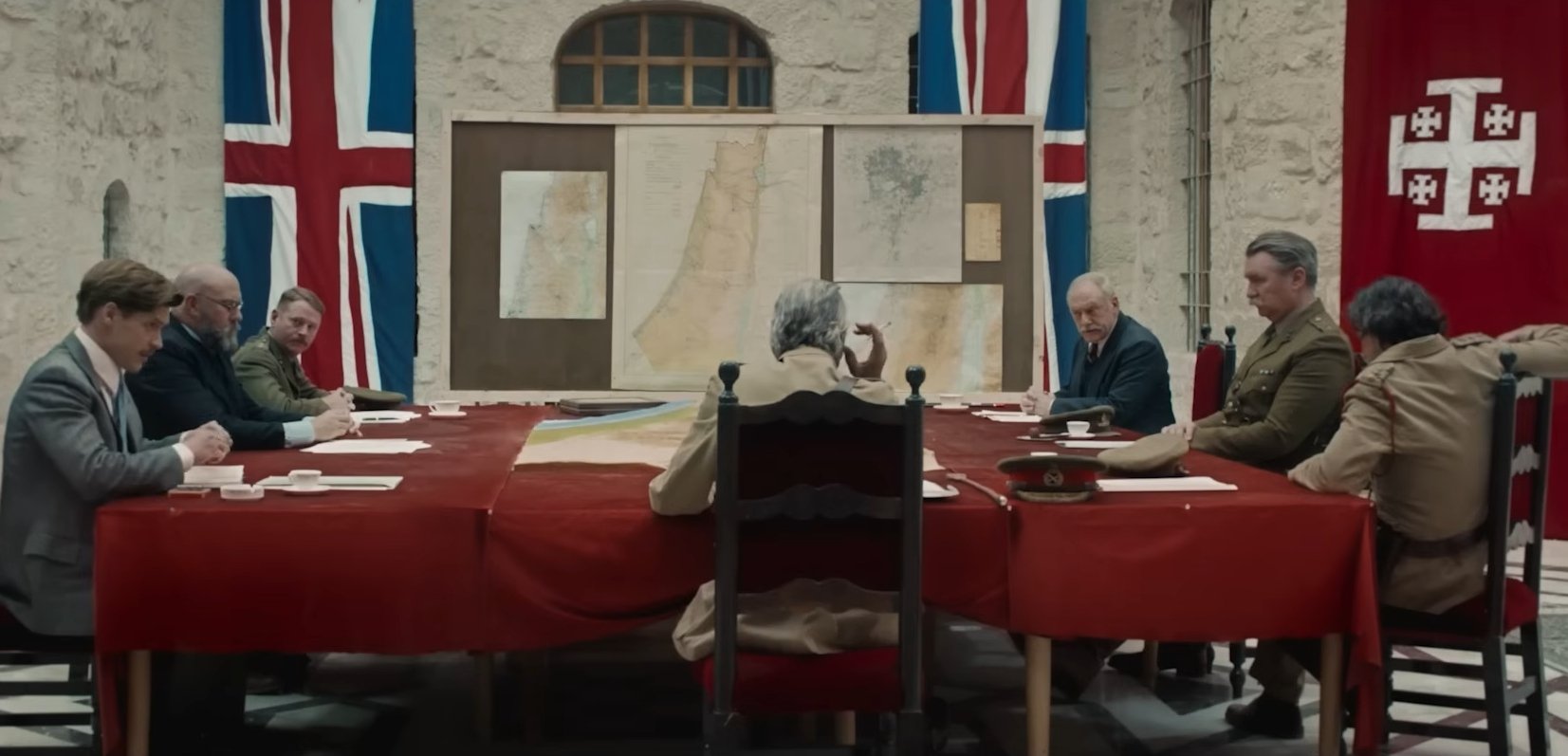
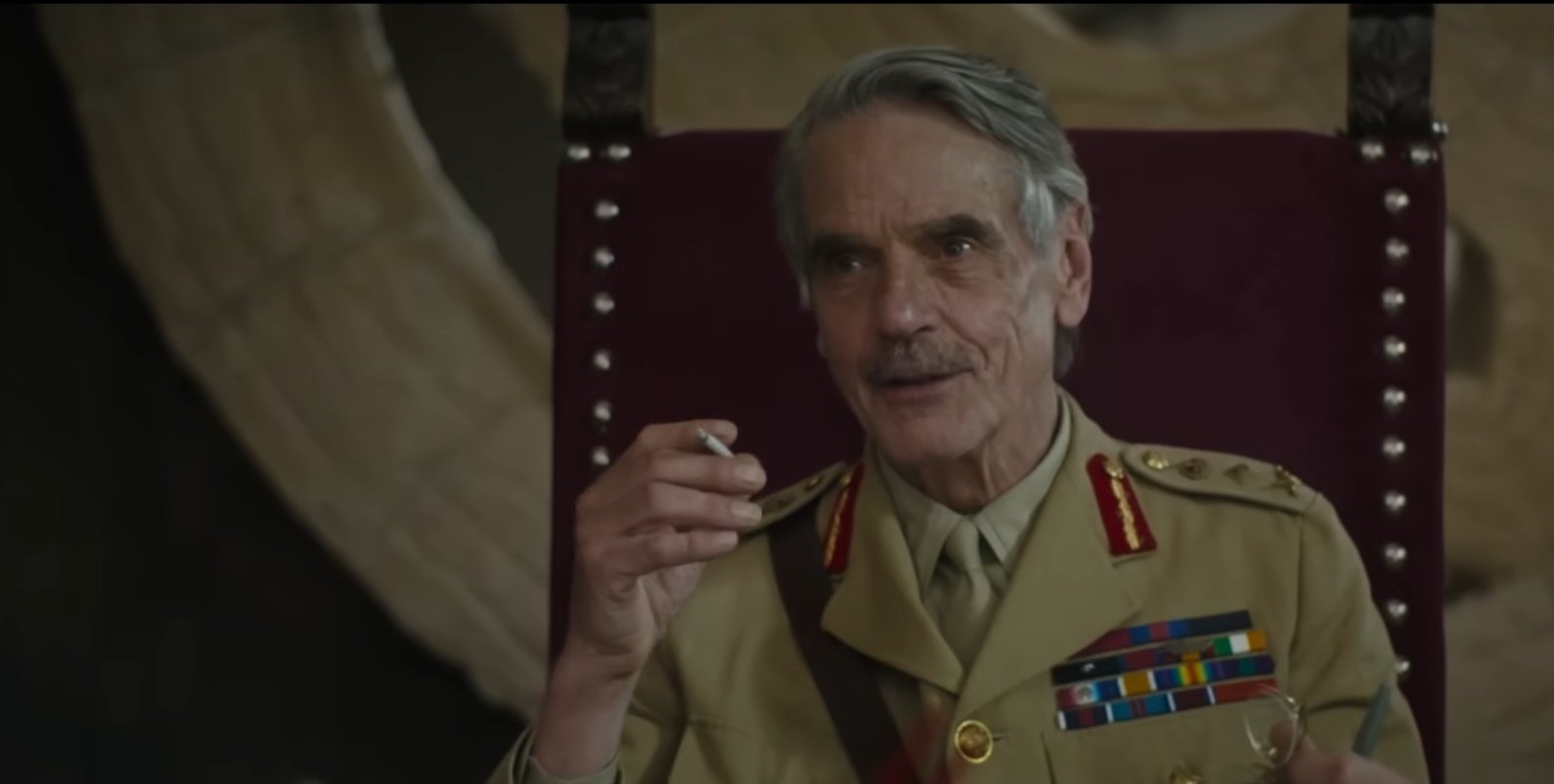
The double standards of the British are a main theme of the film. Their official position in Palestine is the declaration of the British High Commissioner Arthur Wauchope (Jeremy Irons) of a “faith that Arab and Jew can live together” in a “united and peaceful Holy Land.” It is the case of course that such a declaration is made in an era of nationalism worldwide where the idea of two peoples with no common historical bond living in harmony would seem nothing less than a joke. Moreover, all that the Palestinians are offered in return for their increasing dispossession is Wauchope’s empty rhetoric of the “gratitude of Jews and the entire Western world.”
A central issue is that of the Peel Commission. There are serious tensions in Palestine at the beginning of 1936, and the Peel Commission is set up in London to resolve them. In the film, Thomas Hopkins, played by Billy Howle, is a British official who is sympathetic to the plight of the Palestinians. He exclaims that “I have a good feeling about the Peel Commission.” However, his optimism turns out to be misplaced, for the report of this commission is what kicks off the Arab Revolt in earnest. The Palestinians already have deep-seated reasons to distrust the British and the core reason is suggested when Hopkins first appears in the film. For when he turns up in the village of al-Basma to plead with the villagers to register their land, upon his arrival he is shown a donkey the villagers have named Balfour.
The donkey has been named Balfour due to the Balfour Declaration of 1917, which sets the tone for the film, but in predating it is not directly covered by it. To contextualize, this infamous declaration was made in 1917, three years into a world war in which Britain had long come to view victory as essential to its survival as a great power. Wishing to gain the maximum amount of support for their campaign against the Ottoman Empire, and having abjectly failed at Gallipoli, the British made three promises to three different constituencies regarding the Arab Middle East. One was to support Arab nationalists who wanted independence from the Ottoman Empire, another was to divide this whole area between itself and its ally France, and the third, the Balfour Declaration, was “the establishment in Palestine of a national home for the Jewish people” and “to facilitate the achievement of this object.”
These promises were clearly contradictory and could only even be technically resolved in the post-war period through sophistries. Thus, Palestine was made a mandate, not a colony, meaning that technically Arab freedom had been achieved there. However, it was a colony in fact if not in name, for the Arabs in it were made second-class citizens expected to defer to foreign masters in their own land. The film shows this, for instance, towards the beginning, the imperious accosting of Yusuf by a young British soldier who demands to see his papers. More importantly for the future, though, British control through the mandate system meant that the indigenous Arabs had no control over who could come and settle in their country. The British thus allowed mass Jewish settlement into Palestine over their heads.
This duplicitous behaviour on the part of the British, though begun with the Balfour Declaration and established with the establishment of the mandate, continues into the period of the film. For the Peel Commission proposes to resolve the tensions in Palestine with partition between its Arab inhabitants and the newly-settled Jews. This, of course, means a loss of land that has traditionally belonged to the Arabs and necessitates a “forcible transfer of its population.”
Here the British authorities abruptly switch from a high-sounding hypocritical idealism to a cruel realism. Justifying the idea of partition through what he calls the “dual obligation” of the British to Arabs and Jews, Wauchope avers that “half a loaf is better than no bread at all.” History has proved him right, for in each subsequent Western-originated or backed partition plan the amount of the “loaf” offered to the Palestinians has got progressively smaller, though today there are not even crumbs on offer. This has led to Wauchope-like criticism of the Palestinians for not simply accepting whatever is proposed to them at each stage, including that by the political commentator Fareed Zakaria. However, that clearly misses the point that before the first partition plan, the “loaf” in question was not a British one for them to cut up and, as with every subsequent plan, to expect that a people to quietly acquiesce in the ceding of their national rights is a horrific injustice. Moreover, even when partition has, in principle, been accepted by the Palestinians, further concessions have been demanded from them.
In contrast to the shifty British position in the film, the Palestinian one is consistently clear. While being painfully aware that “every day we lose land,” they are adamant that “the land is ours” and “Palestine is not for sale.” The stereotype of the violent Palestinian is addressed when Yusuf declares that “I don’t want to fight” to be told that “none of us do”; they feel forced into defending their national rights. Hence, they take up arms against the British colonial authorities in the hope that “Resistance be crowned with Victory”; they also embark on a campaign of sabotage, including attacking an oil pipeline running through their country from Iraq and carry out a general strike. The resistance is a popular one as it is funded by the Palestinian people and Yusuf himself takes part. It should be noted that among the Palestinian elite, there is less of a feeling of national solidarity. One leading member of the elite, a publisher, for instance, is in the pay of the Zionists.
The increase in violence leads to a horrible denouement. Towards the end of the film, the armored car leading a small British military convoy on a winding hill road hits what today would be called an IED and blows up. The soldiers in the other vehicles then find, as a focus for their shock that is transforming to rage, the nearby village of al-Basma.
Aside from Jerusalem, this village is the central place of the film. Yusuf, Afra and Um Kareem all hail from there. It is a beautiful little hilltop village with a church tower marking its left and a minaret marking its right side. In this way, the film depicts the Palestinians as what they are, not an exclusively Muslim people but a people made up of a sizable Christian element. Wingate, on his earlier first view of the village, exclaims that it is “a good village” with “fields of gold,” leading him to exclaim that “this truly is a holy land.” In the aftermath of the explosion, Wingate is less exuberant, however, and leads the angry British troops into the village.
This reminded me of the most disturbing scenes in Oliver Stone’s 1986 film "Platoon" set in the Vietnam War. There, the soldiers are Americans and the villagers are Vietnamese. Here they are British and Palestinian, respectively. However, as in "Platoon," the villagers’ homes are ransacked, and a soldier tells one of the villagers to “stop smiling,” then rifle butts him in the face. Indeed, this British soldier does not go on to crack open the villager’s skull as does his American Platoon counterpart, and there is no mass rape here. All the same, there is mass murder for a couple are blown up in their house and the Palestinian men and boys are sent off on a bus along a road in which a mine has been laid to “give them a taste of their own medicine.” Also, as with Platoon, the scenes end with the village aflame.
There is another point of comparison with "Platoon" for although both of these films end with foreign soldiers still in situ, the viewer knows that the Vietnam War came to an end following an American withdrawal in 1973 and the British vacated Palestine in 1947. The Vietnamese, however, got their country back, while the Jewish settlements enabled by the British occupation meant that the situation for the Palestinians has only worsened since. In the aftermath of the burning of the village, Um Kareem tells her scarred son Kareem (Ward Helou) that “this isn’t the first and it won’t be the last.” It has not even come to an end ninety or so years later as both The Teacher and our daily newsreels show us; indeed, now it has turned into a genocide.
With its portrayal of this little-known but extremely important piece of history, the film is a good, even necessary one. As a piece of cinema, however, it has one small failing that is not particularly important considering the issues with which it deals, but it is one that prevents me from giving the film a perfect score. It is that the characters seem types rather than real people. They have unadulterated singular motivations rather than the sometimes messy, complex ones evinced by real human beings. This both makes their actions fully predictable and can prevent the viewer from fully engaging with them emotionally. But as I have already stated, this is a minor, perhaps even an irrelevant fault concerning its important issue, and I highly recommend anyone who has not seen this film and has the opportunity to do so to take that opportunity.
Rating: 4 from 5.