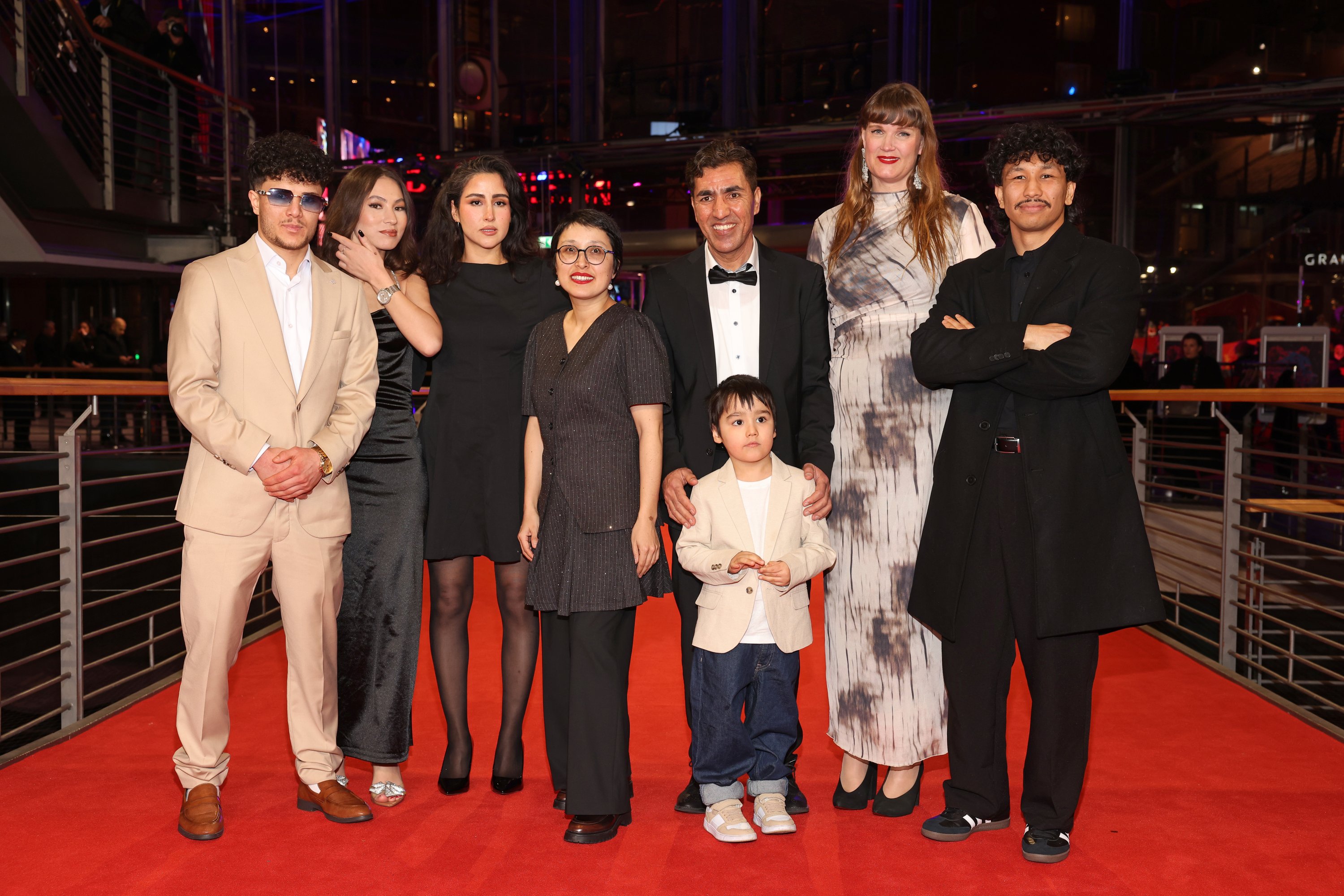
One of the ironies of the calls for "leaving politics aside" at this year’s Berlinale was the choice of opening film, "No Good Men," about a female cameraperson’s fight to be recognized as an equal colleague at a Kabul news station, set at a time when the Taliban were closing in on the capital.
The director, Shahrbanoo Sadat, is likely to have had firsthand experience of the media scene in Kabul, as her biography says she studied documentary filmmaking at the Kabul workshop of Ateliers Varan in 2009. That year is only five years after the ousting of the Taliban regime and the establishment of the internationally backed Republic of Afghanistan. This is the period in which the West was still interested in the Afghan enterprise and was pouring money into several projects, including those in the arts.
This background is important for the film’s plot because it is toward the end of this period that our heroine Naru (played by Sadat herself) is trying to fight for her place at the TV station. The film opens with a beautiful sequence, in very crisp HD, of cactus flowers blooming, with an Afghan dance number in the background. Cacti are very lush metaphors, not only for the ability of beauty to bloom in the harshest conditions, but also for several body parts, as evidenced by of one of the playful posters for the film.
Sadat’s nuanced approach in "No Good Men" is to talk about women’s issues in Afghanistan that are often readily recognizable elsewhere in the world. The term "glass ceiling" was not invented in Kabul and yet it is precisely what we see happening at Naru’s TV station. Because she is a woman she is relegated to the women’s morning show where she is moved to tears of boredom.
Before we move on, a few words must be said about the headgear of the Afghan women appearing on TV in the film. Now we know that in the lands of Khorasan - no doubt through interaction with India - women have developed very elaborate ways of ornamenting themselves. In Sadat’s film female Afghan TV presenters, including news anchors, wear their bright silk scarves over a mound of sculpted hair that rises some 10-15 centimeters from the forehead. I must admit I never watched Afghan TV in the 2004-2021 non-Taliban period and my internet search hasn’t revealed anything to corroborate the look that is presented in Sadat’s film – but they are something to behold. Sadat, as she does elsewhere in the film, plays with the audience’s emotions here. Just as you find yourself thinking "but that style is a bit much" you remember that soon the Taliban will take over again and women will become invisible and then resolve, once again, to never to pass judgement on women’s choices.
Naru, being on the other side of the camera, is an average hijabi woman in shirt and jeans, covering her hair Iranian style. We see her run from office to office at the station to secure a proper gig and with the wounding of a cameraman gets to be included in the team that will interview a Taliban commander. When they reach the commander’s house they are surprised to see Naru carrying the camera and the interaction between her and the commander remains the most striking scene of the film for me. When he sees her, the commander assumes that Naru is a foreigner, offers his hand to shake and is all smiles welcoming her, commenting on how well she speaks the language. When he realizes that Naru is an Afghan his tune changes completely, he criticizes her hijab and then leaves the room. This moment of how men will "tolerate" certain behaviors from women of other cultures and be scandalized when their compatriots do the same is one of the most acute observations of the film.
Sadat and her cast’s subtle acting reveal these moments of truth throughout the story. It is beautiful to see Naru stand her ground and her male colleague stand by her although he has voiced opposition to her involvement in the interview at the beginning. We see him see himself in the Taliban commander’s contempt for Naru and repent at once because he doesn’t want to be part of their women-erasing project.
While all this is going on, or rather because all this is going on, an inappropriate office romance develops between Naru and one of her male colleagues (yes, he is, like herself, married) precisely because this man recognizes her efforts to do her job. The scenes between the two would-be lovers are beautifully acted by Sadat and Anwar Hashimi, where you get all the shades of the hesitations and temptations. The plotline of Naru’s catastrophic marriage is also delivered with lots of nuance. She is a woman who has chosen to marry for love and is stuck in a situation where she can’t divorce her no-good husband because she fears he will take custody of her child- again, a plotline not unfamiliar from Hollywood (the recent film "The House Maid," for instance, has this as a narrative thread)
The "no good men" in the film’s title refers to a fun women’s conversation at the TV station but we also recognize it from all manner of social media posts from all over the world. It is a comment made by women when they are treated unfairly in social or romantic situations. As a good filmmaker Sadat does not give into this conventional sentence on men and contrives, by the end of the film, to show us there is at least one good man in Kabul. In the end, "No Good Men" suggests that even in a city about to disappear behind a curtain, recognition – however fragile – is the first act of resistance.