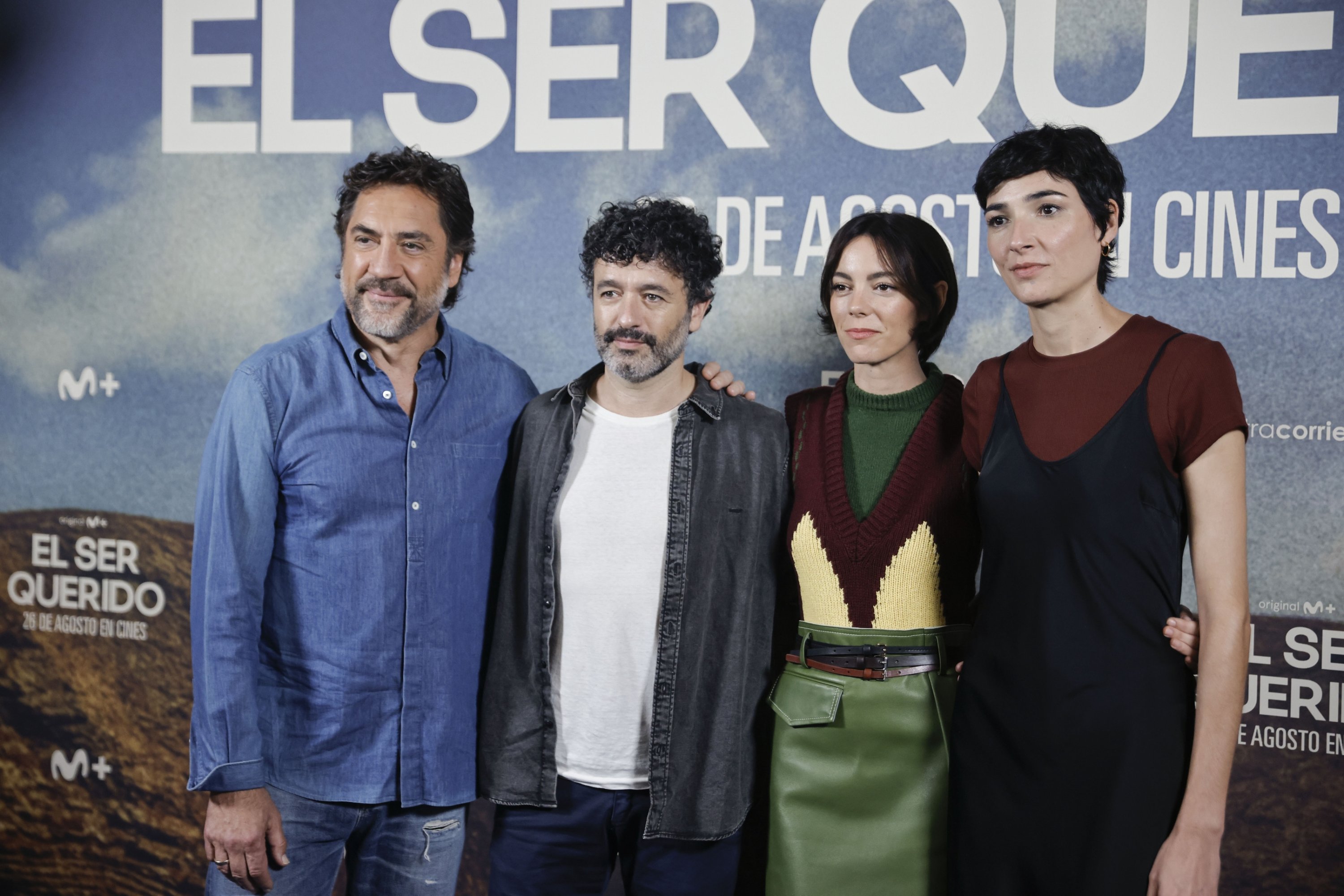
One of the most attended Open-Air Screenings at the Sarajevo Film Festival was Rodrigo Sorogoyen’s "The Beloved," about a film director who gets in touch with his estranged daughter after 13 years and casts her in his new film. Sorogoyen took to the stage, walking among the audience on a raised red platform, waving and smiling. His manner that night and later in the master class could not have been more opposed to Esteban, the director he depicts in the film. Sorogoyen’s film, with its narrative levels and the narcissistic director at its center, functions as a psychological hall of mirrors, where the audience is on the edge of their seat, waiting for the next crisis to erupt at any moment.
"The Beloved" opens with a very tense first meeting of father and daughter, with close-ups of the two characters’ faces – a plan you can risk only if you have total trust in your actors. Sorogoyen has chosen one of, if not the, best-known faces of Spanish cinema, Javier Bardem, to play his lead. At the beginning of the conversation, he seems a vulnerable enough man, trying to make it up to his daughter, but the minute she brings up a version of their past – a version which later events in the film corroborate – he doesn’t agree with, we see his face go cold, almost evil instantaneously and I am thrown back to his performance in "Mother!" (2017) where his patriarchal character goes stone-cold on Jennifer Lawrence’s allegorical Mother. That we should not trust this "father," that this is very likely an abusive man, is signaled from the very beginning.
Holding her own across from Bardem is Victoria Luengo Saez, also known as Victoria Luengo, playing a daughter navigating her father’s expectations while he tries to manipulate her. Throughout the film, Luengo's portrayal of Emilia channels her own versatile background as an actor – evolving from hesitant to confident, echoing the sharp onscreen presence she established in the 2020 miniseries Riot Police. When we see that Emilia has accepted her father’s offer, we get the sense that she sees this not as a conciliatory journey, but as the break that the universe has given her to test her abilities.
The film then moves on to the shooting of the film "Desierto," where Sorogoyen’s points of view multiply. We see things through Sorogoyen’s lens, through Esteban’s lens, and a third, black-and-white lens that hovers between Sorogoyen and Esteban – for those interested in narrative levels, "The Beloved" is a feast.
While the audience expects the cast and crew to be critical of Emilia, we quickly understand it is, and will remain, Esteban who needs to be reassured. This is a film about fatherly responsibility and the leeway we give to artistic genius such as Esteban’s, but Sorogoyen has also cleverly inserted a very topical subject into the film: that of Western Sahara. It is a truth universally acknowledged that when colonial powers leave their overseas holdings, they leave unhealed scars, ensuring there will be bloodshed and misery after they leave. Having made his name as an auteur cinematographer, Esteban is now trying his hand at period drama, setting his film in 1930s Western Sahara, back then a Spanish colony. The film Esteban is shooting looks very much like "The English Patient" (1996), with Emilia’s character thrown into the midst of this colonial chaos.
For lovers of cinema, all films about the making of film are precious, as through them we get glimpses – fictional though they may be – of the filmmaking process, and watch actors portray the movement of getting in and out of character. At one point the cast discuss Esteban’s choice of material and how he chose not to shoot in the Sahara. This comes up in conversation in the master class when Neil Young congratulates Sorogoyen on not shooting in the Western Sahara, while the blockbuster of the summer, "The Odyssey," has been filmed there. While expounding on the subject, Sorogoyen drew an interesting comparison: Spain leaving Western Sahara, Esteban leaving his daughter. Seeing how abusive Esteban turns out to be, one cannot but think that ultimately it was good for the Western Sahara that this abusive father left. Meanwhile, back in "The Beloved," the Moroccan actor jokes that Esteban should have cast not him but a West Saharan actor for the role if he meant real solidarity. This is a pointed criticism of all our activism, as market forces and not our convictions continue to shape our decisions.
While Emilia tries to get into the rhythm of her role and to listen to her father’s advice, she makes the mistake of conversing with him about her art, and makes the mistake of calling out one of her vices. When two people who have not lived as parent and child make these observations about one another, it is bound to lead to a conflict, and it does, on the set. In one of the most dramatic and tense sequences of the film, Esteban makes his cast repeat the same scene over and over again with soul-crushing words and psychological violence. This is where we understand that, having left his daughter, the celebrated director came to treat his crew as a patriarch whose words must be obeyed.
This is also where we come to understand where Sorogoyen stands when it comes to how we are to treat "genius." When asked about it in the master class, he says that no film is more important than someone’s psychological health. This is something nice to hear from a director because the film reminds me of "Whiplash" (2014), where the teacher’s terrorizing ‘teaching’ methods seemed to be condoned by the film’s makers. In "The Beloved," however, Sorogoyen doesn’t give Esteban the satisfaction of her daughter’s acquiescence to his methods as having been worth the ordeal, or an acknowledgment that the "genius" has paid his dues. Not genius, but Emilia’s mundane life triumphs in the end, leaving Esteban with his ultimate crime and guilt of having abandoned his child.