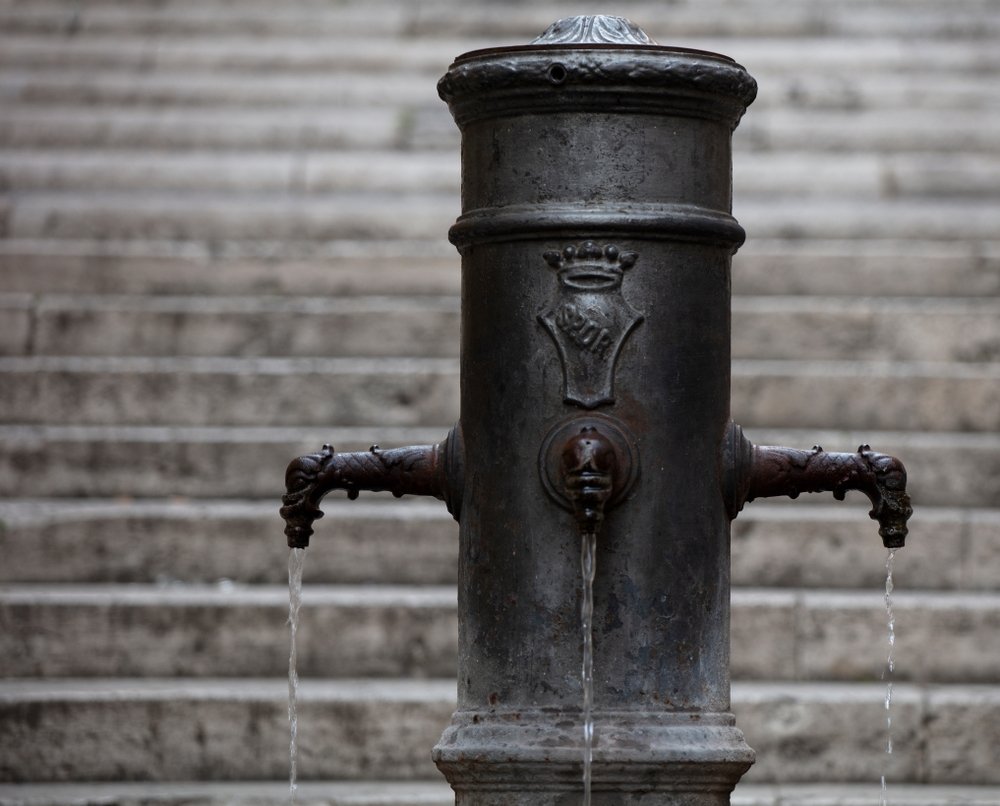
Rome is known for its history, churches, statues and many more. Yet one of the city’s symbols often goes unnoticed: the small street fountains known as nasoni, a name that comes from the Italian word for “big nose,” referring to the shape of their curved spouts.
Nasoni have become a symbol of Rome for two main reasons. While small public fountains exist in other Italian cities, their design is unique to Rome and they are found everywhere. Today, there are between 2,500 and 3,000 nasoni across the city.
The first nasoni were built in the early 1870s. They were created with a simple but powerful idea: to provide free drinking water for everyone. This vision came from Rome’s mayor at the time, Luigi Pianciani, together with city councilor Rinazzi.
More than a century later, nasoni still serve the same purpose, offering fresh, drinkable spring water to residents and visitors alike. Around 200 of them are located in the historic city center.
The earliest nasoni were about 120 centimeters (305 inches) tall and weighed 100 kilograms (220 pounds). Water flowed from three spouts shaped like dragon heads. Over time, this design changed, and most fountains were replaced with a single, smooth metal spout. However, a few of the original three-spout dragon-head fountains still survive today. They can be seen on Via di San Teodoro, Piazza della Rotonda and Via della Cordonata.
Despite their importance, these small fountains faced a serious threat in 2017 due to a water shortage. In June of that year, Italy’s then-Environment Minister Gian Luca Galletti called on citizens to reduce water use. As part of emergency measures, it was proposed that only 85 of Rome’s nearly 3,000 nasoni would remain in use. The plan immediately sparked public debate.
Among those who opposed the decision was Piergiorgio Benvenuti, president of the environmental association Ecoitaliasolidale. He pointed out: “Beyond the damage to the city’s image, Rome’s 2,172 nasoni are famous worldwide, play a role in cleaning the sewer system, and 350 of them provide water for irrigation. The more serious problem, however, is water loss, which in Rome reaches peaks of up to 45%, while the fountains account for only 1.1% of the water supplied by Acea.” Following growing public debate, the decision was abandoned, and the nasoni continue to flow today.
Over time, nasoni have also become part of Italy’s cultural and artistic life. In 1990, architect Aldo Tommasi won the Premio di Poesia Romanesca for his poem "La Funtanella," written in the Roman dialect. The jury praised the poem, stating: “'La Funtanella,' a short and demanding poem, offers a rare watercolor of Rome, one of the few evocative corners that still withstand the blows of the modern world, offering something that remains authentically true. The small Roman fountain, the ‘nasone,’ continues, within its limited role, to stir the poet’s soul and, through it, to spread a sense of peace and reconciliation: a rainbow.”
They also appear in the background of films, silently sharing the frame with Rome’s stories, such as "Bicycle Thieves" (1948) by Vittorio De Sica, "Accattone" (1961) by Pier Paolo Pasolini, "I Soliti Ignoti" (1958) by Mario Monicelli and "Il Piccolo Diavolo" (1988) by Roberto Benigni.
In 2023, the exhibition "Water in Art" and the "Art of Water – Fountains and Nasoni of Rome" curated by Stephane Verger was held at the National Roman Museum. The exhibition explored the importance of water in Rome, once known as Regina Aquarum, the “Queen of Waters,” and displayed archaeological findings related to the city’s fountains.
Because nasoni continue to meet the daily water needs of both Romans and tourists, they are now also part of the digital age. An app called Aquea shows the locations of fountains and nasoni across the city. Users can find the closest fountain, learn about its history, and even see details about the water, such as its calcium and sodium content.
Quiet, practical and Roman, nasoni remain one of the city’s silent yet historic symbols, still flowing in a modernizing world, continuing to tell the story of Rome.