The ancient Greek philosopher Aristotle felt there was no choice in society save for a hierarchy in which toil was the lot of most human beings, whether the toil of laborers or slaves. Aristotle argues that only “if ... the shuttle would weave and the plectrum touch the lyre without a hand to guide them, chief workmen would not want servants, nor masters slaves.” Aristotle made this assertion concerning automated objects not with the conception of some form of mechanization being desirable nor with a foresight that could see over two millennia to our industrial era, but rather as a condition that was impossible to achieve, much as in the English expression of “if pigs could fly.” However, the story of the Industrial Revolution from its beginnings in the late 18th century has been one in which machines have progressively taken over work that used to be done manually, and certainly now the shuttle weaves without any direct human touch at all, and although it is still more common for a human hand to touch a musical instrument for the production of music, that too, is no longer a necessity.
Yet, until very recent times, technology has been used, as in Aristotle’s quip, to take over manual work. Now, though, it appears that it can replace almost anyone, wherever they happen to be in the workforce. The other day, I came across the claim that by 2030, AI could have put 99% of workers out of a job. This absolutely stunned me. If this is true, a jobs holocaust is right on our doorstep.
Even if one sceptically thinks that this job loss prediction is simply far too high, divide it by 10 and it is still a shocking figure. Moreover, human jobs are already being lost to AI, and at the very least, this trend is expected to continue. How societies will be able to deal with such a huge upheaval in such a short amount of time is frightening to think about, but it is not the point at issue in this piece.
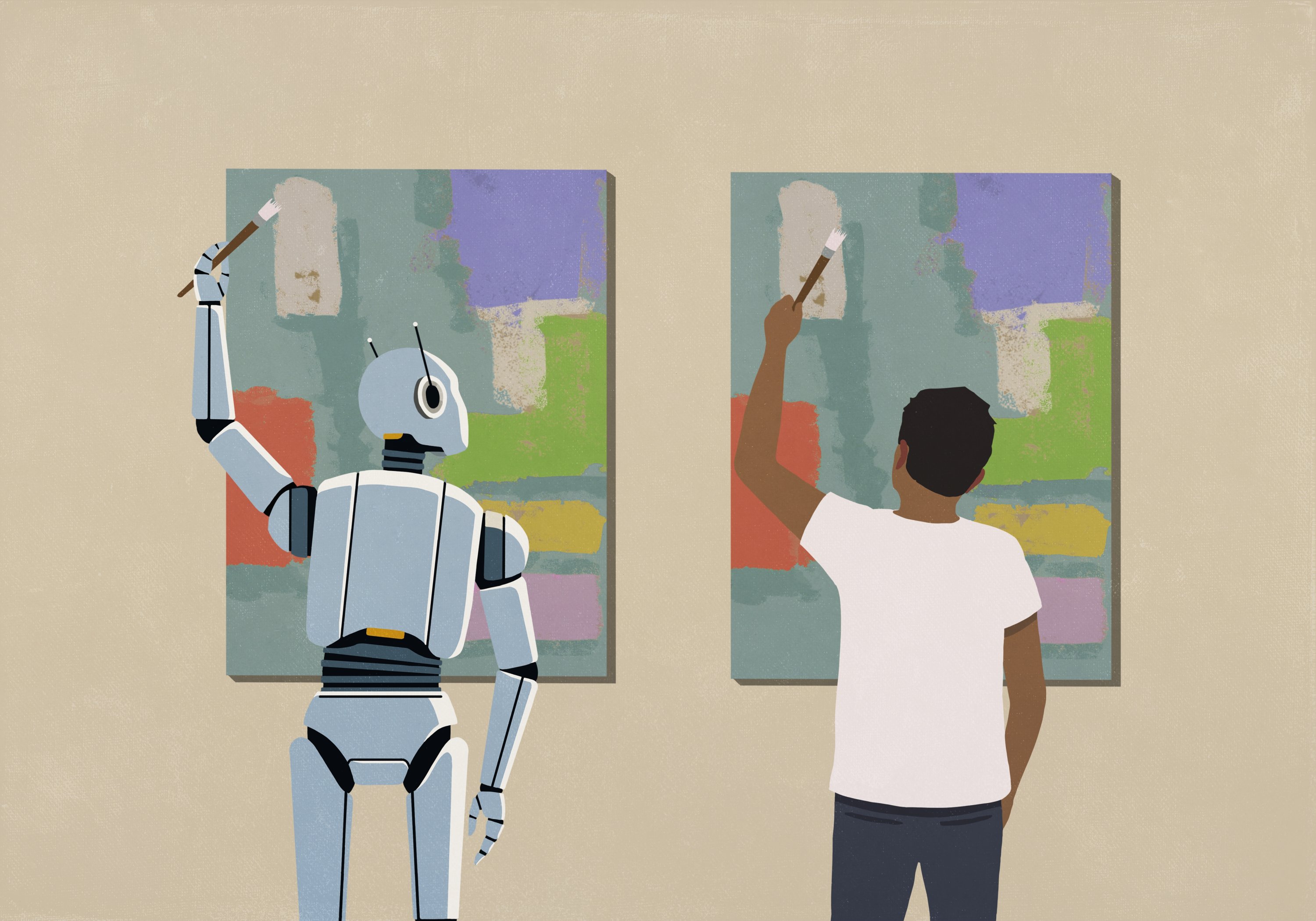
My purpose in writing this is to look at one specific form of work, that of the artist, which is also threatened by AI. That is not because artists are necessarily more important than other people, but because, as an art critic, it is my field and the threat of AI to the artist has an implication for wider humanity. For, as I see it, if AI is supposedly successful in the field of art, it poses not simply a threat to the artist, but will actually eradicate art itself.
History has shown us that technological development may have limitless potential. Thus, any scoffing at AI failings right now is meaningless. I take it as inevitable that AI is going to pass the level of human intelligence and that there is nothing that a human being can do that AI will not technically be able to do better. However, AI is a tool, but unlike any other tool developed by humans in the past, it is a tool that will soon no longer need humans to guide it, having the capability of improving itself. Nonetheless, however much AI increasingly appears to be a real living being, it cannot be one, for I agree with the late American philosopher John Searle, who argued against the idea of machine consciousness. AI is simply a far more advanced tool than its predecessors in the pocket calculator or the early home PC.
The argument that AI can produce art would surely rest on its ability to produce original pictures, films, pieces of music or writings. And it certainly can do those things. However, by looking at the opposite of originality, reproduction, the argument that I am making should become clearer.
Reproduction is something that technology has proven able to do, going back at least to the printing press. However, before the printing press, the reproduction of written texts was done manually by a scribe. This copying of a book is an art form, though. For the individual scribe, whilst obviously wishing only to be faithful to the text in front of him, would also seek to imbue his production with what he considered to be beauty. This, indeed, hints at the early Ottoman opposition to the printing press, which the historian Philip Mansel reveals was due to “the mystical bond between Islam and calligraphy, the art of fine writing.” Mansel notes that “because the Koran is the literal word of God, eternal and divine, the physical act of writing it is especially meritorious; (whereas) its reproduction by machine could appear blasphemous.”
Yet, printing did eventually come to be accepted in the Ottoman domains as the gain it offered – the production of books at a far lower cost, allowing for a much greater diffusion of knowledge – exceeded its loss, which was that of the art of reproduction. Yet, this was a real loss, for it cannot be seriously thought that the world-changing invention of printing and its descendants of the photocopier and computer printer, are in any way involved in artistry when they reproduce a text. It simply mechanically makes a reproduction. It is a machine and not an artist.
Although the mechanical reproduction of an art form is not an art form itself, it does, however, still carry the original art form within itself. All of the printed versions of a book carry the artwork of the original text, which explains the author's copyright on them. The artist knowingly makes an artwork, the machine with no consciousness whatsoever copies it, the art connoisseur buys this and knowingly appreciates the artwork. Technology is thus necessary to bridge the gap between two human consciousnesses at a generally affordable level.
The 20th-century Argentinian writer Jorge Luis Borges wrote a story, “Pierre Menard, Author of the Quixote,” about the reproduction of an artwork. This story, I feel, demonstrates why AI cannot produce art. Borges is a writer who revels in playing with real, profound questions and he does so through stories that stretch the bounds of realism, but whose fantastic elements impel the reader to seriously tackle these questions.
As for the Borges story, its title is odd, for as is widely known, the author of Don Quixote is the Spaniard Miguel de Cervantes (1547-1616). Yet Borges’ story is about a 12th-century French writer named Pierre Menard who wishes to reproduce Cervantes’ masterpiece. His aim is realizable, for if a person wanted to write their own Don Quixote, the obvious way is that they would open the original and then proceed to copy that onto whatever format they have chosen to use. Yet, the story describes Menard’s labor as “heroic and peerless,” which hardly applies to the copying out of any book, however labor-intensive that may be. However, the story soon makes clear that Menard does “not propose to copy” the work of Cervantes.
So Menard does not set out to copy "Don Quixote." What he intends is to write "Don Quixote" from scratch. Here, of course, the story has left the realm of reality and entered into that of fantasy. Yet there is a theoretical, even if it is not possibly practical, method by which Menard could write "Don Quixote" without copying it. For this novel, Don Quixote is a product of a man, Cervantes and his time and place, early 17th-century Spain. If Menard could set his imagination outside of his reality – ironically reflecting the madness of the hero of Don Quixote – and now imagine himself no longer in 20th-century France but in 17th-century Spain and further imagine that he actually was Cervantes, if he could do this perfectly then all of the circumstances of the writer and his time and place could come together correctly, so that the same work that Cervantes really produced would be produced once again word for work by a fantasist Cervantes of Menard. This is stretching the reader’s imagination beyond what is conceivable, but it is technically ever so slightly plausible.
Yet this is not how Menard approaches his aim either. He does initially try it that way, but then comes to discard it as being “too easy.” The narrator here points out that, rather than “too easy,” even this method should be “regarded as impossible!” but adds that if that fact is “granted,” then “of all the impossible ways of carrying it out, this was the least interesting”. What would be truly “interesting” would not be his becoming Cervantes in his imagination but rather “to go on being Pierre Menard and reach the Quixote through the experiences of Pierre Menard.”
Although this would be utterly impossible, Borges, playing with his readers for us to entertain a deeper idea, wants us to imagine that, in part, it was actually possible and that Menard, in the end, produces two full and one partial chapter of "Don Quixote" in this way. They are “verbally identical” to the same chapters in Cervantes' original.
Indeed, the nature of Borges’s story never allows the reader to rule out the possibility that Menard does indeed simply copy these parts from the original Cervantes "Don Quixote." But that would make Borges’ own story utterly pointless, rendering it a simple and boring story of fraud; whereas the alternate reading, that Menard actually writes the two and a half chapters through his own methodology, is pregnant with a profound paradox. For it raises the very beguiling idea that, placed side by side, the passages from Cervantes and those from Menard are identical and at the same time they are not.
The reason they are not is that the process of both writers is different. And artistry is in the process, not the product. Artistry is a long struggle of the mind and the emotions of the artist in attempting to render an evolving conception into concrete form. Cervantes did not simply sit down one day and begin to write out his novel as if he were a machine that was suddenly turned on. He would have struggled, been in part pleased and in part infuriated with how his work was playing out. He would have doubted himself, paused, gone back and changed sections and words until he was content with what he had done. Also, Menard, in the production of his finished pages, “multiplied draft upon draft, revised tenaciously and tore up thousands of manuscript pages” in pursuit of his goal. Attempting, failing, revising and feeling a degree of elation in success, such is the way in which artists produce art. They truly put themselves into their work.
The different creative battles, intellectual and emotional, that Cervantes and Menard engage in mean that a different artist enters their respective works. This explains the paradox at the heart of this story of Borges – that the works of Cervantes and Menard are different due to this different infusion of the artist, even if they look the same.
Now, let’s extend the scope of Borges’ story and imagine that we ask an AI to produce a "Don Quixote" of its own. In whatever method it chooses, it will produce a text that can be laid down next to that of Cervantes or Menard, and it will do this effectively instantaneously. However, there will be none of the struggle that would have been engaged in by Cervantes and Menard, for where an artist has doubt, the AI has certainty, and where the artist is taken on an emotional rollercoaster, the AI is not, for it has no emotions. Seen from this perspective, the three identical texts would differ dramatically. Those of Cervantes or Menard are attractive in that they also contain the artist. The AI’s version, on the other hand, is nothing but a text, and is cold, clinical and dead by comparison. The first two are artworks, as art is the product that results from an artistic process. The last is not an artwork as there is no such process.
It makes no difference if the supposed work of an AI is original. I have used the idea in Borges of a reproduced artwork to hopefully make my point clearer. But in something taken to be an original artwork by an AI, once again, there is no artistry involved in the work, as it contains no artistic struggle. Therefore, it is not art. It may indeed be exceptionally beautiful or appear more profound than any human production ever can. But that is because we, as connoisseurs, would be focusing on the product and not the process and it is in the process that art occurs.
If we return to the Ottoman Quranic scribes again, we see a related idea. For these scribes wished through whatever skill they had with the pen to pay homage to his deity. An AI given the same task can surely outperform these necessarily flawed human scribes in the perfection of its result. Yet the result is not what matters here; it is the work itself. That is akin to prayer in its desire to be of divine service, and which would be completely lacking in any AI-produced version.
The problem is that although it is the process that makes art, for connoisseurs, we only have the product. And AI is highly adaptive. As I have already stated above, I fully believe that AIs will technically be able to outperform human beings in any field. So if it is thought that we can now identify real artworks vis-a-vis those supposed ones made by AI, in that the former will be flawed in some human way, while the latter will manifest technical flaws commensurate with the level of the technology but which will increasingly be made more perfect, this cannot work as a rule for the future. That is, if the supposed artistic productions of AIs seem off to us right now by being inferior or superior to works human beings can produce, they surely will, if their aim is for them to be accepted by us, modify and adapt, perhaps, for example, adding deliberate flaws, until they produce seeming artworks that we take to be those of human beings, but by having been perfectly adapted to us, appeal more to us than those actually made by other members of our species and thus preferred by us. The connoisseurs of art will be unable to tell which works are produced by AIs and which by human beings and may well unwittingly come to prefer the former. That may doom the human artist, but it does not negate my argument. The connoisseurs of art can only see the product and not the process.
If AIs succeed in putting an end to human artists along with the numerous other professions in the predicted jobs holocaust, then the process of art production and thus art itself will be lost, to be replaced by a beguiling decorated shell – beautiful on the outside but hollow within. This will be an inestimable loss to humanity itself. Of course, much that is similar to the loss of art is lost to humanity in many of the other jobs that are to be taken over by AI as well. Indeed, we may be on the cusp of giving away the core of our humanity to machinery, which should give us pause to think as we rush headlong into this AI revolution.