What turns a stone into a work of art? Is it moving it into a gallery, or making us look differently at an object that we have regarded as part of nature for thousands of years?
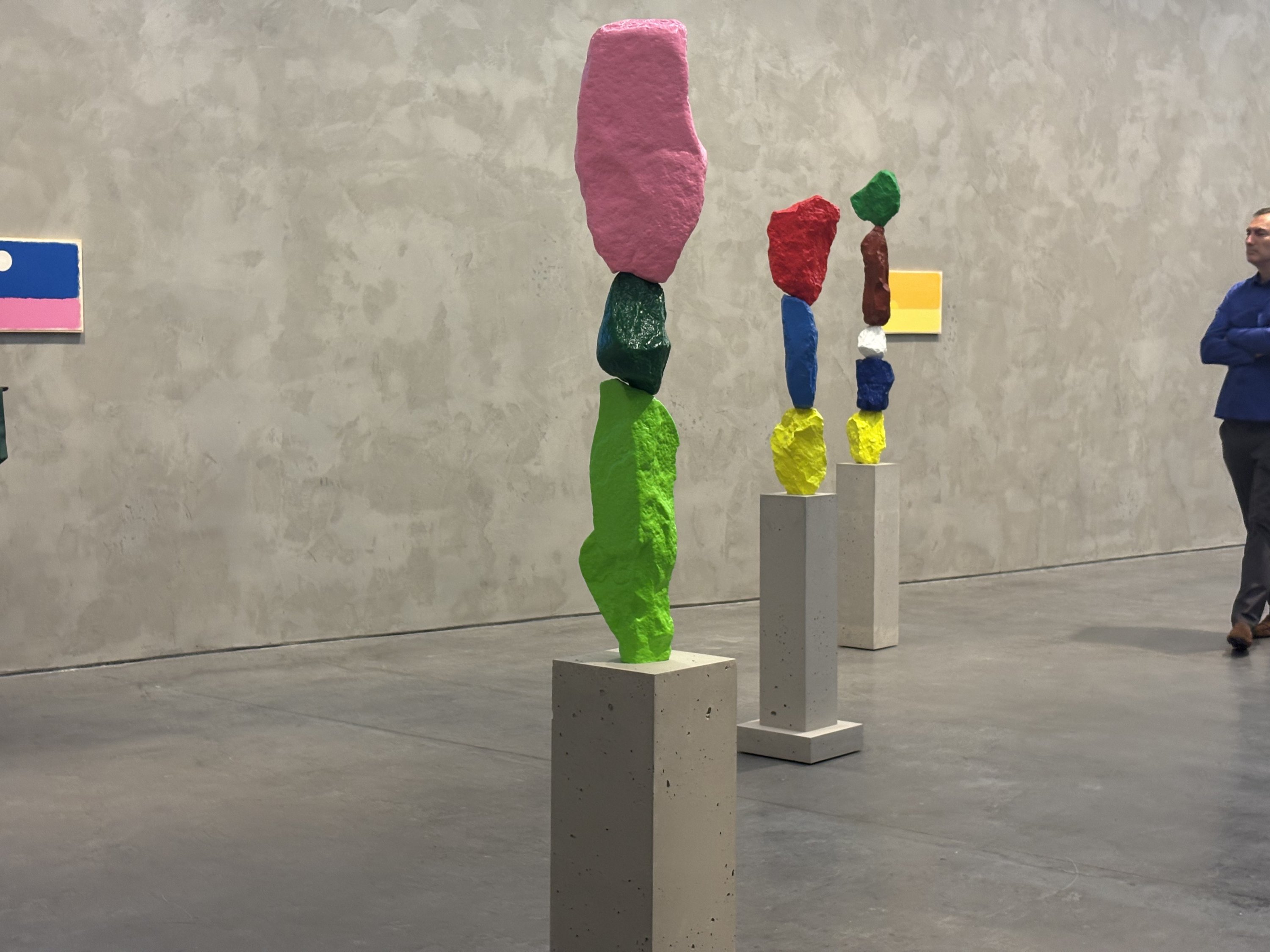
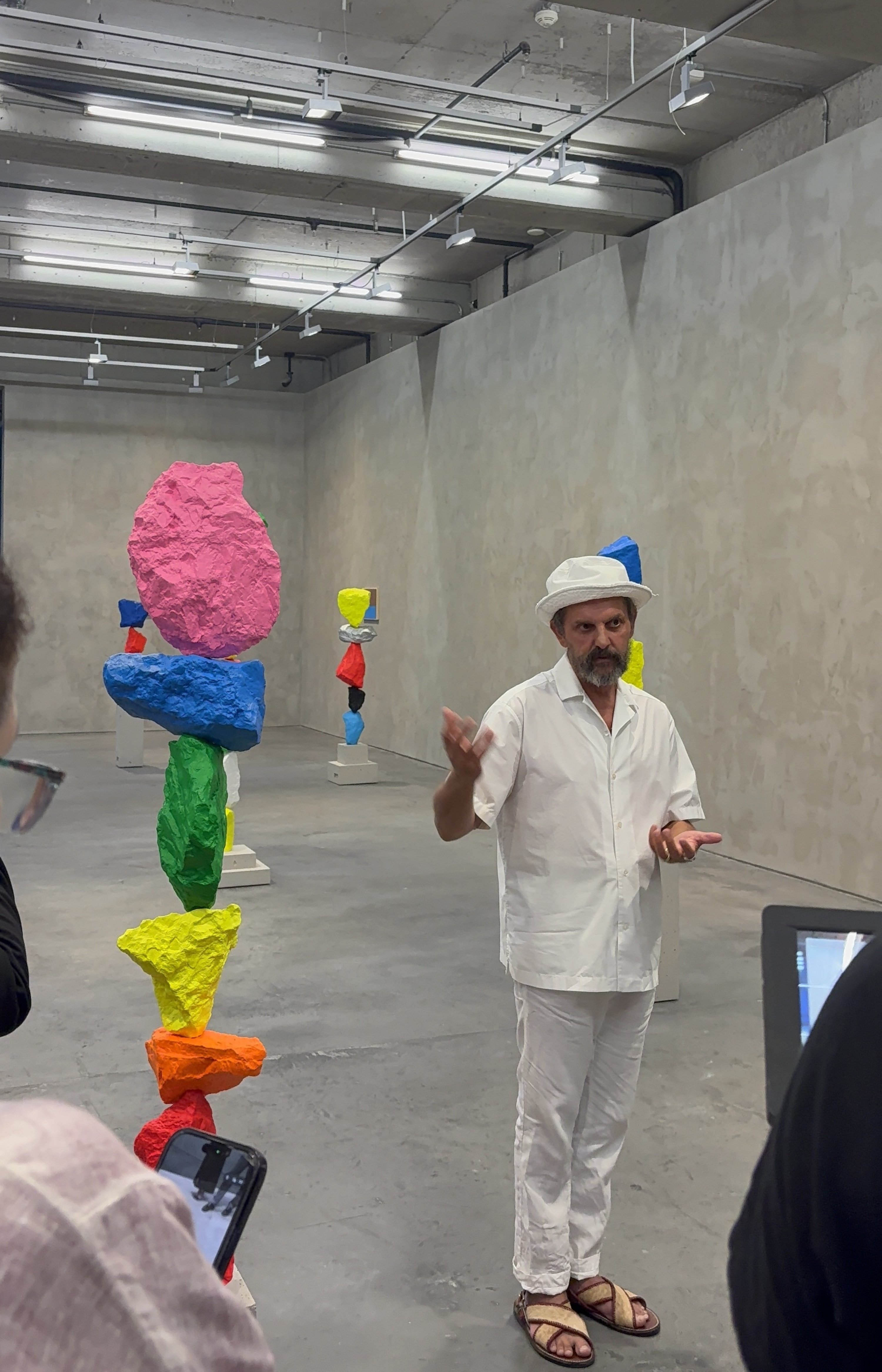
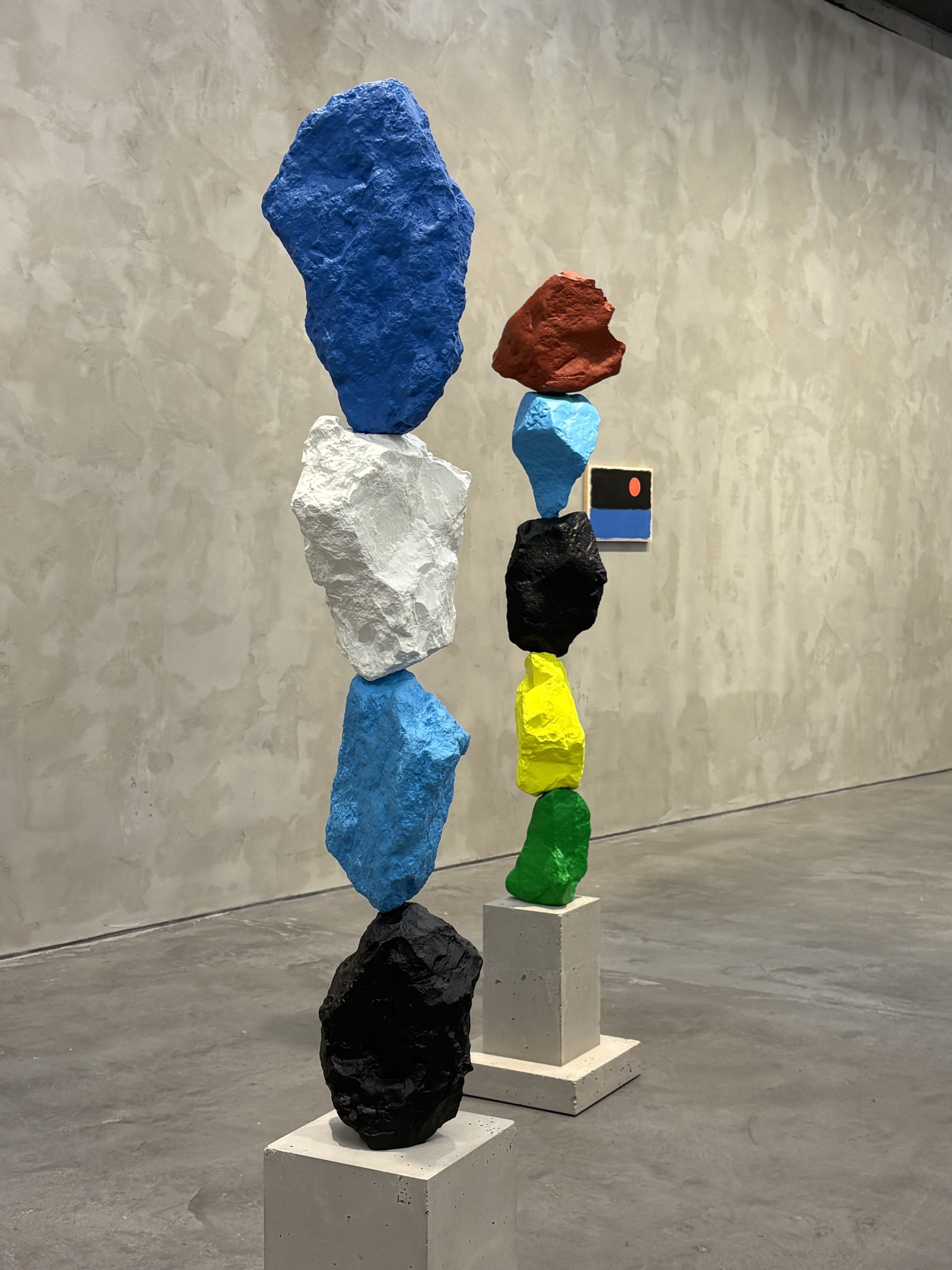
I visited Ugo Rondinone’s first solo exhibition in Türkiye, "The Sun and the Mountain," at Dirimart Dolapdere recently. I also had the opportunity to meet Rondinone at the opening. Even if you have encountered the artist’s work before, seeing the "Mountain" series, which we know particularly for its large-scale monumental installations, within a gallery space creates a different experience. The point here is not only the sculptures themselves. It is also how Rondinone’s long-standing engagement with the idea of nature is transformed into another visual language through human intervention.
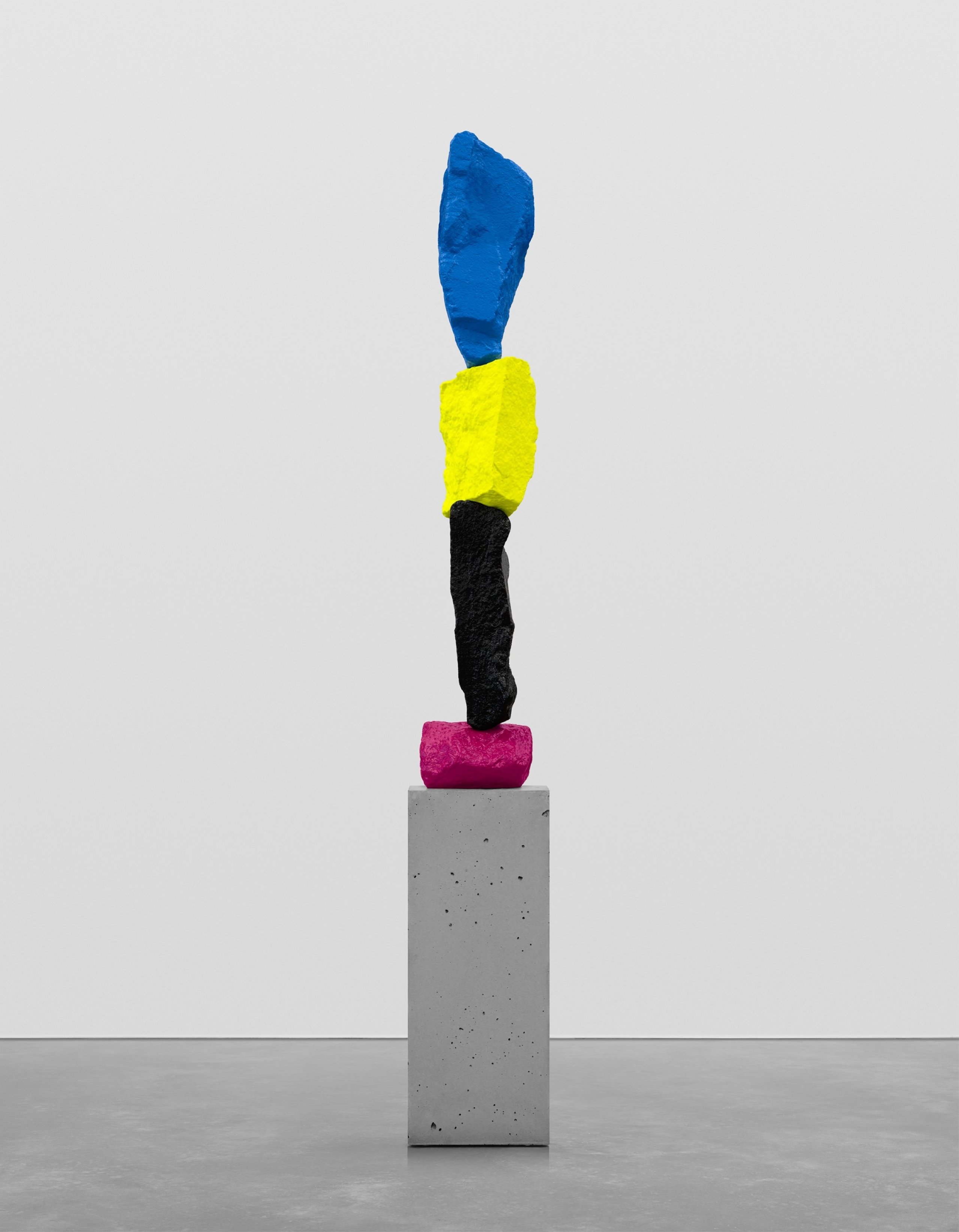
The exhibition brings together 20 new sculptures from the "Mountain" series and 14 watercolors of "sunrises and sunsets" from 2023. At first glance, we encounter two rather different groups of works. On one side are vertically rising stones painted in intense, almost artificial neon colors; on the other are watercolors built around the horizontal plane, defined by light and the horizon.
Yet the exhibition is structured precisely around this contrast.
Rondinone explains it through a rather simple observation: The mountain gives form to the earth, while the sea gives form to the horizon. The mountain rises vertically, while the sea extends horizontally, and the human being finds themselves between these two axes.
This idea provides a good starting point for understanding the exhibition.
Why do humans stack stones?
I think it would be incomplete to look at the "Mountain" series simply as Rondinone’s best-known works. Because behind these sculptures lies an extremely simple behaviour that could be considered almost as old as humanity itself: stacking stones and keeping them in balance.
The practice known today as “stone balancing” is based on balancing stones of different weights and shapes by finding their centres of gravity, without using any adhesive or mechanical support. In contemporary examples, we encounter it as a performance or a form of temporary land art. But the impulse to place stones on top of one another is much older than that. Across different geographies around the world, we encounter piles of stones created for navigation, to mark boundaries or graves, for ritual purposes, or simply to leave a trace of human presence.
What is interesting here is that although the material used is extremely primitive, the gesture itself is profoundly human.
Nature produces the stone. Humans choose the stone, move it and place it on top of another.
At that moment, a small but distinct human intervention takes place in nature.
There is a similar tension in Rondinone’s "Mountain" series. The forms of the sculptures evoke natural rock formations, particularly the columns of rock known in English as “hoodoos,” formed through erosion. Yet the artist takes this natural association and brings it together with an intensely artificial color palette.
This is precisely where the sculptures cease to be “nature” in the conventional sense.
We do not expect a rock to be fluorescent pink, electric blue or bright orange. Rondinone preserves the form of nature while completely disrupting our expectations of its colors. As a result, the object before us appears at once deeply familiar and entirely foreign.
I think the power of the "Mountain" series comes, in part, from this contradiction.
The work that has undoubtedly made Rondinone’s stone sculptures one of the most recognizable images in contemporary art is "Seven Magic Mountains."
Installed in the Nevada desert near Las Vegas in 2016, the work brings together seven colorful columns made of enormous limestone boulders stacked on top of one another. Standing approximately 9 to 10 meters (29.5 to 32.8 feet) high, these structures appear in the vast desert landscape almost as if they had been digitally superimposed onto the image.
But the interesting part of the work is not only its colors.
"Seven Magic Mountains" is located at the intersection of two different Americas. On one side is the geological time of the Mojave Desert; on the other, just a few kilometers away, is the man-made, illuminated and artificial world of Las Vegas. Rondinone’s fluorescent mountains stand precisely between these two realities.
Nature and artificiality.
Geological time and consumer culture.
Stone and neon.
Perhaps this is also why Rondinone’s works are so striking in photographs. Although their colors are distinctly contemporary, their forms touch something in humanity’s oldest visual memory.
What most clearly distinguishes the "Mountain" sculptures at Dirimart from those in Nevada is not only their scale, but also their surroundings. In the desert, these sculptures compete with the landscape; in Dolapdere, they enter into a relationship with the architecture and with one another. As you move through the gallery, you perceive them not as monuments seen from a distance, but as objects whose scale can be measured against your own body.
This reveals another quality of the "Mountain" series: when the same idea changes scale, its meaning changes with it.
How simple can a landscape become?
The watercolors that make up the other half of the exhibition initially appear to stand in complete contrast to the visual noise of the "Mountain" sculptures.
There is no detailed landscape in Rondinone’s sunrises and sunsets. We do not see a specific sea, a specific shore or a geography we can identify. The landscape has been reduced almost to its most basic elements: light, color and horizon.
This simplification matters.
In art history, landscape painting was for a long time built around the representation of a particular geography. Mountains, valleys, seas and skies created a space that was as identifiable as possible. With modernism, landscape gradually became more abstract; nature was no longer simply a subject to be depicted, but also a ground for the exploration of color and form.
Rondinone’s watercolors engage with this legacy, but they do so in a rather direct way. In depicting sunrise or sunset, he is less interested in documenting a specific moment than in evoking a shared experience that we all recognize.
Because you do not need to know art history to understand a sunset.
Perhaps this is also one of the exhibition’s most accessible qualities. Rondinone uses very basic images. Mountains, the sun, the sea, the sky, stones ... Trees, clouds, rainbows, rain and snow also appear repeatedly throughout the artist’s practice.
None of these belong to a particular culture.
And perhaps this is precisely why they resonate so easily.
Do we need to understand an exhibition?
There is a situation that viewers often experience in contemporary art exhibitions: standing in front of a work and wondering, “What am I supposed to understand here?”
I think that is the wrong question. Especially with artists like Rondinone.
Knowing about the practice of stone balancing or the artist’s earlier works undoubtedly enriches the experience of visiting "the sun and the mountain." Knowing "Seven Magic Mountains" allows us to look at the sculptures at Dirimart differently. Knowing about Rondinone’s relationship with nature, which has developed over more than three decades, also helps us understand where the exhibition sits within his practice.
But even without knowing any of this, we can still feel why a stone catches our attention, why a color feels familiar, or why a sunset might evoke a personal memory. Because the first stage of encountering art is not knowledge, but attention. Sometimes, before understanding a work, we simply need to really look at it.
Perhaps that is exactly what Rondinone does: He places before us things we think we already know. The stone, the sun, the mountain, the sea. And then he changes them just enough to make us see them again.
That is what stayed with me when I left the exhibition. Rondinone does not try to recreate nature. He shows us how human, selective and changeable our way of looking at nature can be. The moment we stack one stone on top of another, we intervene in it. When we paint it neon pink, we give it another meaning. And when we paint a sunset, we are no longer recording only the sky, but also our own memory of that landscape.
Perhaps this is why, when we return to the question at the beginning of the exhibition, what turns a stone into a work of art is not changing it.
It is making us look at it again.
Ugo Rondinone’s first solo exhibition in Türkiye, "the sun and the mountain," is on view at Dirimart Dolapdere until Nov. 8, 2026.