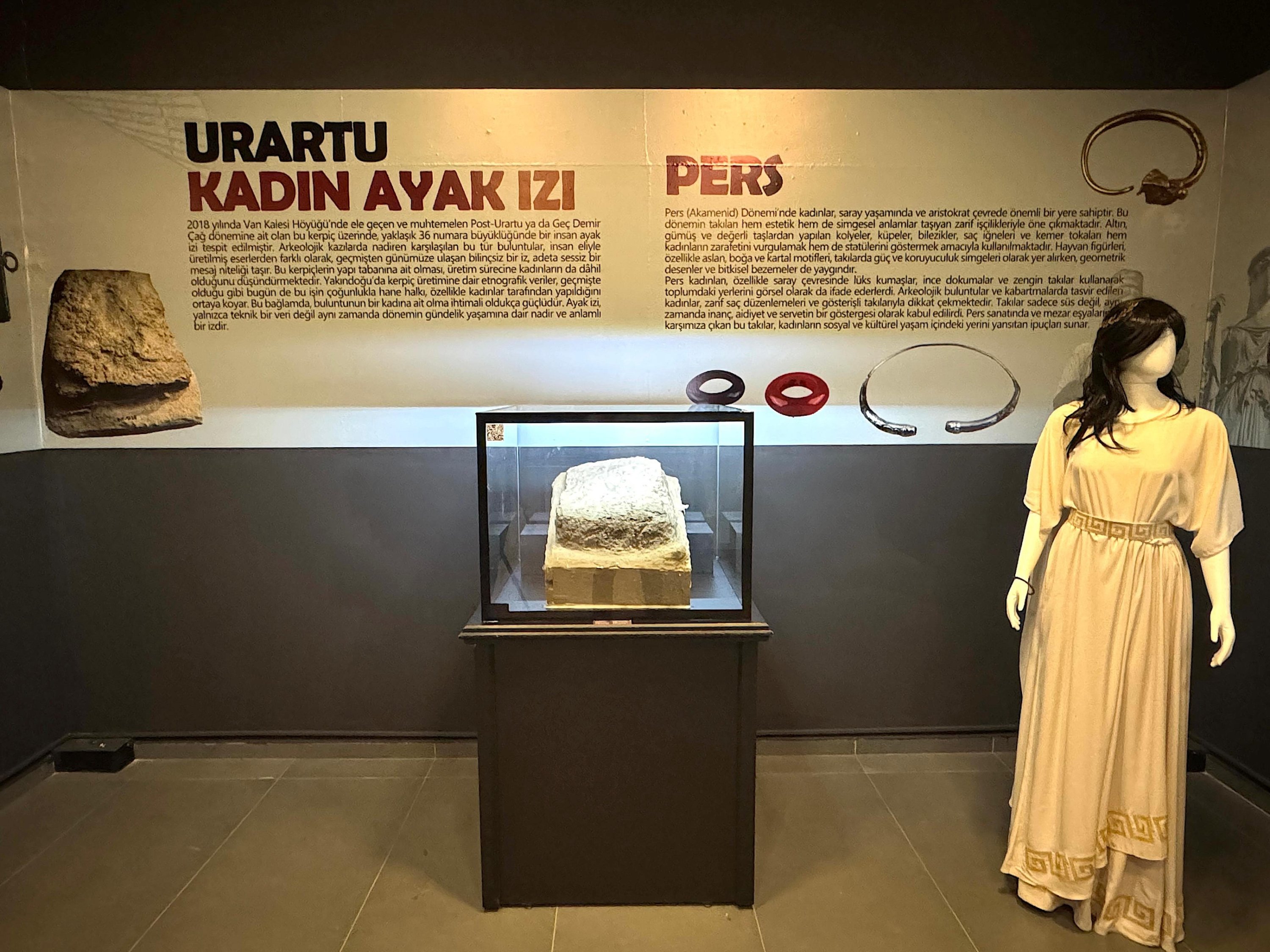
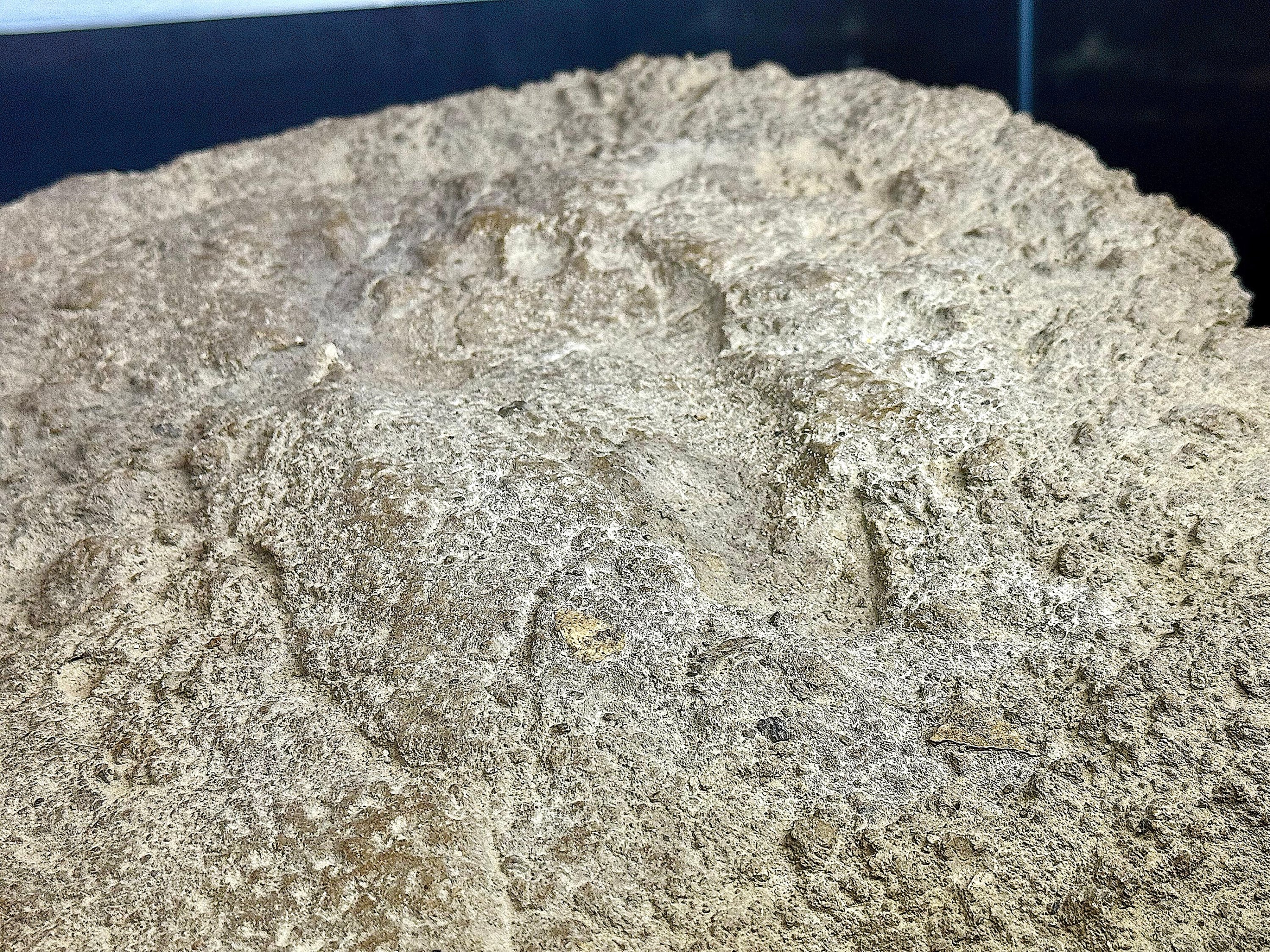
A remarkable artifact discovered during excavations at the mound located north of Van Castle – a footprint believed to belong to an Urartian woman – is now on display for the first time at the Van Museum in eastern Türkiye.
The exhibition is part of the "100+2 Temporary Museum Exhibitions" project, marking the 102nd anniversary of the republic and the declaration of 2025 as the "Year of the Family" in Türkiye.
The footprint was uncovered during archaeological excavations led by professor Erkan Konyar from the Department of History at Istanbul University’s Faculty of Letters. The dig took place in 2018 at a settlement mound formed over time as ancient habitation layers accumulated and were eventually covered by soil. After being carefully molded and removed from its original location, the footprint was placed under protection.
Anthropological analysis has dated the footprint to between the ninth and sixth centuries B.C., confirming it belonged to a woman with an estimated foot size of EU 36.
Having remained in storage for conservation for several years, the footprint is now being publicly exhibited as part of the museum’s special themed show "From Urartu to the Present: Woman," open between July 12 and Aug. 31. The exhibit is attracting considerable attention from visitors.
Van Museum Director Bülent Demir stated that the exhibition emphasizes the foundational role of women in family and society, aligning with the overarching theme of the 100+2 project.
“President Recep Tayyip Erdoğan declared 2025 the ‘Year of the Family,’ and within this context, events and projects have been launched nationwide to protect and strengthen the family structure. As part of these efforts, the Ministry of Culture and Tourism initiated the ‘100+2 Temporary Museum Exhibitions’ project to mark the 102nd year of the republic,” Demir explained.
“Our exhibition merges traditional values with a contemporary curatorial approach, presenting the unique cultural richness of Anatolia. This project is a key initiative that aims to carry our cultural heritage from the past into the future,” he added.
Demir emphasized that the Urartian woman’s footprint is the centerpiece of the exhibition.
“At Van Museum, we have opened a new exhibition titled ‘From Urartu to the Present: Woman,’ as part of the project. The footprint, imprinted on mudbrick, is among the most striking artifacts on display and is being shown to the public for the first time. It was unearthed in 2018 during excavations at the Van Castle mound under the supervision of Konyar, with the permission of the ministry’s Directorate General of Cultural Heritage and Museums.”
Demir described the footprint as both scientifically and symbolically significant. Estimated to be from the post-Urartian or Late Iron Age, the print offers insight into the role of women in daily life.
“The fact that this footprint was found on a mudbrick surface suggests that women played an active role in construction and flooring during that era,” Demir noted. “Ethnographic studies show that, both in the past and today, mudbrick production was largely carried out by household members – particularly women.”
“This footprint is not merely a technical artifact – it is a silent witness to everyday life, labor and the presence of women thousands of years ago. As we exhibit it today, we are not simply displaying a piece of mudbrick, but honoring the unseen figures of history – women, their labor and their lives.”
Müjde Şen Ünal, a visitor from Samsun, said she was on a cultural tour of eastern Anatolia with her family and was deeply moved by the exhibition.
“From the earliest times, the role of women has been essential. What we see here is the effort of a woman; just as women once built homes from mudbrick, they continue their labor today. Women bring beauty to everything they touch. I’ve visited many museums, but I’ve never seen anything like this before. Finding and displaying a woman’s footprint is extraordinary. This has become an unforgettable part of our trip.”
Another visitor, Murat Öz from Tokat, expressed his admiration for both the museum and the artifact: “I came here all the way from the Black Sea because I was so curious about Van. The museum is truly impressive and presents the Urartian period beautifully. It’s a place that will surely draw tourists. You can really feel how ancient the civilizations in Anatolia were. The footprint is incredible; you can clearly see it belongs to a woman. It’s a very powerful piece.”