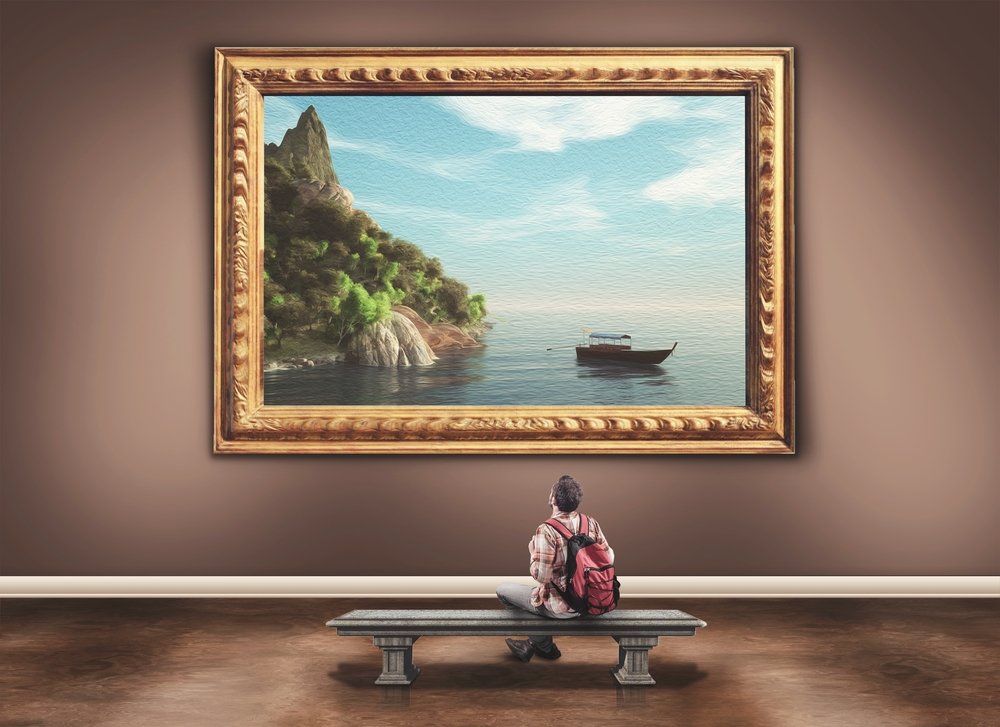
There are journeys we take with a suitcase and others we take with a soul. For me, art and travel have never been separate paths; they have always been one continuous pilgrimage. Each canvas I paint, each exhibition I open in a foreign land, feels like stepping into another geography of the heart, a borderless realm where color becomes language and the brush becomes a passport.
I have often said that peace must be declared the way nations declare war. If war can be announced, why not peace? This belief became the seed of my long-term project, “I Declare Peace,” which began in Türkiye and now travels from city to city like a luminous bird carrying messages of empathy, hope and unity. With each exhibition, from New York to Doha, from Istanbul to Miami, I feel I am both the messenger and the message, an artist who paints not only images, but possibilities.
Travel changes the artist’s eye more than any school ever could. The light in each country has a different temperature, a different rhythm and you begin to understand that painting is not merely about what you see, but how you see. When I first exhibited at the Turkish House in New York, I felt the energy of a metropolis that never sleeps. The light there is electric sharp, vertical, urgent. It makes colors vibrate in a different frequency. The canvases I created after that were filled with confident lines, almost architectural in spirit, like the skyline itself.
Then came Doha where the desert light has a softness no photograph can capture. Gold and beige dance in the air. You start painting not what’s visible, but what glows between things: silence, dignity, horizon. In Qatar, I also began to think of myself as a cultural bridge, someone who translates emotions across languages.
Now, as I prepare for my sixth solo exhibition in Miami, I realize Florida’s light will bring yet another metamorphosis. Miami is humidity and neon, ocean and rhythm, a city where the tropics meet contemporary art. My works will hang there like messages in bottles, washed ashore from distant continents.
The world keeps shaping me, and in return, I try to shape the world back gently, with pigment and intention.
The artist’s journey has always been intertwined with geography. Long before digital media flattened distances, painters were travelers, messengers and interpreters of civilization. During the Renaissance, they crossed borders in search of patronage, but also enlightenment. When Leonardo da Vinci moved from Florence to France to serve Francis I, he carried the spirit of an entire era in his sketches. His journey was not only physical, it was civilizational.
The same happened centuries later with Eugene Delacroix, whose 1832 voyage to Morocco transformed Western art. He came searching for exoticism, but he found something purer: a new way of seeing light. His reds became warmer, his brush looser, his soul freer. Every painting he made afterward carried the hum of desert wind.
For artists like Osman Hamdi Bey, travel was not only inspiration but diplomacy. As a painter, archaeologist and cultural ambassador of the Ottoman Empire, he turned observation into understanding. His “Tortoise Trainer” is still, to me, one of the most eloquent metaphors for patience and reform, a man guiding change, not by command, but by example. He showed that art could be both introspective and international. In truth, every artist is a kind of ambassador. We carry no flags, but we represent something deeper: our capacity for empathy. Each painting exhibited abroad is a small act of diplomacy, a silent handshake between cultures.
Today, cultural diplomacy is not conducted only in embassies; it happens on canvas, in museums, at art fairs and in conversations between creators. As a Turkish artist showing my works in New York, Doha, and soon, Miami, I see myself as part of this invisible embassy – a bridge built not of concrete, but of compassion. When I stand before my paintings abroad, people often approach me not with questions about technique, but about feeling.
“What does peace look like to you?” they ask.
And I answer: “It looks different in every country but it sounds the same in every heart.”
That’s when I realize that travel is not only about moving through space; it’s about moving through understanding. The most meaningful journeys are not the ones that change our scenery, but the ones that change our gaze.
We often say artists leave a mark on the places they visit but the truth is, those places mark us first.
In New York, I learned the language of urgency. In Doha, I learned the language of stillness. In Istanbul, I live in the tension between memory and modernity – a city where past and future coexist like two lovers who never stop arguing.
Now I wonder what Miami will teach me. Perhaps movement, perhaps brightness, perhaps playfulness.
Travel doesn’t only expand our palette, it deepens our humility. You learn to paint less and feel more. You begin to notice how sky colors change at different latitudes, how people’s laughter carries differently in humid air. You start to understand that beauty is not universal, but plural – and that art’s real task is to honor this plurality without losing sincerity.
When I visit a new country, I don’t see borders; I see textures. I notice how walls are built, how windows frame light, how children draw in school. These details matter because they reveal how a society perceives its own rhythm. Every artist is, in some way, a cartographer. We map not territories but emotions. I once walked through a narrow street in Ankara and saw a pigeon perched on a traffic light. It reminded me of the “Birds of Different Feathers” series from my "I Declare Peace" project. That little bird was both local and universal, a symbol of coexistence in the middle of chaos. And I thought: Maybe this is what art diplomacy looks like, recognizing yourself in what seems foreign.
Art history is full of painters whose brushes carried the weight of travel. The Impressionists wandered across Europe, chasing light. Gauguin sailed to Tahiti, seeking purity (and confronting his own contradictions). Turner followed the fogs of Venice until they melted into abstraction. Each of them returned home transformed because travel, like art, makes us see differently. Yet what I admire most about these artists is not their exotic subjects, but their humility before the unknown. They were explorers of perception. They didn’t conquer places; they surrendered to them. Today’s artists, those of us who still travel for residencies, biennials, or exhibitions, continue this lineage. But we do so in a more connected world, where every border crossed is also a dialogue opened. To paint abroad now is to participate in a new kind of diplomacy – one made not of treaties, but of tenderness.
As I write these words, I am preparing for my sixth solo exhibition in Miami, hosted at the Moxy Hotel. Each exhibition in the I Declare Peace journey has felt like a conversation with the world. In New York, peace was intellectually debated and defined. In Doha, it was spiritual like a prayer whispered in gold. In Miami, I feel it will be kinetic, vibrant, tropical, alive.
I imagine my paintings glowing against the humid air, colors reflecting in the pool lights, people gathering not only to see art but to feel belonging. Because in a time when the world feels fragmented, I want my canvases to remind people that beauty is a form of unity.
Sometimes, I think of myself less as an artist and more as a carrier of messages, a courier of shared humanity. Maybe that’s what a cultural ambassador truly is: someone who travels not to represent a country, but to remind others that art is the country of everyone.
Pigments themselves are proof of travel, ultramarine from Afghanistan, cinnabar from Spain, ochres from Egypt. Every color carries a trace of migration. To paint, then, is to participate in the oldest global dialogue. The artist’s brush, dipped in color, becomes a tool of diplomacy – softer than speech, yet more permanent than policy.
Where politics separates, art unites.
Where borders define, art dissolves.
That is why I continue to travel not to escape, but to connect.
Every exhibition, every dialogue, every shared silence feels like adding another line to the map of empathy we’re all still drawing together.
There is a point in every artist’s life when the question changes from Where am I going? to What am I carrying?
For me, the answer is simple: I carry peace and love in color, in form, in faith. When I step onto a plane, I don’t think of departure or arrival anymore. I think of light, the one I will find, and the one I will leave behind. Because art and travel, at their essence, are not about movement; they are about becoming. And somewhere between the airport and the easel, between the gallery wall and the horizon, we discover who we truly are, citizens of color, pilgrims of peace.