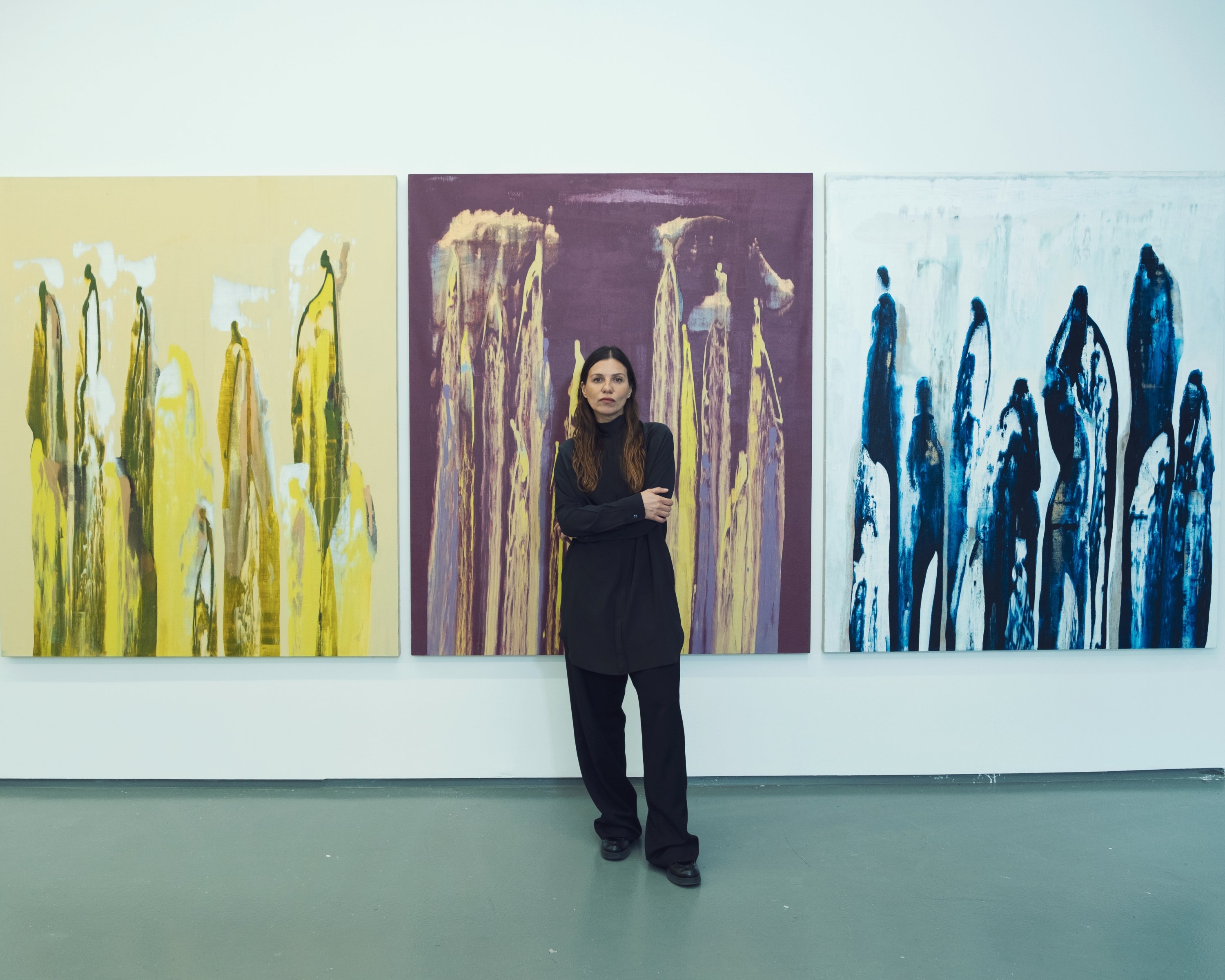
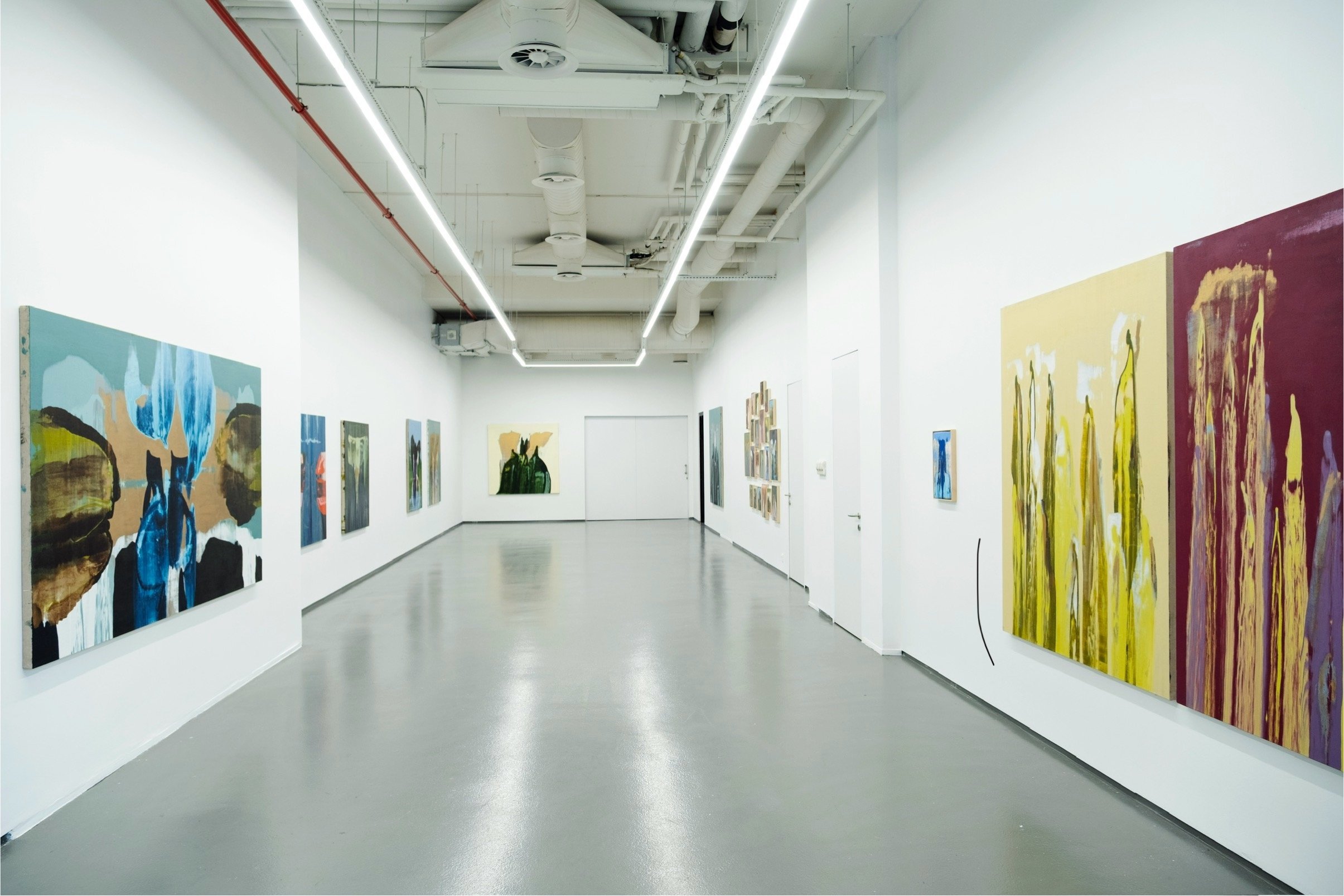
When I entered the MERKUR Gallery in Istanbul, the exhibition had already been open for a while. I was there to meet Nilüfer Yıldırım. The prospect of discussing the works in the same space with an artist whose practice I have followed with admiration was genuinely exciting. "Human Landscapes" communicates its central idea at first glance; figures, distances and surfaces immediately make this orientation visible to the viewer.
We begin walking through the gallery together. At times, we stand silently in front of a work; at others, we step back a few paces to look from a distance. This is not a question-and-answer format, but rather a conversation formed by moving among the works. It is a state that aligns with her mode of production: a way of thinking that is not fixed, not read from a single point, but constantly in motion.
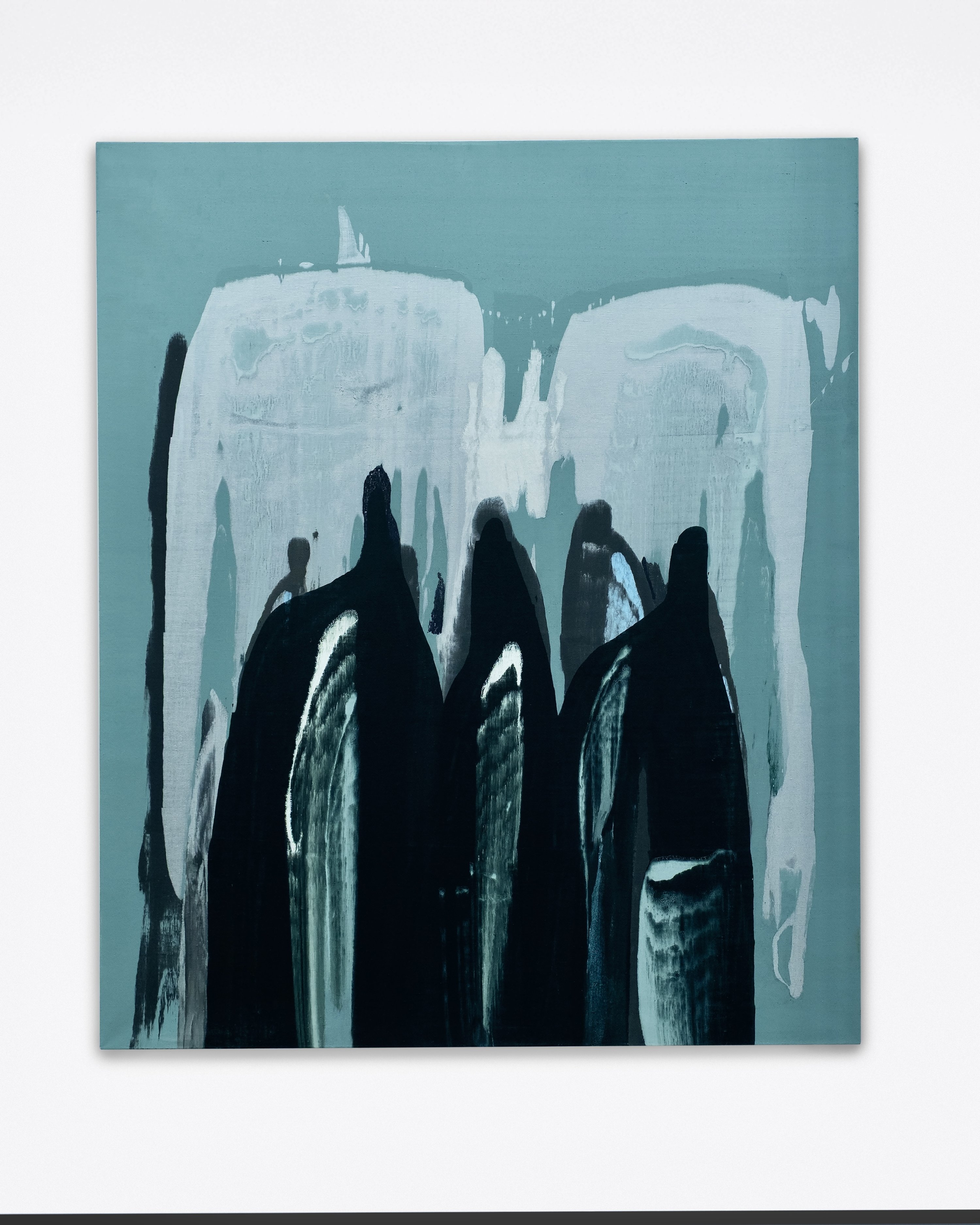
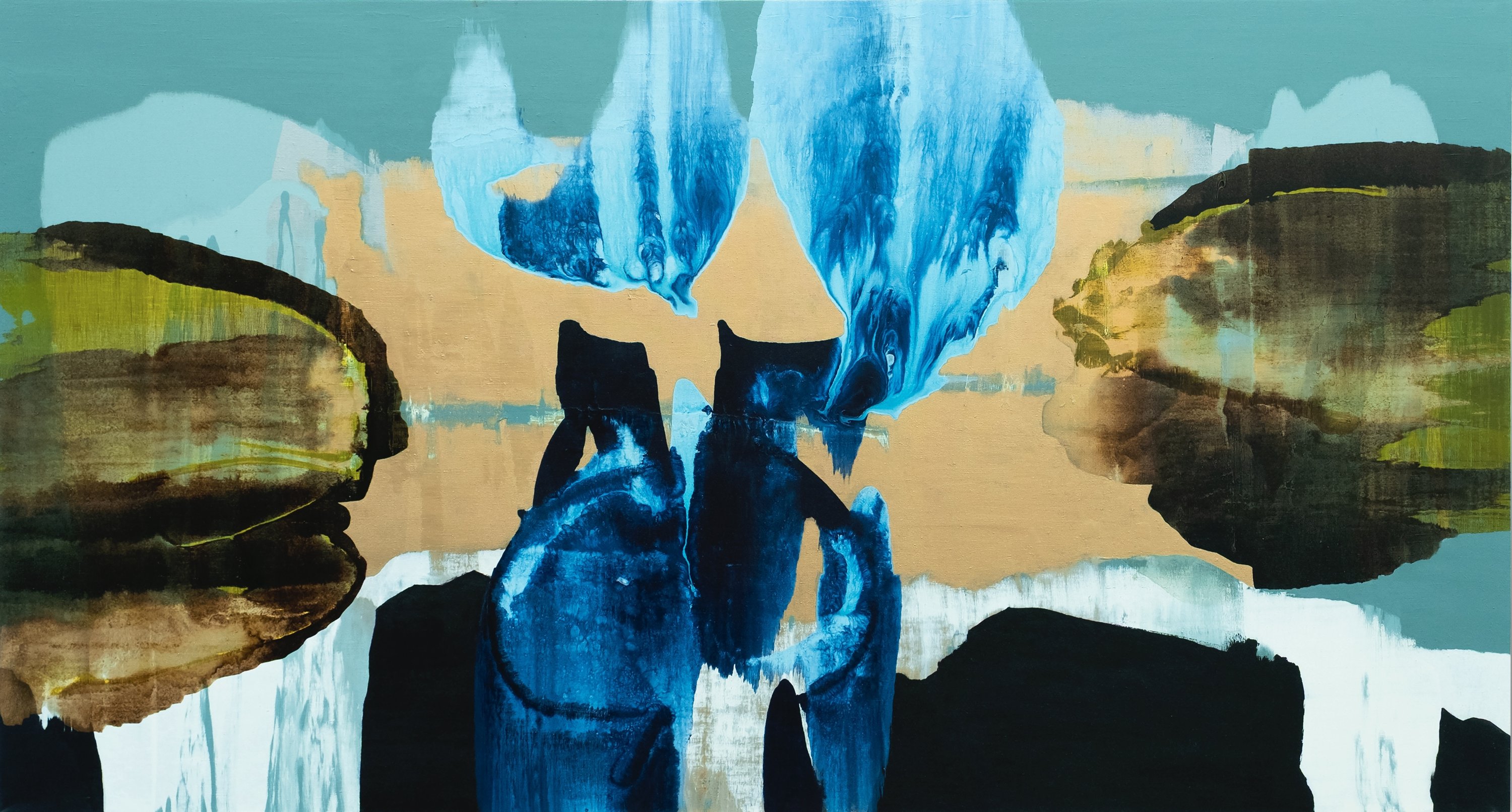
What is felt first in Nilüfer Yıldırım’s paintings is a deliberate ambiguity between figuration and abstraction. The works are neither fully figurative nor entirely abstract. There is a suggestion of the human body, yet this suggestion never settles into a clearly defined form. The figure appears less as an image to be identified than as a condition whose presence is sensed. She explains that this space is intentionally left open.“It’s impossible for someone else to see exactly what I see,” she says. “Everyone brings their own experience into the painting. I want to preserve that gap.”
This approach forms the foundation of Yıldırım’s artistic practice. Born in Istanbul in 1984, the artist now lives and works between Istanbul and Milan. Her relationship with painting begins in childhood, but it develops not through a formal academic painting education, but rather through an intuitive process unfolding over time. She studies graphic design and art history at Istituto Marangoni in Milan, a period that becomes a decisive turning point in her orientation toward painting. The encouragement of her graphic design instructor – particularly his attention to her sense of color and visual intuition – marks a significant threshold.“He really admired my sense of color harmony,” she recalls. “Hearing ‘you must paint’ was genuinely encouraging for me.”
After completing her education, she returns to Istanbul and begins working with Mustafa Horasan. This period unfolds not as a traditional master-apprentice relationship, but as a form of intellectual companionship. When speaking about this time, Nilüfer repeatedly emphasizes the idea of carving out her own path.“Classical training can sometimes close off intuition,” she says. “My way of producing is experimental. I needed to build both the technique and the path myself.”
Approximately 15 years ago, she opened her first studio in Bebek. This moment does not mark the beginning of her production, but rather the point at which her practice gains a physical space of its own. Soon after, she realizes her first solo exhibition, Roots. The title appears today as an early signal of a conceptual continuity still visible in her work: roots, belonging, points of origin and how these transform over time.
In her early works, black-and-white, ink-based figures come to the fore. These thin, fragile figures gradually multiply, layer and expand onto larger surfaces. The figure never disappears entirely; it simply changes form. The abstract figure remains a constant conceptual field within Nilüfer Yıldırım’s practice.
Her many years in New York play a decisive role in this transformation. The city’s pace, layered structure and visual density translate into a more graphic and increasingly abstract language in her work. She gains visibility through series such as "Night for Day" and "Archipelagos," presenting her work at international fairs including Scope New York and Scope Miami.
The question of material moves to the center of our conversation. For Yıldırım, material is not merely a tool; it is directly connected to the thought process itself. She works with handmade papers sourced from southern France, bamboo papers from Tokyo and inks she has carried with her from Paris for years. “Texture is very important to me. Each material speaks differently. What one gives, another cannot. That’s why experimenting never ends.”
Her practice spans a wide range: from pastel, pigment, ink, acrylic and oil, to small-scale works on paper, large canvases and collages. Layers are not concealed and previous decisions are not erased. Yıldırım does not like placing her paintings behind glass; she wants direct contact with the surface. When viewed up close, it is possible to see traces left behind within the works, shifts in direction, reversals, moments of return.
At one point, we turn to the viewer. I ask what she would want someone to see if they could step inside one of her paintings. “I’d want them to see something of themselves,” she replies. “Not my scene.”
"Human Landscapes" is shaped precisely around this idea. The exhibition focuses on human relationships, encounters and modes of coexisting. Yet it does so not by constructing clear narratives, but through emotional states and tensions. The distance between two figures, overlapping forms, separating surfaces, each work touches upon the idea of a relationship without defining it. Color plays a crucial role in this dynamic. The palette is calm yet dense. Colors are neither dominant nor recessive; they coexist. Solitude and togetherness can occupy the same surface simultaneously. Color functions less as a formal choice than as an emotional carrier.
When we talk about her studio practice, I ask how someone observing from the outside might perceive her working process. “They’d probably see a very peaceful scene, but in reality, I’m completely inside the work and I lose track of time.”
On days when she is not engaged with art, she spends time with her daughter; she visits exhibitions, goes for walks and blends into the rhythm of daily life.
"Human Landscapes" feels like a moment of clarification within Nilüfer Yıldırım’s practice. The exhibition reveals where her long-standing engagement with abstraction and figuration currently stands. It is a stance marked by quiet confidence.
Opened at MERKUR Gallery on Nov. 15 and extended through Jan. 10, 2026, "Human Landscapes" makes visible one of the clearest and most mature articulations of the language Nilüfer Yıldırım has built to date.
Following this exhibition, the artist is preparing for a solo presentation with MERKUR Gallery at Miart – the International Modern and Contemporary Art Fair in Milan – this coming April. As the only Turkish gallery participating, this presentation stands as a natural continuation of the production line Yıldırım has established between Istanbul, Milan and New York over the years.
As I leave the gallery, what stays with me is a sense of having encountered this exhibition at the right moment and in the right place. Getting to know Nilüfer Yıldırım not only through her works but also through her way of producing deepens the impact the exhibition leaves behind. "Human Landscapes" is not a show to be passed through quickly; it demands attention, time and repeated looking. For this reason, it stands out as a destination that deserves not just to be seen, but truly observed.