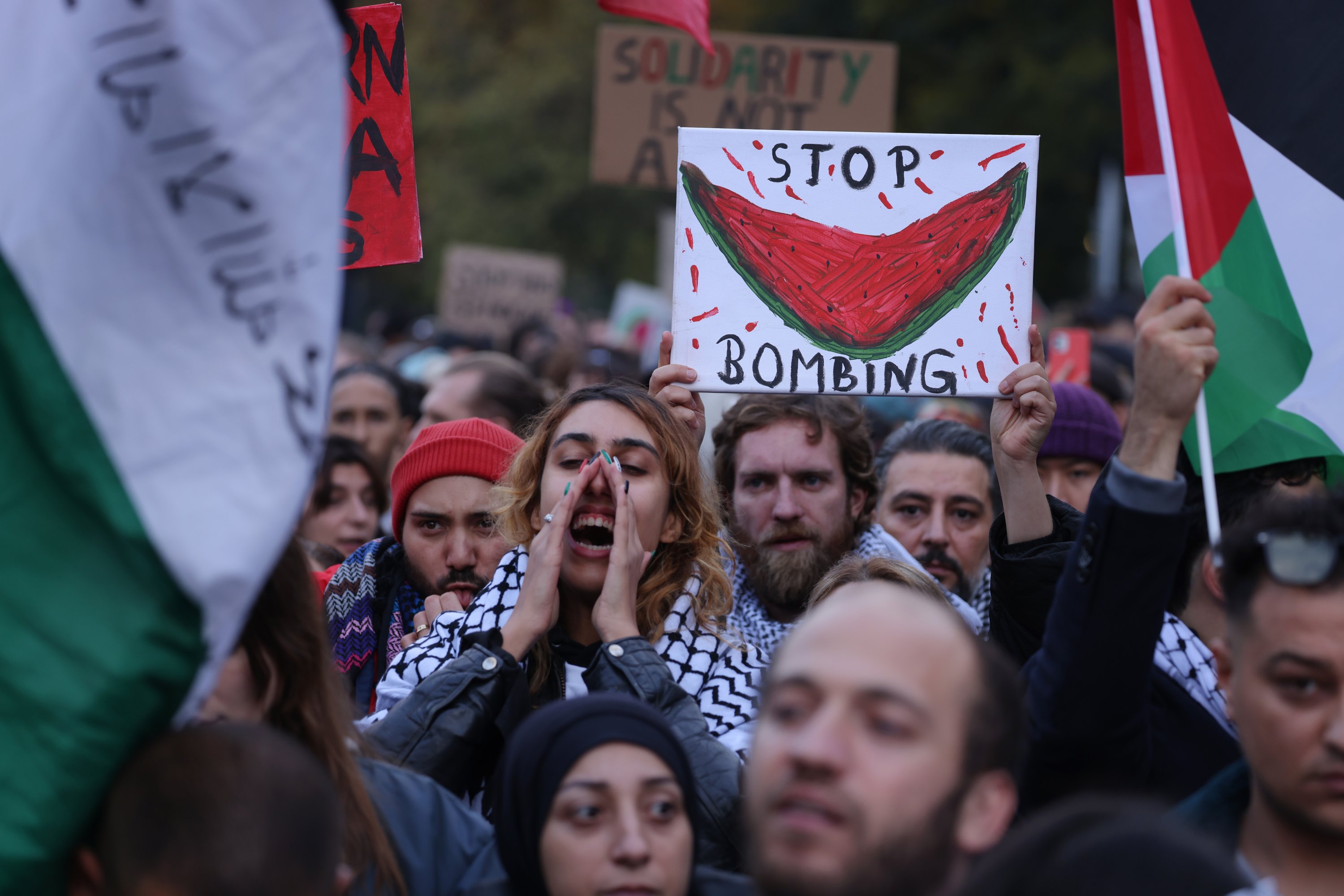
In the last three months, a symbol has surfaced globally in demonstrations against the Israel-Palestine conflict, appearing on banners, T-shirts, balloons and social media posts: the watermelon.
The colors of sliced watermelon – with red pulp, green-white rind and black seeds – are the same as those on the Palestinian flag. From New York and Tel Aviv to Dubai and Belgrade, the fruit has become a symbol of solidarity, drawing together activists who don't speak the same language or belong to the same culture but share a common cause.
To avoid repressive censorship, Chinese dissidents once pioneered "algospeak,” or creative shorthands that bypass content moderation, recently seen with Winnie the Pooh memes mocking Chinese President Xi Jinping. People around the world began using algospeak to subvert algorithmic biases on TikTok, Instagram and other platforms.
The internet is now teeming with pictorial signs – pixelated images, emoji and other typographical codes – that signal political dissent. The watermelon emoji is the latest example.
Here's how the watermelon went from being a symbol of protest in the West Bank and Gaza to a global sign of solidarity with Palestinians online.
After the 1967 Mideast war, the Israeli government cracked down on displays of the Palestinian flag in Gaza and the West Bank. In Ramallah in 1980, the military shut down a gallery run by three artists because they showed political art and works in the colors of the Palestinian flag – red, green, black and white.
The trio was later summoned by an Israeli officer. According to artist and exhibit organizer Sliman Mansour, an Israeli officer told him, "It is forbidden to organize an exhibition without permission from the military, and secondly, it is forbidden to paint in the colors of the Palestinian flag.” The officer mentioned a watermelon as one example of art that would violate the army's rules, Mansour told The Associated Press (AP) last week.
In protest, people began to wave the fruit in public.
"There are stories of young men who defiantly walked the streets with slices of the fruit, risking arrest from Israeli soldiers,” Jerusalem-born author Mahdi Sabbagh wrote. "When I see a watermelon, I think of the unbreakable spirit of our people.”
From the mid-90s, when Israelis and Palestinians reached interim peace deals, until the current right-wing Israeli government took office a year ago, raising the Palestinian flag receded as a major issue. Three decades later, "it became a national symbol” again, Mansour said.
A year ago, Israel’s far-right National Security Minister Itamar Ben-Gvir banned Palestinian flags in public places. This effort was met with fervent opposition. In response, Zazim, an activist group of Arab and Jewish Israelis, plastered taxis in Tel Aviv with large watermelon stickers that read: "This is not a Palestinian flag.”
"Our message to the government is clear," the organization said in a written statement. "We’ll always find a way to bypass any absurd ban and we won’t stop struggling for freedom of expression and democracy – whether this involves the Pride flag or the Palestinian flag.”
For some, embracing the colors of the flag is about striving for freedom and equality rather than necessarily statehood.
"I’ve never cared for flags or nationalism,” says Mayssoun Sukarieh, an expert in Middle Eastern studies at King’s College London. "But when it comes to Palestine, it’s a flag of a colonized people who never saw independence. And because it has been banned, it becomes more of a symbol of resistance than it is of nationalism.”
Watermelons have long been a staple of food in the region, with some dishes, like a popular salad in southern Gaza, originating with Bedouin Arab tribes.
Increasingly, young activists have adopted the watermelon emoji in calling for a cease-fire in Gaza. Emoji may confuse algorithms that advocates say tech companies deploy to suppress posts with keywords like "Gaza” and even just "Palestinian.”