There was no way Jose Ramon Garcia, a food transporter in Venezuela, could afford new tires for his van at $350 each. Whether he opted to pay in U.S. currency or in the devalued local bolivar currency at the equivalent black market price, Garcia would have had to save up for years. Though used to expensive repairs, this one was too much and put him out of business. "Repairs cost an arm and a leg in Venezuela," said the now-unemployed 42-year-old Garcia, who has a wife and two children to support in the southern city of Guayana.
"There's no point keeping bolivars."
For a decade and a half, strict exchange controls have severely limited access to dollars. A black market in hard currency has spread in response, and as once-sky-high oil revenue runs dry, Venezuela's economy is in free-fall. The practice adopted by gourmet and design stores in Caracas over the last couple of years to charge in dollars to a select group of expatriates or Venezuelans with access to greenbacks is fast spreading. Food sellers, dental and medical clinics, and others are starting to charge in dollars or their black market equivalent - putting many basic goods and services out of reach for a large number of Venezuelans. According to the opposition-led National Assembly, November's rise in prices topped academics' traditional benchmark for hyperinflation of more than 50 percent a month - and could end the year at 2,000 percent. The government has not published inflation data for more than a year.
"I can't think in bolivars anymore, because you have to give a different price every hour," said Yoselin Aguirre, 27, who makes and sells jewelry in the Paraguana peninsula and has recently pegged prices to the dollar. "To survive, you have to dollarize."
The socialist government of the late president Hugo Chavez in 2003 brought in the strict controls in order to curb capital flight, as the wealthy sought to move money out of Venezuela after a coup attempt and major oil strike the previous year. Oil revenue was initially able to bolster artificial exchange rates, though the black market grew and now is becoming unmanageable for the government.
President Nicolas Maduro has maintained his predecessor's policies on capital controls. Yet, the spread between the strongest official rate, of some 10 bolivars per dollar, and the black market rate, of around 110,000 per dollar, is now huge. While sellers see a shift to hard currency as necessary, buyers sometimes blame them for speculating. Rafael Vetencourt, 55, a steel worker in Ciudad Guayana, needed a prostate operation priced at $250.
"We don't earn in dollars. It's abusive to charge in dollars!" said Vetencourt, who had to decimate his savings to pay for the surgery.
In just one year, Venezuela's currency has weakened 97.5 per cent against the greenback, meaning $1,000 of local currency purchased then would be worth just $25 now. Maduro blames black market rate-publishing websites such as DolarToday for inflating the numbers, part of an "economic war" he says is designed by the opposition and Washington to topple him. On Venezuela's borders with Brazil and Colombia, the prices of imported oil, eggs and wheat flour vary daily in line with the black market price for bolivars.
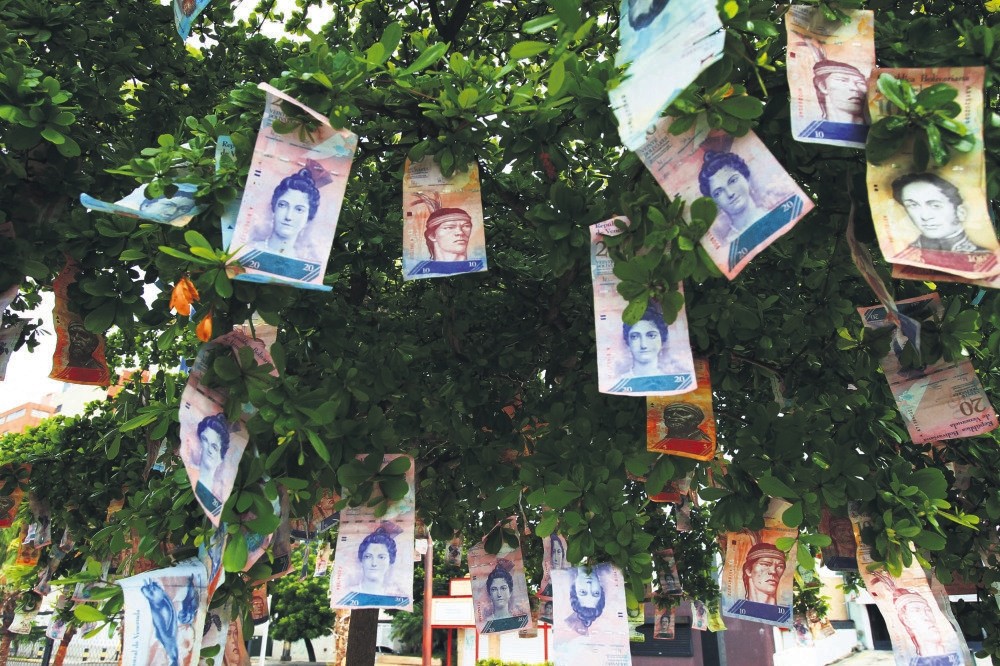
In an upscale Caracas market, cheese-filled arepas, the traditional breakfast made with corn flour, increased 65 percent in price in just two weeks, according to tracking by Reuters reporters. In the same period, a kilogram of ham jumped a whopping 171 percent. The runaway prices have dampened Christmas celebrations, which this season were characterized by shortages of pine trees and toys, as well as meat, chicken and cornmeal for the preparation of typical dishes. In one grim festive joke, a Christmas tree in Maracaibo, the country's oil capital and second city, was decorated with virtually worthless low-denomination bolivar bills. Most Venezuelans, earning just $5 a month at the black market rate, are nowhere near being able to save hard currency. "How do I do it? I earn in bolivars and have no way to buy foreign currency," said Cristina Centeno, a 31-year-old teacher who, like many, was seeking remote work online before Christmas in order to bring in some hard currency.