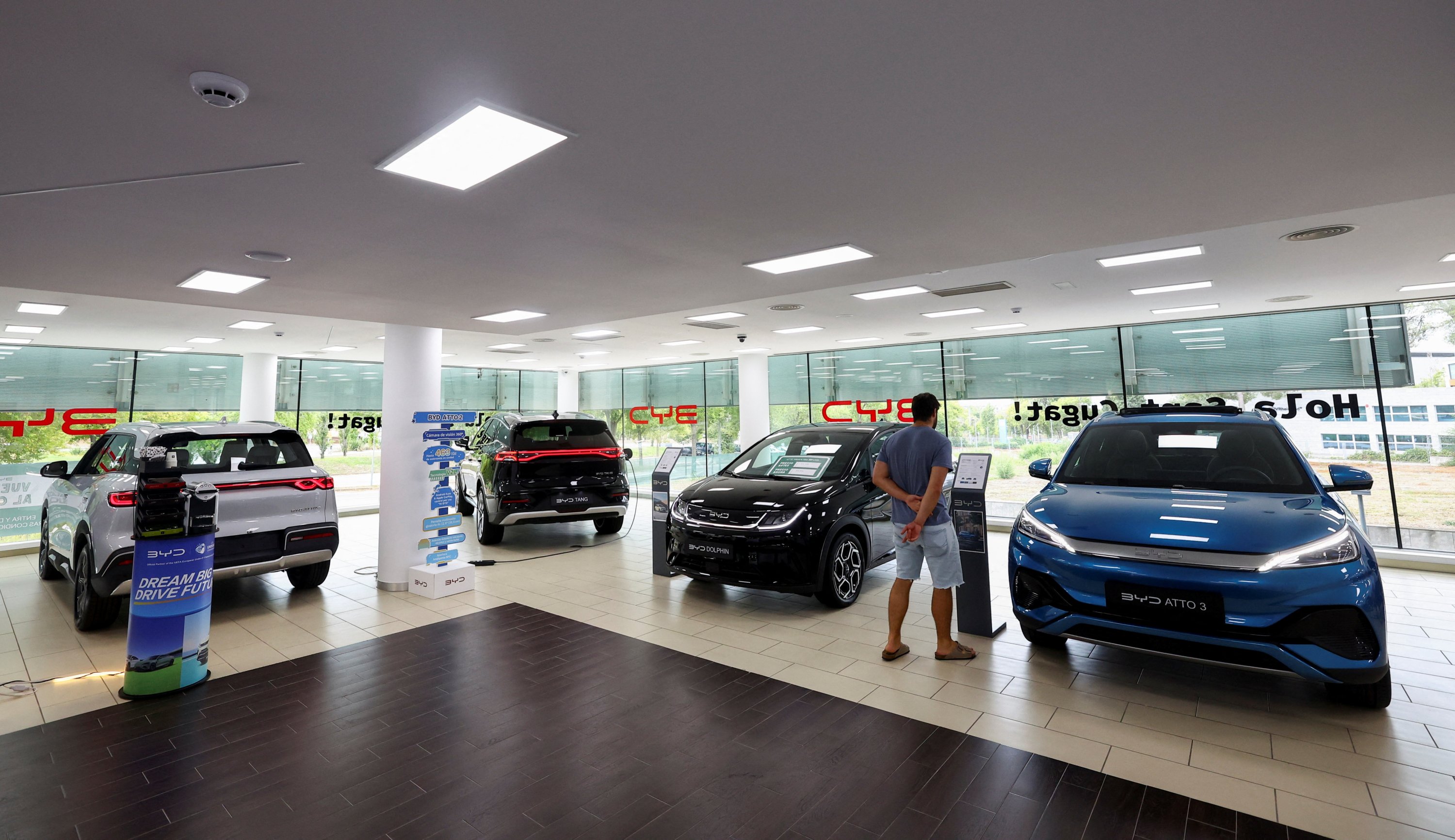
China's top automaker BYD is considering Spain as the leading candidate for its third European car plant, a report said on Tuesday, as the company looks to expand its footprint and boost sales across the continent.
A BYD assembly plant, joining two other planned factories in Hungary and Türkiye, would be a significant boost for the carmaker that competes with Tesla, and would also bolster Spain's aim of becoming a major hub for electric vehicle production.
Spain is favored by BYD because of its relatively low manufacturing costs and clean energy network, Reuters reported, citing two people briefed on the matter.
While it is known that BYD has been looking for a third plant to serve the European market, Spain's emergence as a frontrunner has been previously unreported.
BYD country manager for Spain and Portugal, Alberto De Aza, told Reuters last month that Spain would be an ideal location for further expansion of the carmaker's European manufacturing footprint because of its industrial infrastructure and cheap electricity.
A third source cautioned that the company has not communicated any final decision and is still considering other countries besides Spain. A final decision on the plant, which should come before the end of the year, will need to be approved by Chinese regulators.
BYD has looked at other countries, including Germany, though that has been debated internally because of high labor and energy costs, Reuters reported in March.
BYD's sales in Europe jumped 280% in the first eight months of the year from the same period in 2024 after the automaker began selling plug-in hybrids as well as fully electric cars.
The carmaker had overhauled its European operations to boost sales by hiring more managers and adding dealerships, Reuters reported in April.
Diplomatic and business ties between Spain and China have warmed considerably in recent years. Last year, Spain abstained on a European Union vote on tariffs on Chinese-made EVs.
China's government privately told automakers to halt investments in European countries that supported those tariffs, Reuters reported last year. Germany voted against the tariffs.
Spain, Europe's second-largest car-producing nation, has attracted major investments, including from Germany's Volkswagen and China's Chery and CATL, since it announced a 5 billion euro ($5.8 billion) plan in 2020 to attract EV and battery manufacturing using EU pandemic relief funds.
BYD aims to produce all EVs for sale in Europe locally within three years, which would help it avoid EU tariffs.
Its planned factory in Hungary is currently under construction, though sources told Reuters in July that BYD has pushed back its timeline for mass production at the plant until next year. Its Turkish plant is due to open in 2026.