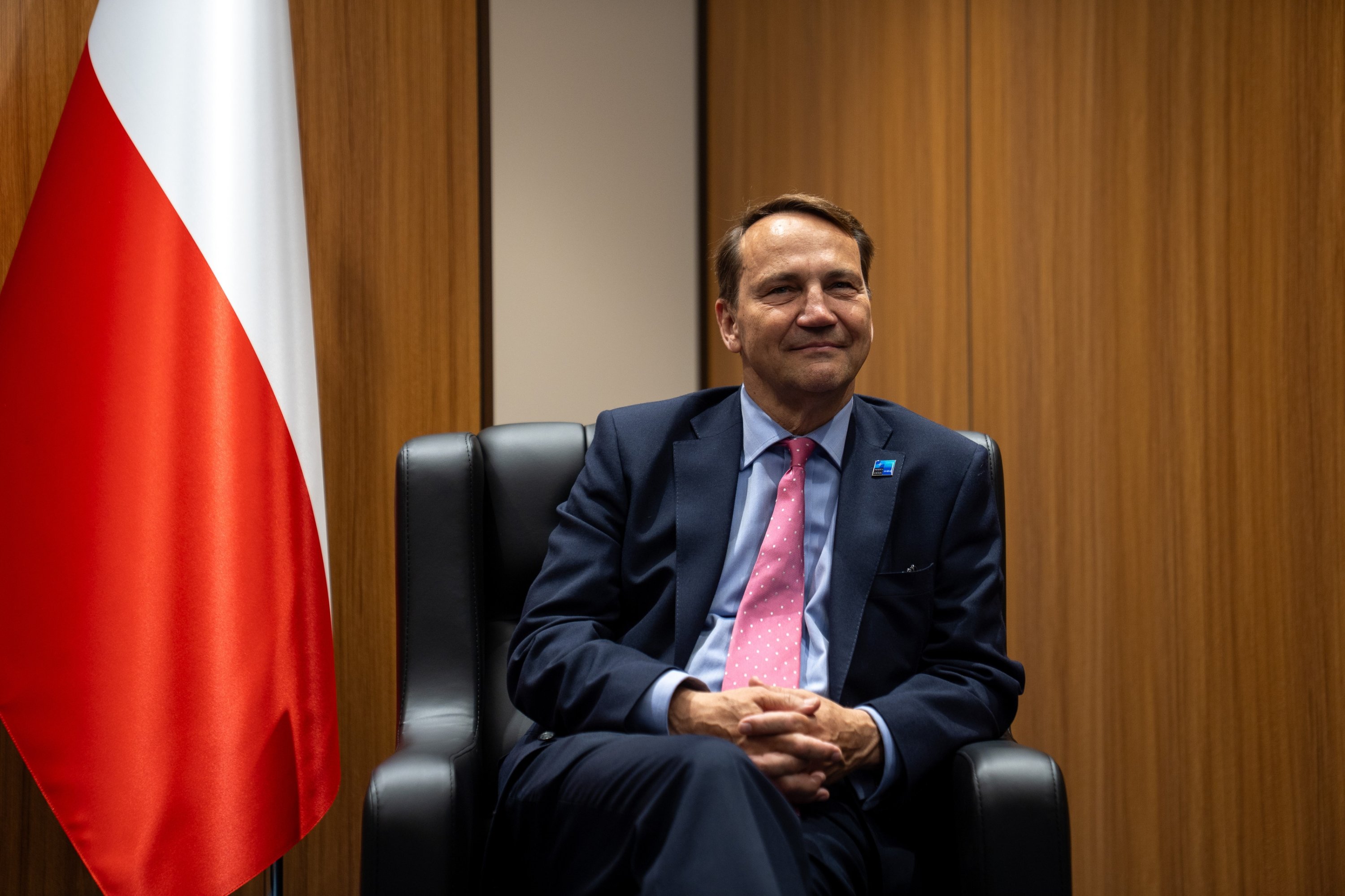
Poland views Türkiye as a major ally on the southeastern flank of NATO, the country's top official said on Wednesday, also citing growing defense cooperation between the countries and Ankara's strategic position as regional security challenges mount.
"We appreciate Türkiye as a major ally on the southeastern flank of NATO," Polish Deputy Prime Minister and Foreign Minister Radoslaw Sikorski told Daily Sabah on the sidelines of the two-day NATO summit, which took place in the Turkish capital.
"We also appreciate Türkiye's diplomatic role in trying to keep channels of communications with Russia open. So it's fitting that the summit is taking place here," he added.
Answering the question on the European defense spending and the commitments announced during the previous Hague summit, Sikorski cited spending since U.S. President Donald Trump's first term.
"European allies have doubled spending since the beginning of President Trump's first term of office. And we agreed ambitious goals at The Hague, and I'm very glad that here in Ankara we are reviewing this," he said.
Sikorski noted that Poland "leads" as it spends about 4.8% of gross domestic product (GDP) on defense, as he suggested that "it is not by coincidence" that countries more towards the east are spending more in apparent reference to Russia.
The minister's remarks came hours before the alliance shared the Ankara Summit Declaration, in which it said that "allies are delivering on The Hague defence commitment," adding that it "announces more than $50 billion in new procurements" to expand collective manufacturing capacity and innovation.
The two-day Ankara summit concluded on a note of "unity," as seen in the concluding statements of Trump, as well as NATO chief Mark Rutte.
"Alliance is stronger than ever, united," Rutte said.
Sikorski, on the other hand, speaking of Warsaw-Ankara ties, said it was one of the "oldest" diplomatic relations in the world.
Furthermore, touching upon the potential to enhance cooperation in the defense field and how Türkiye could contribute more to Europe in this sense, he said Poland was "one of the early purchasers of the Bayraktar system."
He referred to the famed Turkish drones, produced by Baykar, which have been exported to a number of countries, including European nations such as Albania and Croatia, fellow NATO members.
"We now have contracts to buy something like $400 million worth of electronic warfare," Sikorski added.
On the part of the security risks, and could Türkiye's role become even stronger considering the continuous pressures, the Polish official went on to say: "Well, we now have an Iran-Russia axis, with both countries helping each other ... Shahed and Geran drones ... are hitting both Ukraine and countries in this region, and I know that some drones were launched at Türkiye. I'm not sure which particular piece of equipment. But these countries clearly collaborate to our detriment."
"And we need to feel solidarity towards each other's predicament," he noted.
Elaborating on the allies' support for Ukraine, which was also one of the dominant topics during the summit, Sikorski said there are countries "where I have to explain stuff about Ukraine and those that I don't."
"Türkiye is very much a country that understands the stakes," he noted, adding that Ukraine is "a very important part of the balance of power around the Black Sea."
"So we all need to do what is in our part. Ninety percent of Western assistance to Ukraine goes through Poland," he added.
He also noted that Poland supplied Ukraine early on, as the cited different mechanisms, and said that Kyiv "has done much better in this war than anybody expected."
"Russia has done much worse. And I would call the war a draw at this stage," he said.
He also touched upon Ukraine's recent deep strikes on refineries and armaments factories, saying that they "have brought the war home to Russia and the Russian leadership."
"But it takes time to make a real impact on the Russian economy," he added.
"And, of course, if (Russian President Vladimir) Putin continues the war till next year, then we need to sustain Ukraine during another winter, which will be a challenge."
He concluded by saying that it would be "absurd" to halt the commitment to Ukraine at this stage, "when it has a chance of winning."