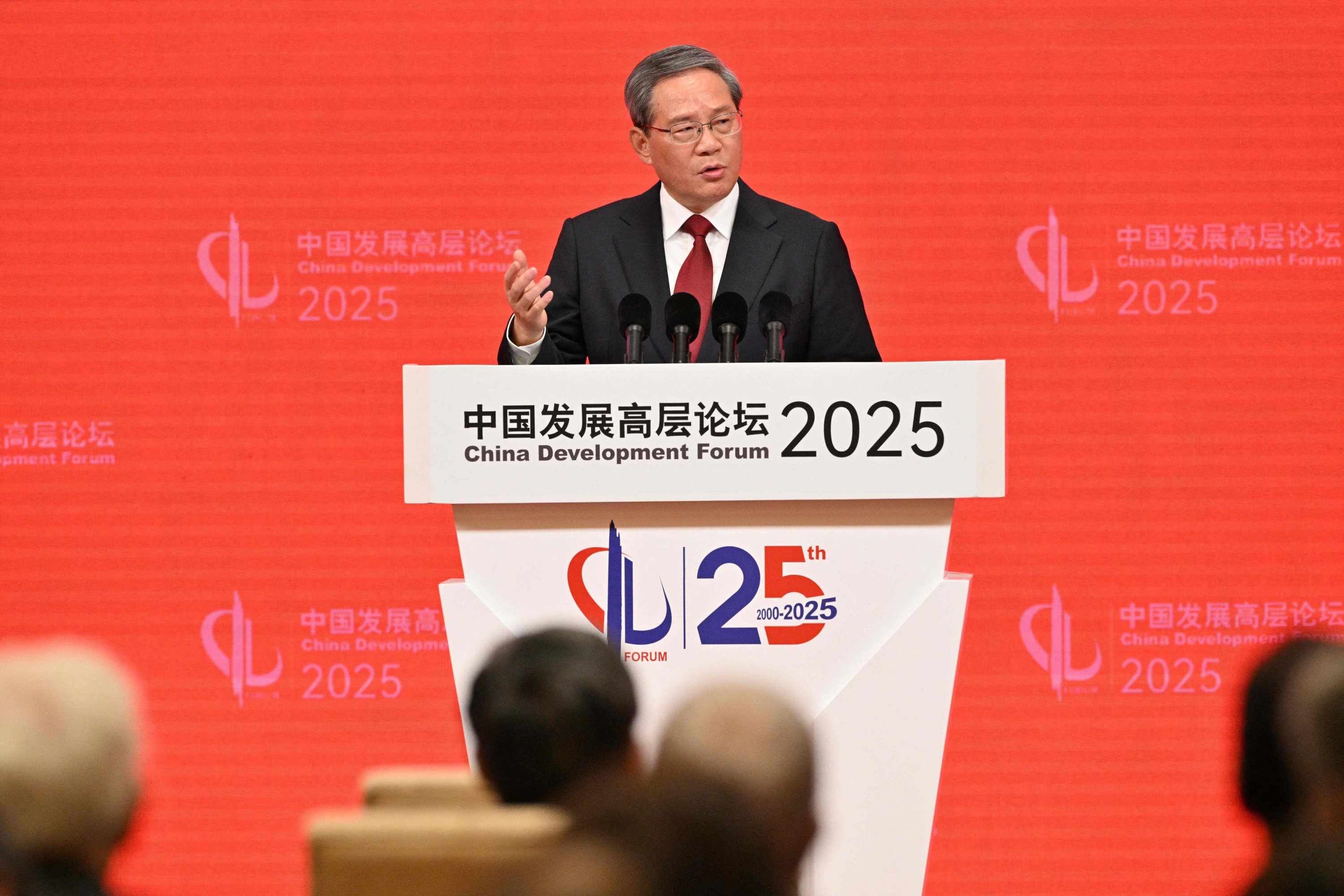
China aims to pursue economic globalization despite "fragmentation," the country's top official said on Sunday during a major gathering of business executives in Beijing, in what appeared to be a thinly veiled reference to trade turmoil sparked by U.S. President Donald Trump.
The China Development Forum (CDF) convenes after weeks of Trump slapping multiple rounds of tariffs on goods from the country, threatening a vital lifeline as economic challenges persist.
Chinese leaders have been attempting to steer a shaky economy onto a more stable path since the end of the pandemic, particularly by boosting consumption.
They are also now seeking to assert the country's role as a staunch defender of the multilateral economic system as Trump wages tariff wars with major U.S. trading partners, including China, Canada and Mexico.
"China will firmly stand on the correct side of history, that of fairness and justice, and act in a righteous manner amid the rough waters of the times," Premier Li Qiang said.
Li's speech came at the opening of the annual forum, attended this year by prominent business leaders including Apple CEO Tim Cook.
The country will "adhere to the correct direction of economic globalization, practice true multilateralism and strive to be a force for stability and certainty," Li vowed.
In an apparent reference to renewed trade wars sparked by Trump, he added, "Today, global economic fragmentation is intensifying," while "instability and uncertainty are on the rise."
In recent weeks, Beijing has expressed an open attitude toward engaging with Trump for trade talks.
U.S. Senator Steve Daines, on Sunday afternoon met with Li during a visit to Beijing viewed as a bid to ease strained relations between the two countries.
Joining the Montana Republican for talks in Beijing's grandiose Great Hall of the People were the CEOs of major firms, including FedEx, Pfizer and Qualcomm.
Daines's engagement with Chinese leaders also included a Saturday meeting with Vice Premier He Lifeng, a close advisor to President Xi Jinping on economic matters.
The discussions in Beijing were expected to focus in large part on the alleged flow of the deadly drug fentanyl and its precursor chemicals from China into the U.S.
Trump says his new tariffs on China are due to Beijing's failure to stem shipments of the chemicals, which underpin a devastating drug crisis.
Beijing has insisted that it cracks down harshly on the illicit production and trade of drugs, describing the issue as one for Washington itself to solve.
During his meeting with Daines on Saturday, He said China "firmly opposes the politicization, weaponization and instrumentalization of economic and trade issues."
The vice premier added that China was willing to "engage in candid dialogue" with the U.S. to resolve issues.
The two countries have "many common interests and broad space for cooperation," he added.
The tariffs imposed by Trump since taking office in January amount to a 20% blanket hike on Chinese overseas shipments to the U.S.
The country's exports reached record heights last year, but observers warn that turbulence in the global trading system could force Beijing to find other ways to boost activity.
Data released Monday indicated an uneven recovery during the first two months of the year.
Retail sales increased moderately from January to February, though unemployment rose to its highest level in two years.
Beijing says it is targeting growth this year of around 5% – the same as last year and a goal considered ambitious by many economists.