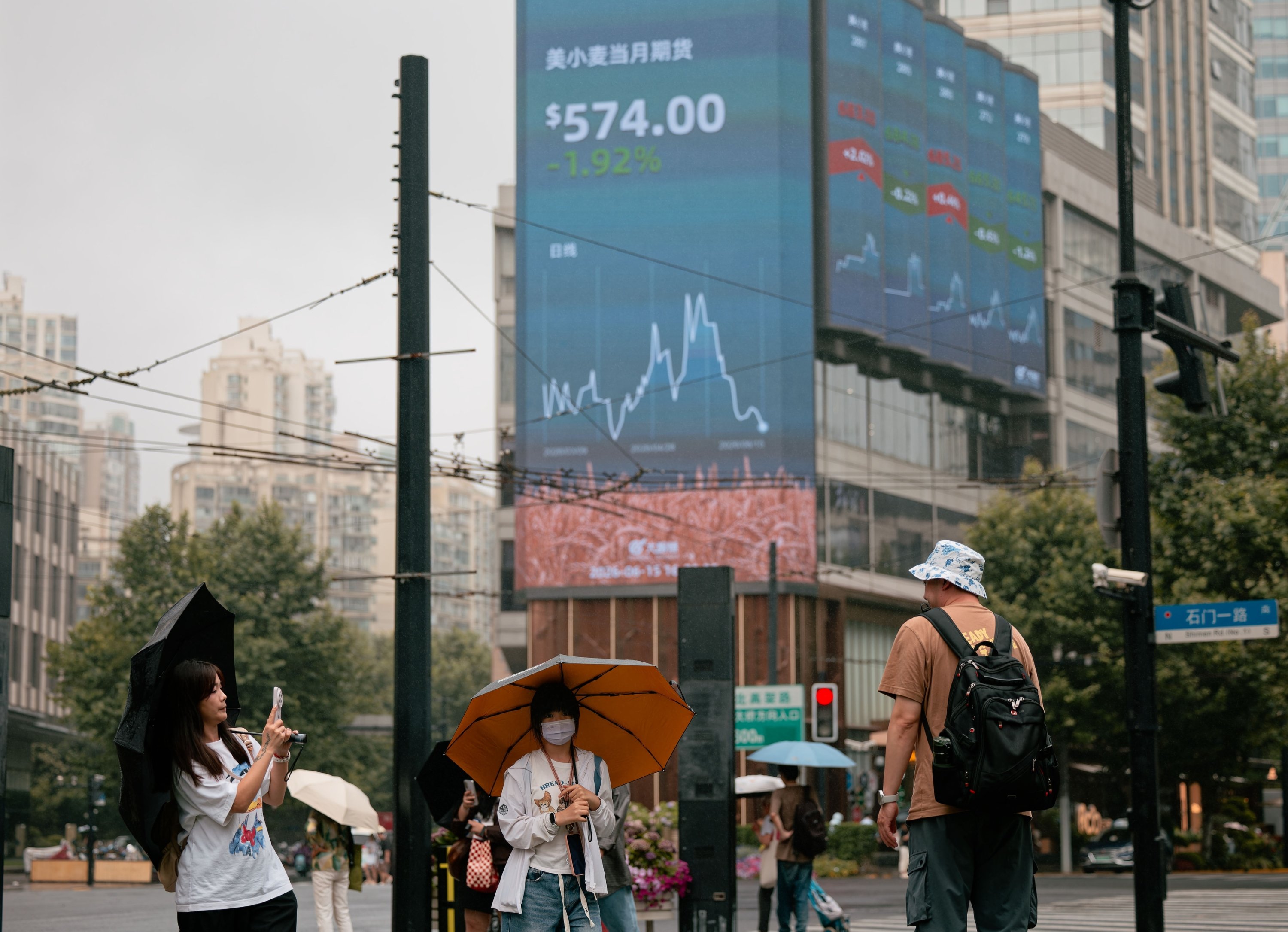
China's economic growth is predicted to have slowed down in the second quarter of the year, according to a recent survey, although strong exports tied to a global artificial intelligence boom helped offset trade frictions and high energy prices amid the Middle East war.
The world's second-largest economy is increasingly reliant on foreign trade to expand as a prolonged property-sector slump and weak consumer demand continue to pose problems.
The U.S.-Israeli war on Iran threatened growth as it choked off shipping through the Strait of Hormuz, through which a fifth of global oil and natural gas normally passes, and sparked fears of a downturn that would have hit demand for Chinese exports.
But data due on Wednesday is expected to show the country's economy expanded 4.5% year-over-year in April-July, according to the median forecast of an Agence France-Presse (AFP) survey of experts.
That would represent a significant slowdown from the five percent recorded in the previous quarter but still leave the economy on track to reach the government's annual target of 4.5%-5.0%.
Dan Wang, a director on Eurasia Group's China team and one of 11 analysts surveyed by AFP, said the economy had stood up well to energy and supply chain disruptions from the Iran war.
But he added that "weaker global demand has a visible negative impact on lower-end consumer goods and small exporters."
High-tech sectors thrived, however, with industries related to artificial intelligence and renewable energy seeing "stellar performance," Wang said.
China weathered a punishing trade war launched by U.S. President Donald Trump last year to emerge with an eye-watering $1.2 trillion trade surplus in 2025, the largest on record.
Exports have surged again in the first half of this year, driven by demand for AI-related tech and automobiles, with overseas shipments up 19.4% year-over-year in May.
In the second quarter, "external demand continued to outperform despite tariffs and geopolitical uncertainty," Sheana Yue, senior economist at Oxford Economics, told AFP.
She said this reflected "China's improving competitiveness, continued gains in global market share, and its ability to rapidly scale production in higher value-added manufacturing sectors."
But surging exports are compensating for weak domestic demand and subdued business and household sentiment that "appears to have been further weighed down by uncertainty stemming from the Iran conflict," Yue said.
Despite the government rolling out billions of yuan in special bonds since 2024 to support trade-in programs for consumer goods and subsidies, retail sales fell for the first time in three years in May, while fixed-asset investment has also slumped, according to official data.
The debt crisis in China's massive property sector, which began in 2020 and has spooked consumers, has also dragged on.
Once a key store of wealth, home prices across the country have stagnated, dissuading would-be buyers from investing.
"With still no signals that the real estate crisis is coming to an end, it is hard to see a recovery in consumption," said Rabobank's Teeuwe Mevissen.
Analysts expect new measures will be needed to support growth in the second half of the year, especially if the AI export wave subsides.
Policymakers had focused on debt resolution and reform in the second quarter, but would likely pivot to "re-prioritize growth, with potential policies to step up investment and support services and employment," according to Guo Shan at Hutong Research.
Continued trade frictions with the U.S. and the European Union, China's second-largest trading partner, could threaten Beijing's exports and require new efforts to rebalance the economy.
A U.S. trade truce, agreed last year, is due to expire in November, while the EU is considering measures to protect domestic industries from what it considers unfair competition from China.
With domestic demand subdued, Chinese manufacturers such as electric vehicle makers have pinned their hopes on overseas expansion to boost profits outside the country's ultra-competitive market.
"Ultimately, China's ability to sustain growth will depend on a meaningful recovery in household consumption and a revival in private-sector confidence," Sarah Tan of Moody's Analytics said.