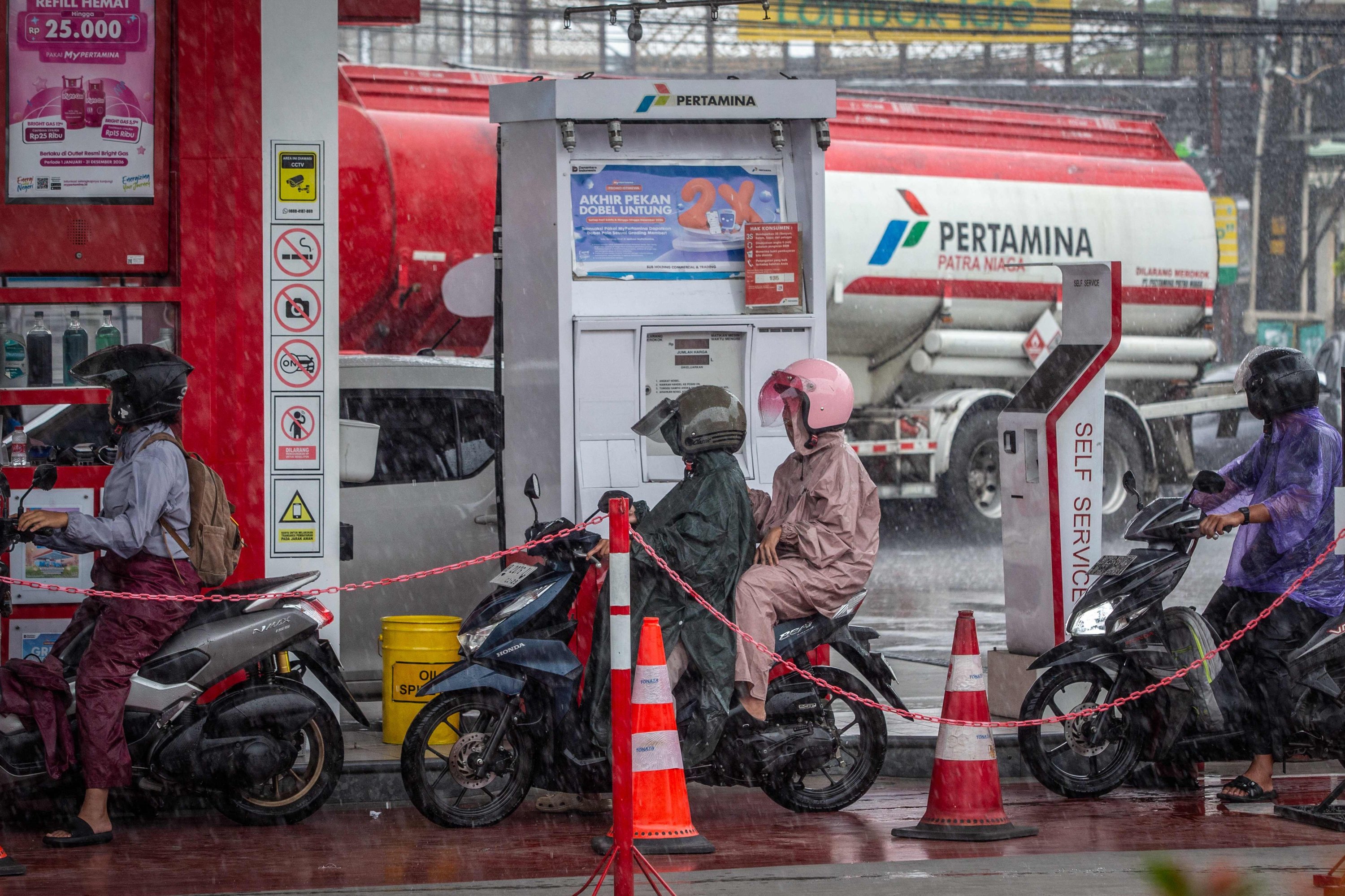
U.S. and Israeli attacks on Iran have pushed prices up, clouded the outlook for the global economy, sent global stock markets crumbling and forced both developed and developing countries to step in with measures including rationing of fuel and subsidizing the energy costs to protect the most vulnerable.
Ongoing strikes and counterstrikes on Persian Gulf refineries, pipelines, gas fields and tanker terminals threaten to prolong the global economic pain for months, even years.
"A week ago or certainly two weeks ago, I would have said: If the war stopped that day, the long-term implications would be pretty small,’’ said Christopher Knittel, an energy economist at the Massachusetts Institute of Technology.
"But what we’re seeing is infrastructure actually being destroyed, which means the ramifications of this war are going to be long-lived."
Iran hit Qatar’s Ras Laffan natural gas terminal, which produces 20% of the world’s liquefied natural gas (LNG). The March 18 strike wiped out 17% of Qatar’s LNG export capacity and repairs will take up to five years, state-owned QatarEnergy said.
The war caused an oil shock from the get-go. Iran responded to U.S. and Israeli attacks, which commenced on Feb. 28 by effectively closing off the Strait of Hormuz, a transit point for a fifth of the world’s oil, by threatening tankers trying to pass through.
Gulf oil exporters like Kuwait and Iraq cut production because there was nowhere for their oil to go without access to the strait.
The loss of 20 million barrels of oil a day delivered what the International Energy Agency (IEA) calls the "largest supply disruption in the history of the global oil market.’’
The price for a barrel of Brent crude oil climbed 3.4% on Friday to settle at $105.32. That was up from roughly $70 just before the war began. Benchmark U.S. crude rose 5.5% to settle at $99.64 per barrel.
"Historically, oil price shocks like this have led to global recessions," Knittel said.
The war has also dredged up a bad economic memory from the oil shocks of the 1970s: stagflation.
"You’re raising the risk of higher inflation and lower growth," said the Harvard Kennedy School's Carmen Reinhart, a former World Bank chief economist.
Gita Gopinath, former chief economist at the International Monetary Fund (IMF), recently wrote that global economic growth, expected before the war to register 3.3% this year, would be 0.3 to 0.4 percentage points lower if oil prices averaged $85 a barrel in 2026.
The Persian Gulf accounts for a big share of exports of two key fertilizers, a third of urea and a quarter of ammonia. Producers in the region enjoy an advantage: easy access to low-cost natural gas, the primary feedstock for nitrogen fertilizers.
Up to 40% of world exports of nitrogen fertilizer pass through the Strait of Hormuz.
Now that the passage is blocked, urea prices are up 50% since the war and ammonia 20%.
Big agricultural producer Brazil is especially vulnerable because it gets 85% of its fertilizer from imports, Alpine Macro commodity strategist Kelly Xu wrote in a commentary.
Egypt, a big fertilizer producer itself, needs natural gas to make the stuff and production falters when it can’t get enough.
Eventually, higher fertilizer prices are likely to make food more expensive and less abundant as farmers skimp on it and get lower yields. The squeeze on food supplies will land hardest on families in poorer countries.
The war has also disrupted world supplies of helium, a byproduct of natural gas and a key input in chipmaking, rockets and medical imaging. Qatar makes helium at the Ras Laffan facility and supplies a third of the world’s helium.
"No country will be immune to the effects of this crisis if it continues to go in this direction," IEA head Fatih Birol said on March 23.
Poorer countries will be hit hardest and face the biggest energy shortages "because they will be outbid when competing for the remaining oil and natural gas," said Lutz Kilian, director of the Center for Energy and the Economy at the Federal Reserve Bank of Dallas.
Asia is especially exposed: More than 80% of the oil and LNG that passes through the Strait of Hormuz is headed there.
In the Philippines, government offices are now open just four days a week and bureaucrats must limit the use of air conditioning to nothing cooler than 75°F (24°C). In Thailand, public workers have been told to take the stairs instead of elevators.
India is the world’s second-biggest importer of liquefied petroleum gas (LPG), which is used in cooking. The Indian government is giving households priority over businesses as it allocates its limited supply and absorbing most of the price increases to keep costs low for poor families.
But LPG shortages have forced some eateries to shorten hours, close temporarily or drop dishes like curries and deep-fried snacks requiring a lot of energy.
South Korea, dependent on energy imports, is restricting the use of cars by public employees and has reinstated fuel price caps that had been dropped in the 1990s.
The United States, the world’s largest economy, is somewhat insulated.
America is an oil exporter, so its energy companies stand to benefit from higher prices. And LNG prices are lower in the U.S. than elsewhere because its export liquefaction facilities already are running at 100% capacity. The U.S. can’t export any more LNG than it already is, so gas stays home, keeping domestic supplies abundant and prices stable.
Still, higher gasoline prices are weighing on American consumers already frustrated by the high cost of living. According to AAA, the average price of a gallon of gasoline has risen to nearly $4 a gallon from $2.98 a month ago.
"Nothing weighs more heavily on consumers’ collective psyche than having to pay more at the pump," Mark Zandi, chief economist at Moody’s Analytics, and his colleagues wrote in a commentary.
The U.S. economy already was showing signs of weakness, expanding an annual pace of just 0.7% from October through December, down from a rollicking 4.4% from July through September.
Employers unexpectedly cut 92,000 jobs in February and added just 9,700 a month in 2025, the weakest hiring outside a recession since 2002.
Gregory Daco, chief economist at EY-Parthenon, has raised the odds of a U.S. recession over the next year to 40%. The risk when times are "normal'' is just 15%.
The world economy has proven resilient in the face of repeated shocks: a COVID-19 pandemic, Russia’s invasion of Ukraine, resurgent inflation and the high interest rates needed to bring it under control.
So there was optimism that it could shrug off the damage from the Iran war. But those hopes are fading as the threats to the Gulf's energy infrastructure continue.
"Some of the damage to LNG facilities in Qatar done will likely take years to repair,'' said the Dallas Fed's Kilian, who also noted necessary repairs to refineries in countries like Kuwait and tankers in the Gulf that must be re-provisioned and stocked up with marine fuel.
"The process of recovery will be slow even under the best circumstances.''
"There is no economic upside to the conflict with Iran," Zandi and his colleagues wrote.
"At this point, the questions are how much longer the hostilities will continue and how much economic damage they will cause.''