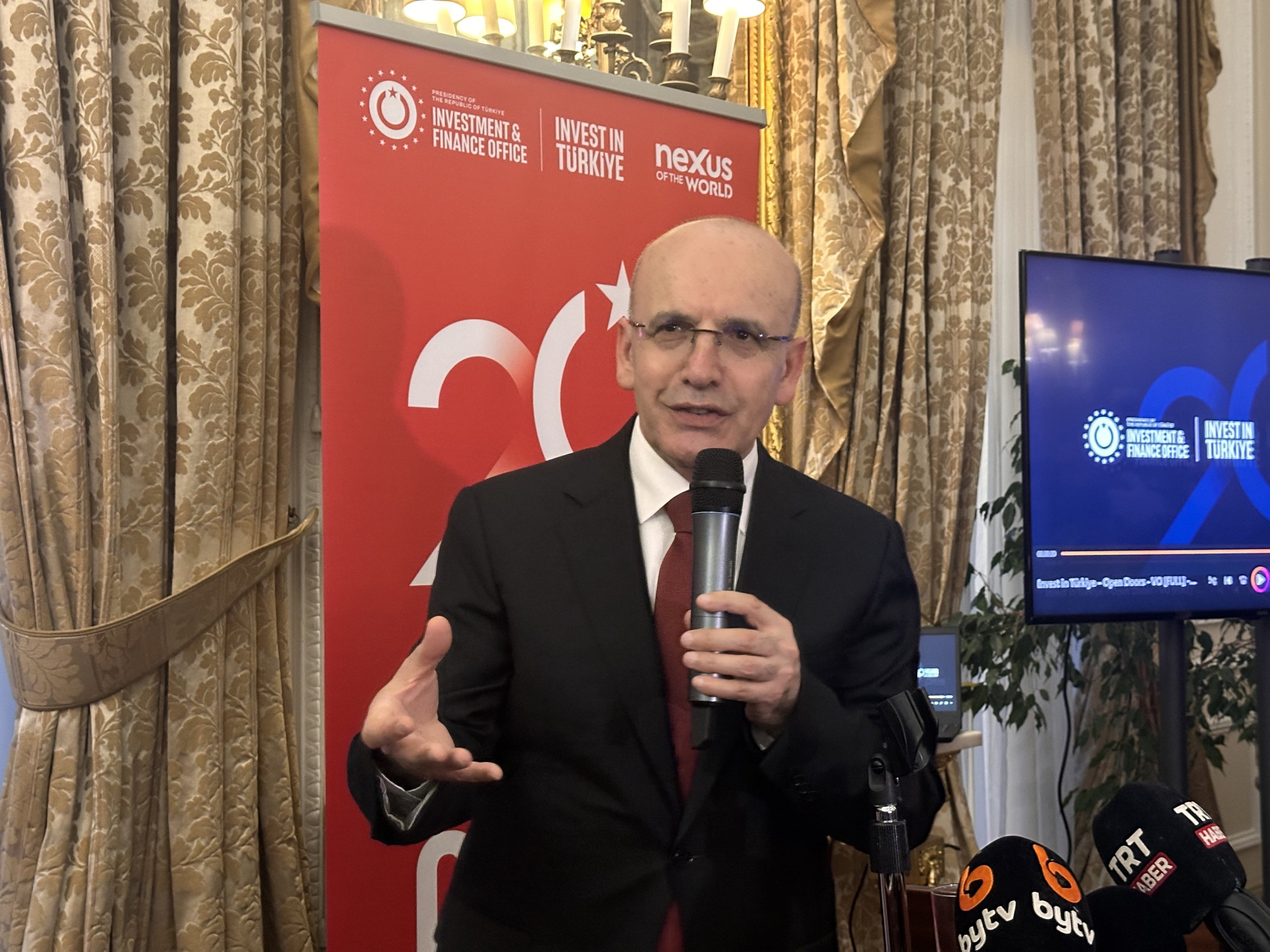
Short-term economic effects of the Iran war are negative but manageable for Türkiye, with energy supply security not at stake and fiscal space being deployed as a shock absorber, according to Treasury and Finance Minister Mehmet Şimşek.
"Limited warflation, wider current account deficit, slower growth," are among the effects, according to a presentation by Şimşek to investors in London.
Despite the risks, the minister said there has been no change in the government's macroeconomic policy priorities and that disinflation remains authorities' top goal.
Annual inflation in Türkiye was 31.5% in February after a gradual decline from 75% in 2024. But expectations have risen amid the conflict, largely due to soaring global energy prices.
The U.S.-Israeli war on Iran has effectively shut the Strait of Hormuz, which normally carries around 20% of global crude, products and liquefied natural gas, stoking concerns about global energy supply.
Şimşek's presentation said Türkiye's energy supply security is not at stake.
The government's policy framework remains focused on restoring price stability, maintaining fiscal discipline, achieving a sustainable current account balance and advancing structural reforms, the presentation said.
Şimşek said higher energy costs linked to the conflict could weigh on the economy.
If oil prices average around $85 per barrel in 2026, inflation could rise by roughly 3.6 to 4.4 percentage points, according to the presentation.
The same assumption could also reduce economic growth by around 0.6 to 1.5 percentage points.
Oil prices fell briefly below $100 per barrel on Wednesday after President Donald Trump said the U.S. could be done attacking Iran probably in two to three weeks, and that the U.S. "will not have anything to do with" what happens next in the Strait of Hormuz.
Şimşek said fiscal policy tools were being used to limit the pass-through of higher oil prices to domestic inflation.
To curb price hikes, authorities last month introduced a "sliding-scale" system, which adjusts the special consumption tax (ÖTV) on fuel products and prevents higher oil prices from being fully passed through to consumers.
Central Bank of the Republic of Türkiye (CBRT) Governor Fatih Karahan on Tuesday said their calculations showed the system reduces the impact of oil prices on inflation to one-third.
The central bank last month halted its easing cycle with the main rate at 37%, lifted its overnight rate by about 300 basis points to near 40% and undertook sales and swaps of foreign exchange and gold reserves to support the Turkish lira.
Karahan cautioned about the impact of the fallout from the Iran war on its fight against inflation, noting that in such situations it is a "natural choice" to turn to gold-based transactions to support liquidity.
Karahan said the monetary authority would maintain the needed tight policy to continue the disinflation process.
In separate remarks on Tuesday, Şimşek said the Iran war is likely to reshape supply chains and create new trade corridors, presenting significant opportunities for Türkiye.
Şimşek said Türkiye is becoming an attractive destination once again for global talent and capital.
"In my view, Türkiye is once again becoming a center of attraction for global talent and capital," he noted.
Şimşek said Türkiye remains not only a center of stability in a difficult global environment but also a strong manufacturing base and dynamic services center.
The conflict is likely to prompt companies to rethink and diversify supply chains, which Şimşek says could lead to the creation of new trade corridors.
Türkiye's role in the Middle Corridor and its investments in regional connectivity could position the country to benefit from those changes, he added.
Şimşek also said the conflict would likely accelerate both the green transition and the digital transformation, creating additional opportunities across sectors.
"Our focus is on the twin transition, and we are making good progress in this area," he said.