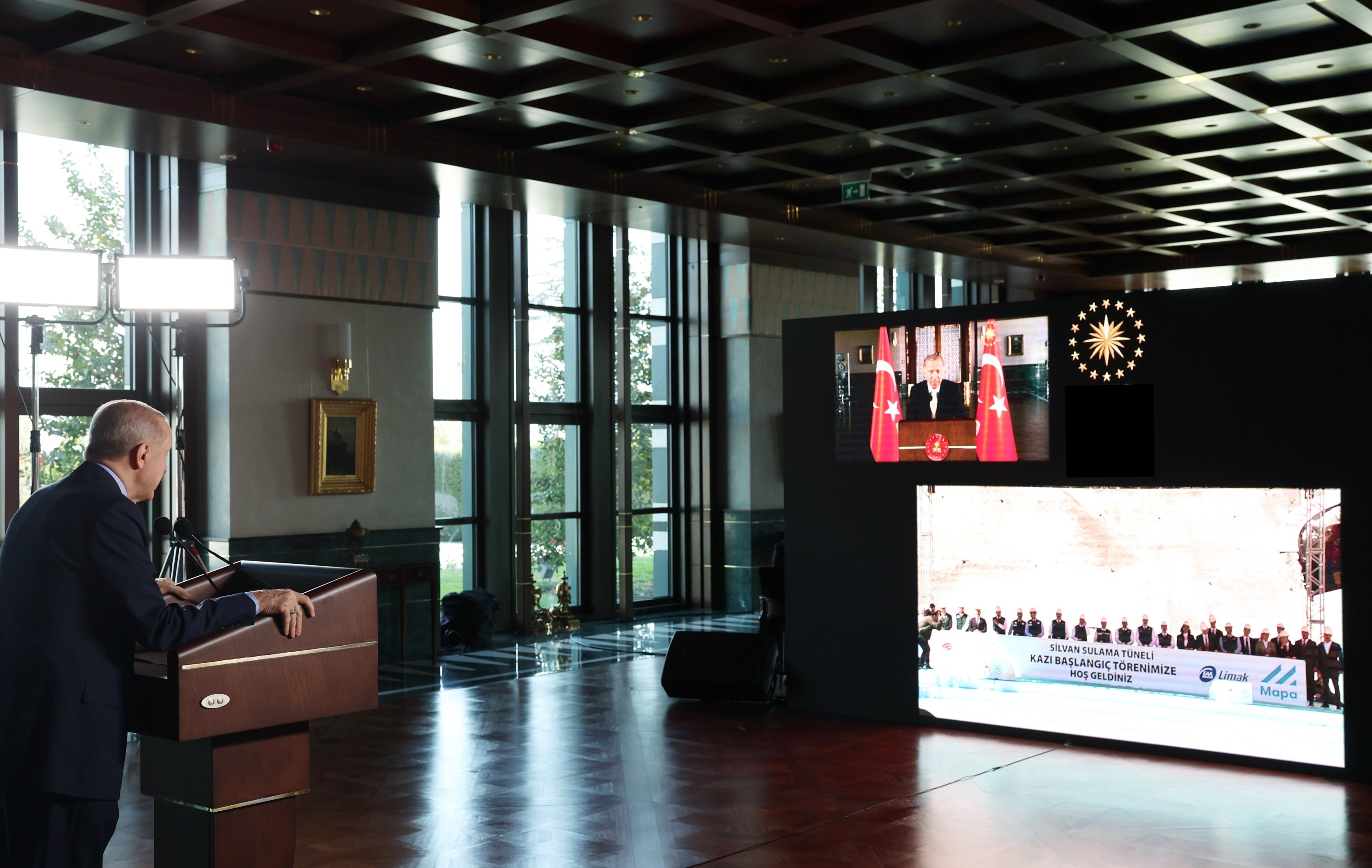
Excavation works at the largest irrigation tunnel in Türkiye, situated in southeastern Diyarbakır province, began on Thursday with a ceremony video-addressed by President Recep Tayyip Erdoğan, who stressed the importance of properly managing water resources, calling it a matter of "national security."
"Türkiye is not a water-rich country; on the contrary, we are a water-stressed country. If we do not take the necessary measures and take action now, we may face much bigger problems," Erdoğan said, speaking at a ceremony for the start of excavation works for Silvan Tunnel.
"Preserving, efficiently using and properly managing our water resources before they reach the limit of depletion is not optional for our country, but a matter of national security," he added.
Erdoğan, as part of his remarks, also noted that they have focused on policies aimed at the efficient use of water over the last 23 years, stating that they have made a total investment of TL 3.35 trillion in the water sector and opened 10,663 facilities.
Highlighting that water is the source of life, production, civilization and energy, and that without water there is no life and abundance, he said: "In the past, people fought over oil and carbon fuels. Apparently, it looks they will fight over water in the coming period, because water is the most strategic and valuable resource of this century."
However, he pointed out that the pressure on water resources has been increasing over the last century due to climate change, drought, increasing population and urbanization.
"We have started to witness droughts, floods and forest fires more frequently. Last week, we had an agricultural frost that adversely affected many provinces in our country," he recalled.
"Scientists say that much more difficult days await us in the future. We are all well aware that Türkiye is not a water-rich country. On the contrary, we are a water-stressed country. If we do not take the necessary measures and take action now, we may face much bigger problems. Preserving, efficiently using and properly managing our water resources before they reach the limit of depletion is not optional for our country, but a matter of national security," he explained.
Erdoğan also said that the Silvan Tunnel will be the largest irrigation tunnel in Türkiye, with an excavation diameter of 11.2 meters.
"The 13,200-meter-long tunnel will transmit 212 cubic meters of water per second to the irrigation areas and other dams within the scope of the project. This project is the largest irrigation project in our country after the Atatürk Dam," he noted.
Agriculture and Forestry Minister Ibrahim Yumakli was in Diyarbakır, where he met with local officials and Governor Murat Zorluoğlu, and also attended the ceremony for the start of excavation works on the "Silvan Tunnel," the largest irrigation tunnel in Türkiye.
Mehmet Mehdi Eker, Chairperson of the Board of Directors of the Agricultural Strategy and Policy Development Center (TARPOL) and former Minister of Food, Agriculture and Livestock, stated in his speech at the ceremony that the Silvan Dam is a project that will change the fate of farmers.
Explaining that cotton, corn and similar industrial plants have been produced in Diyarbakır in the last twenty years, Eker noted that the city is among the few provinces in Türkiye with production in this area and that they owe this to irrigation.
He also mentioned that the Silvan Dam dream was first seen in the 1970s, but it remained a dream until 2004, when he said President Erdoğan announced at Diyarbakır Square that the Silvan Project would be implemented. "We laid the foundation in 2012. Today marks the beginning of an important stage. The tunnel is one of the most important legs of this project," he said.
Silvan Dam is part of the Southeastern Anatolia Project (GAP), a multi-sector, integrated regional development project, for which the Turkish government envisages an allocation of around $14 billion by 2028.
Zorluoğlu, for his part, also said that the dam is not an ordinary infrastructure project for Diyarbakır, suggesting it will increase agricultural production by two to three times and make profound contributions to employment.