Anita Akpeere prepared fried rice in her kitchen in Ghana's capital as a flurry of notifications for restaurant orders lit up apps on her phone.
"I don’t think I could work without a phone in my line of business,” she said, as requests came in for her signature dish, a traditional fermented dumpling.
Internet-enabled phones have transformed many lives, but they can play a unique role in sub-Saharan Africa, where infrastructure and public services are among the world's least developed, said Jenny Aker, a professor who studies the issue at Tufts University. At times, technology in Africa has leapfrogged gaps, including providing access to mobile money for people without bank accounts.
Despite growing mobile internet coverage on the continent of 1.3 billion people, just 25% of adults in sub-Saharan Africa have access to it, according to Claire Sibthorpe, head of digital inclusion at the U.K.-based mobile phone lobbying group GSMA.
Expense is the main barrier. The cheapest smartphone costs up to 95% of the monthly salary for the poorest 20% of the region's population, Sibthorpe said.
Literacy rates that are below the global average, and lack of services in many African languages – some 2,000 are spoken across the continent, according to The African Language Program at Harvard University – are other reasons why a smartphone isn't a compelling investment for some.
"If you buy a car, it’s because you can drive it," said Alain Capo-Chichi, chief executive of CERCO Group, a company that has developed a smartphone that functions through voice command and is available in 50 African languages such as Yoruba, Swahili and Wolof.
Even in Ghana, where the lingua franca is English, knowing how to use smartphones and apps can be a challenge for newcomers.
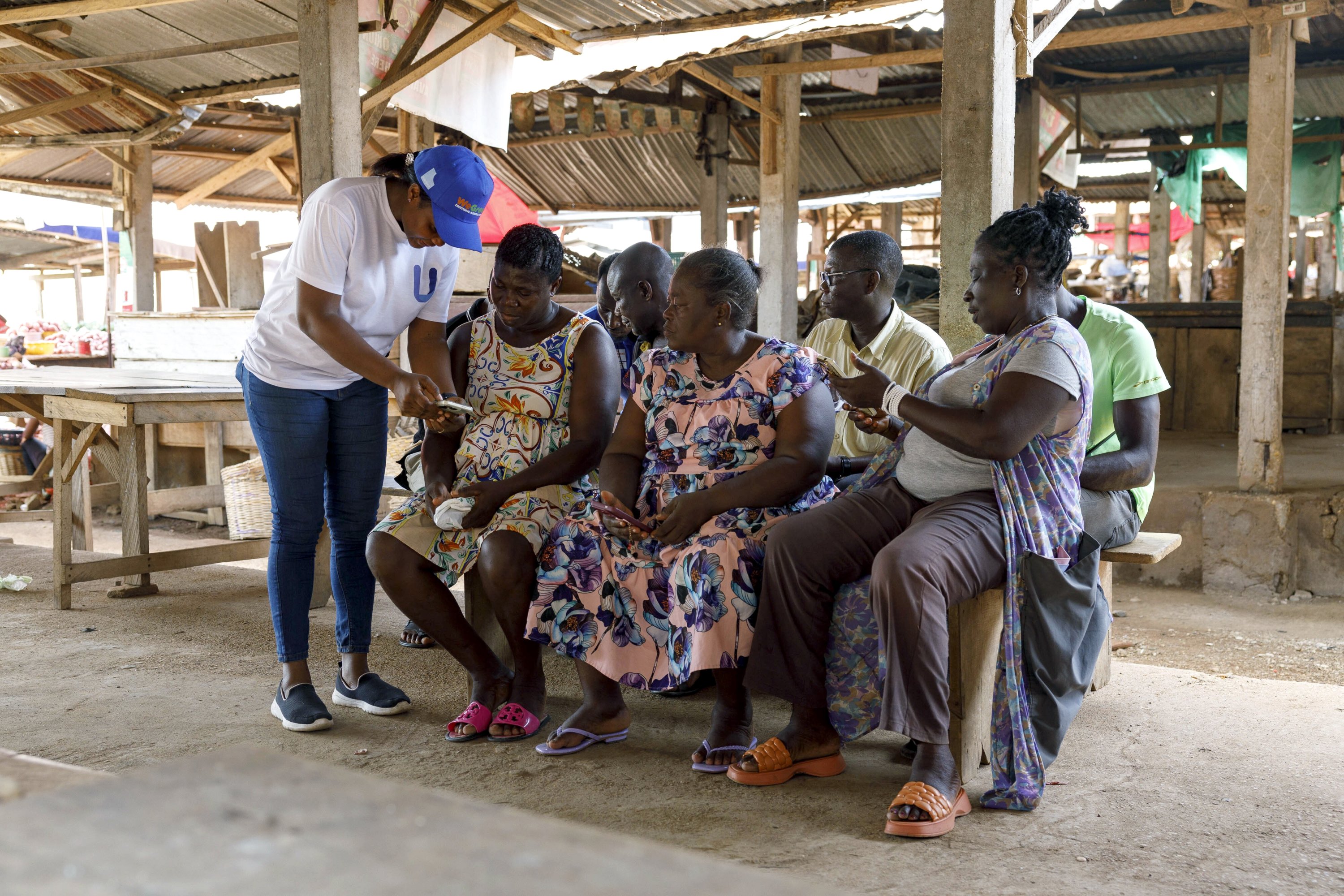
One new company in Ghana is trying to close the digital gap. Uniti Networks offers financing to help make smartphones more affordable and coaches users to navigate its platform of apps.
For Cyril Fianyo, a 64-year-old farmer in Ghana’s eastern Volta region, the phone has expanded his activities beyond calls and texts. Using his identity card, he registered with Uniti, putting down a deposit worth 340 Ghanaian cedis ($25) for a smartphone and will pay the remaining 910 cedis in installments.
He was shown how to navigate apps that interested him, including a third-party farming app called Cocoa Link that offers videos of planting techniques, weather information and details about the challenges of climate change that have affected cocoa and other crops.
Fianyo, who previously planted according to his intuition and rarely interacts with farming advisers, was optimistic that the technology would increase his yields.
"I will know the exact time to plant because of the weather forecast,” he said.
Kami Dar, chief executive of Uniti Networks, said the mobile internet could help address other challenges including accessing health care. The company has launched in five communities across Ghana with 650 participants and wants to reach 100,000 users within five years.
Aker, the scholar, noted that the potential impact of mobile phones across Africa is immense but said there is limited evidence that paid health or agriculture apps are benefiting people there. She asserted that the only beneficial impacts are reminders to take medicine or get vaccinated.
Having studied agricultural apps and their impact, she said it doesn't seem that farmers are getting better prices or improving their income.
Capo-Chichi from CERCO Group said a dearth of useful apps and content is another reason why more people in Africa aren't buying smartphones.
Dar said Uniti Networks learns from mistakes. In a pilot in northern Ghana designed to help cocoa farmers contribute to their pensions, there was high engagement but farmers didn’t find the app user-friendly and needed extra coaching. After the feedback, the pension provider changed the interface to improve navigation.
Others are finding benefit with Uniti's platform. Mawufemor Vitor, a church secretary in Hohoe, said one health app has assisted her to track her menstruation to help prevent pregnancy. And Fianyo, the farmer, has used the platform to find information on herbal medicine.
But mobile phones are no substitute for investment in public services and infrastructure, Aker said.
She also expressed concerns about the privacy of data in the hands of private technology providers and governments. With digital IDs in development in African nations such as Kenya and South Africa, this could pave the way for further abuses, Aker said.
Uniti Networks is a for-profit business, paid for each customer that signs up for paying apps. Dar asserted that he was not targeting vulnerable populations to sell them unnecessary services and said Uniti only features apps that align with its idea of impact, with a focus on health, education, finance and agriculture.
Dar said Uniti has rejected lucrative approaches from many companies including gambling firms. "Tech can be used for awful things,” he said.
He acknowledged that Uniti tracks users on the platform to provide incentives, in the form of free data, and to provide feedback to app developers. He acknowledged that users' health and financial data could be at threat from outside attack but said Uniti has decentralized data storage in an attempt to lessen the risk.
Still, the potential to provide solutions can outweigh the risks, Aker said, noting two areas where the technology could be transformative: education and insurance.
She said mobile phones could help overcome the illiteracy that still affects 773 million people worldwide according to UNESCO. Increased access to insurance, still not widely used in parts of Africa, could provide protection to millions who face shocks on the front lines of climate change and conflict.
Back in Fianyo's fields, his new smartphone has attracted curiosity. "This is something I would like to be part of," said neighboring farmer Godsway Kwamigah.