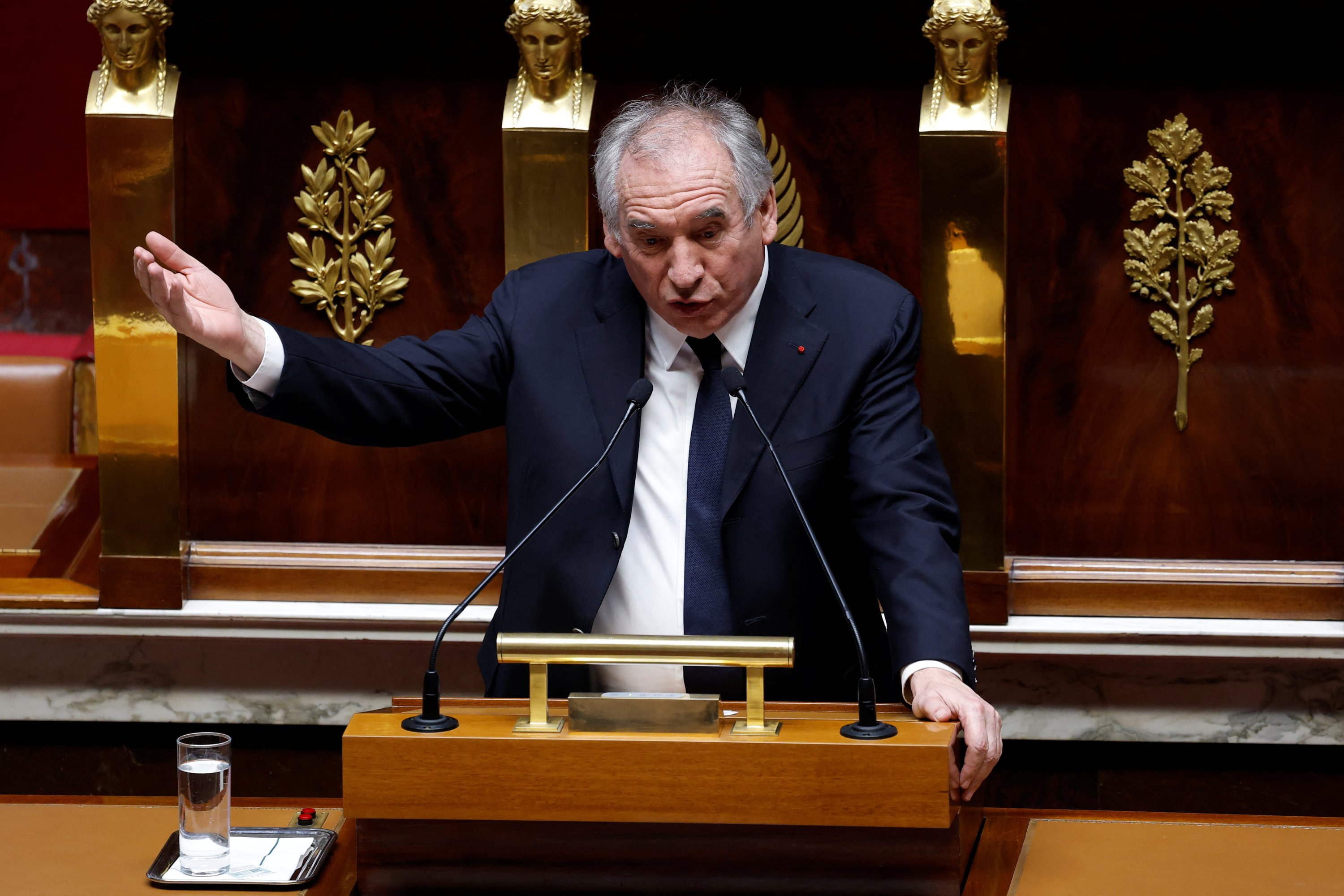
French Prime Minister Francois Bayrou used Monday special executive powers to get the country's 2025 budget approved without a vote by lawmakers and now faces a no-confidence motion that threatens the survival of his six-week-old government, although he appears to be on course to keep his job.
Bayrou, a veteran centrist named by President Emmanuel Macron in December to end months of political crisis following last summer's inconclusive legislative elections, is nowhere near having a parliamentary majority.
He rammed through the budget legislation on Monday using article 49.3 of the constitution, which allows the government to pass laws without a vote. The step immediately prompted a no-confidence motion from the left in the divided parliament. A vote is expected in the National Assembly on Wednesday.
But even if the far-right National Rally (RN) party decides to back the vote this week, Bayrou appears certain to keep his job for now, after the Socialist Party decided against backing the motion, giving the prime minister a much-needed boost.
France's main far-right party on Tuesday also said it did not intend to back a no-confidence motion against Bayrou over a cost-cutting budget, claiming it's a "bad budget" but that budget is needed.
Jordan Bardella, president of the National Rally confirmed that his party did not intend to vote against the government, though it would take its final decision on Wednesday, when the vote is expected.
"It's a bad budget," Bardella told the Europe1/CNews broadcaster.
But "we need a budget."
"We need to avoid uncertainty because many of our fellow citizens... are extremely worried about possible long-term instability," he said.
A vote expected on Wednesday may provide France with a budget at last, or send the country into new political and economic turmoil. Bayrou's survival depends on how many parties agree to support the motion.
He is France's fourth prime minister in little over a year.
French politics have been in disarray since Macron called snap elections last year that left no party with a majority in parliament. With one of the world's biggest economies, France's failure to pass a budget has worried investors and hurt the 20-country eurozone.
"No country can live without a budget," Bayrou told the National Assembly lower house.
"We have spared no effort to break this deadlock", he added, thanking his ministers.
The government is under pressure from the European Commission to bring the country's sprawling deficits and growing debt under control.
A sustainable budget plan for this year is the priority for Bayrou, after the austerity budget plan of his predecessor, Michel Barnier, was jettisoned along with his government in December.
The adoption of the budget will make it possible to limit the deficit to 5.4% of gross domestic product (GDP), Bayrou said, still one of the widest in the eurozone.
On Monday, he resorted to the tactic twice, to force through the budget as well as the social security budget, and may need to do this again later this week.
The use of article 49.3, while convenient for a minority government, means the opposition has the right to put forward a no-confidence motion to bring the prime minister and his government down.
In December, the far-right National Rally party teamed up with a left-wing bloc to topple Barnier's government.
The hard-left France Unbowed (LFI) on Monday swiftly called for a similar vote towards toppling Bayrou's government, tabling a motion of censure.
Mujtaba Rahman, Europe director at risk analysis firm Eurasia Group, said that Bayrou looked likely to survive the vote and France would have the budget, "a month late."
"Is there light in the tunnel of France's budgetary and political crisis? Yes, probably," he said on X.
The adoption of the budget and survival of Bayrou's government would be a huge relief for Macron as well.
New legislative elections cannot take place until at least one year after the previous polls, so the toppling of Bayrou's government would plunge France into uncharted political waters.
While fourth in little over a year, Bayrou is Macron's sixth prime minister since taking office in 2017.
He is the second since Macron last year called for snap polls that saw his alliance lose its majority in parliament, and the RN and its allies gain ground in the lower house.
The survival of Bayrou's government will be a relief for Macron who has faced calls to resign since the middle of last year but insisted he will stay on until the end of his term, due to end in 2027.
The prime minister managed to convince the Socialists not to back a no-confidence motion against him earlier this year.
It was a major victory for Bayrou that heralded the end of a broad left-wing alliance including the Socialists and hard-left LFI party that had endured since the election campaign.
But the Socialists broke off talks with Bayrou's administration last week after he referred to migrants "flooding" France, using terminology previously used by the far right.
In a symbolic move, the party leadership decided Monday to propose a separate no-confidence motion after the "flooding" comments.
Socialist leader Olivier Faure on Tuesday said his party decided against voting to topple the government over the budget, as it would only have resulted in France having "a prime minister further to the right," or even "the resignation of a head of state."
"We chose to give France a budget," he told the France Inter radio station.
But he defended the party's other no-confidence motion linked to the immigration comments, which he inferred was to object to "a form of Trumpification of public debate" in France.
Bayrou defended his "flooding" comments last week, pointing to the French Indian Ocean department of Mayotte, which has been battling with mass undocumented immigration from neighboring Comoros.
According to France's national statistics agency INSEE, there were some 5.6 million foreigners living in France in 2023, representing 8.2% of the overall population, against 6.5% in 1975.