The German economy grew for the first time in three years in 2025, although at a modest pace, as consumer and government spending surge begin to fuel a sluggish recovery.
Europe's biggest economy became stuck in stagnation when its vast industrial sector got priced out of key export markets, and consumers chose to save rather than spend.
Chancellor Friedrich Merz has launched a huge spending plan to boost economic prospects, but it is taking time to feed into the economy.
"After two years of recession, the German economy edged back into growth. The growth is primarily attributable to increased household consumption and government expenditure," said Ruth Brand, President of the Federal Statistical Office.
The economy grew by 0.2% both in the final quarter of 2025 and the year as a whole. The full-year increase was in line with the forecast by analysts polled by Reuters.
The German economy was broadly stagnant last year but improved relative to 2024, said Claus Vistesen, chief eurozone economist at Pantheon Macroeconomics.
"Looking ahead, our forecasts assume that the German economy will now gain momentum, primarily as the investment cycle turns, supported by sustained fiscal stimulus focused on infrastructure and defense spending," Vistesen said.
Gross domestic product (GDP) is 0.2% above its level in 2019 before the COVID-19 pandemic, finally recovering the ground lost, although with a lag in comparison with European peers.
German household consumption increased in 2025 by a price-adjusted 1.4%, while government spending grew by a price-adjusted 1.5%.
However, investment was down 0.5% compared with the previous year.
"The substantial growth in general government investment spending, particularly on defence, did not offset the decline in investment in machinery and equipment," the statistics office said. That segment fell 2.3%.
Germany's parliament approved in March plans for a massive spending surge, throwing off decades of fiscal conservatism in hopes of reviving economic growth and scaling up military spending.
The fiscal plan includes a 500-billion euro ($568 billion) special fund for infrastructure and plans to largely remove defence investment from the rules that cap borrowing.
Despite a 5.1% increase in government expenditure in 2025, the financial deficit was almost 8 billion euros lower than the previous year because revenue grew 5.8%.
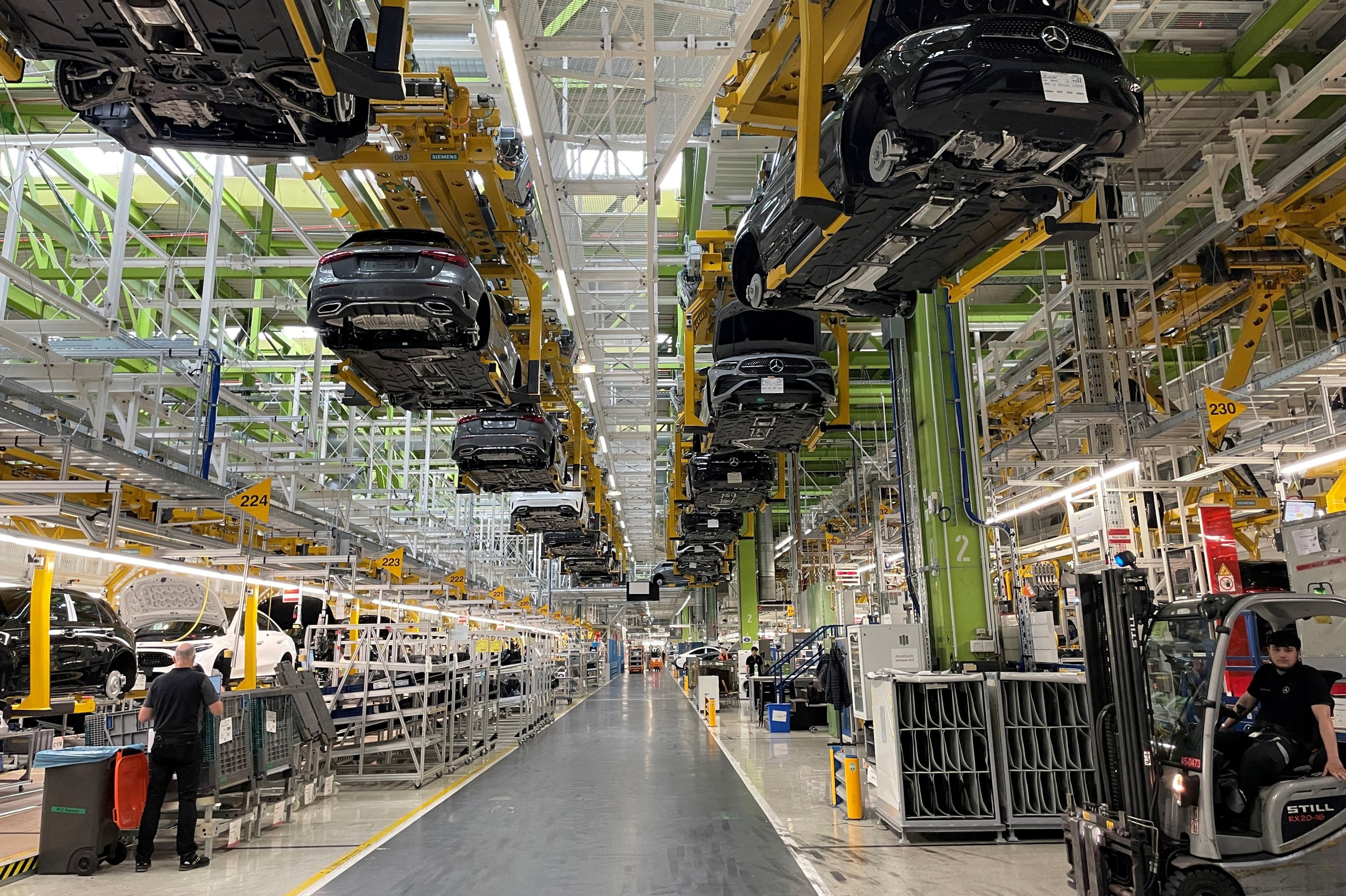
In a turbulent year for German foreign trade, exports fell 0.3%, dropping for the third consecutive year.
"Germany's export business faced strong headwinds owing to higher U.S. tariffs, the appreciation of the euro and increased competition from China," Brand said.
Fewer motor vehicles, trailers and semi-trailers, machines and chemical products were exported. By contrast, exports of services were up a price-adjusted 1.1% on the previous year.
Following two years of decline, imports rose substantially by 3.6% after adjustment for price effects.
As a consequence, the trade surplus more than halved to 110 billion euros ($127.6 billion) in 2025 from 241 billion euros in 2024. This is one of the lowest levels in more than two decades, showing how Germany's export growth engine has lost steam.
"The period of national gloom has come to an end and there are good reasons to finally be more positive about the German economy," said Carsten Brzeski, global head of macro at ING, citing fiscal stimulus as the main reason for optimism.
ING forecasts 1% GDP growth for this year, but Brzeski noted that the economy’s problems are deeply rooted, often structural and largely self-made, and solving these issues quickly is impossible.
"As regards Germany's growth prospects, the corn's about to pop," Brzeski said. "However, a healthy diet includes more than only popcorn."