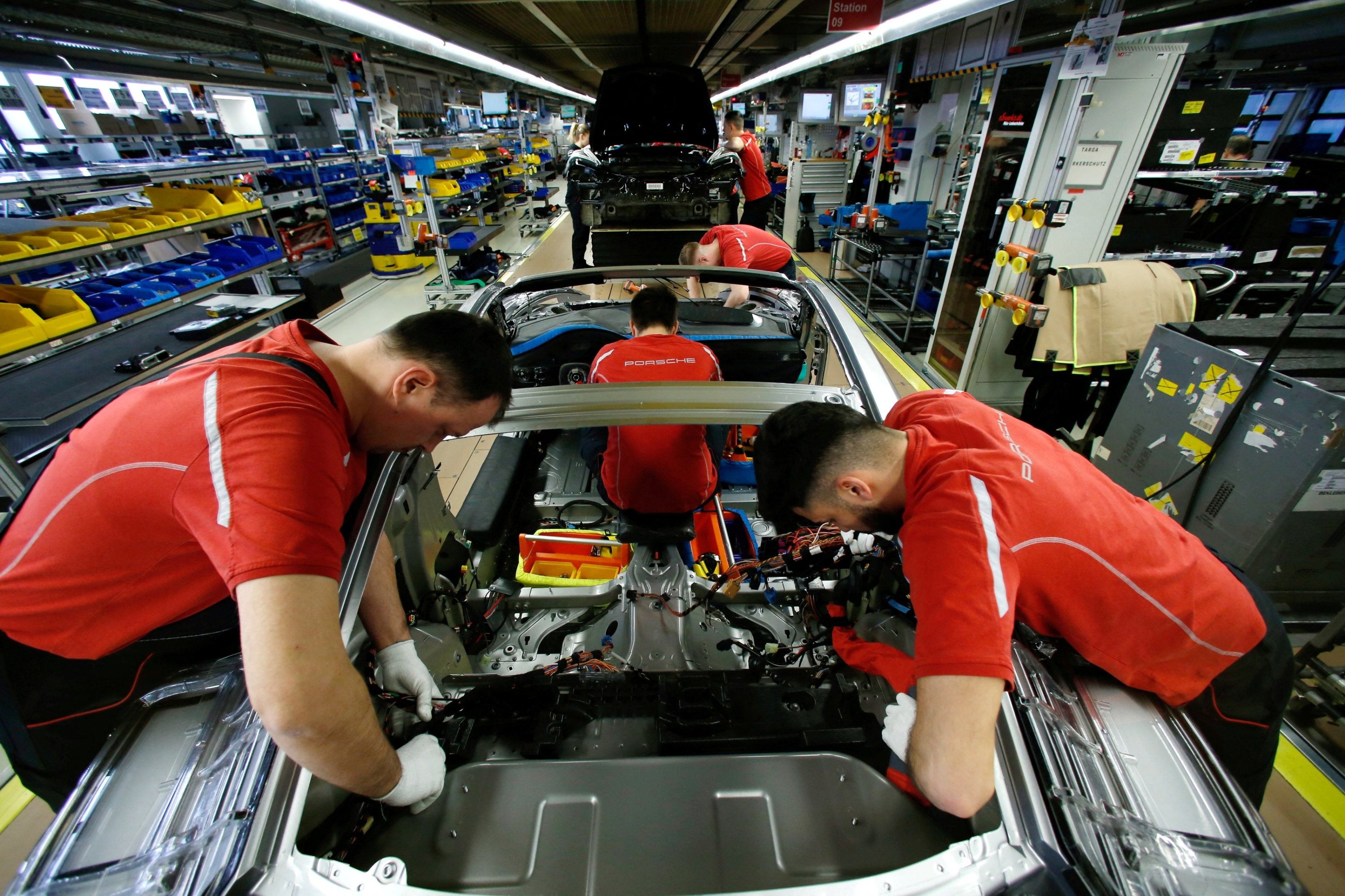
German factory orders dropped sharply in August, more than forecasted, as large-scale orders for aircraft, ships, trains and military vehicles declined, official data showed Tuesday, underscoring the fragility of a recovery in Europe's biggest economy.
New orders, a key indicator of future business activity, were down 10.6% from a month earlier due to a drop in large-scale domestic orders, according to provisional data from Destatis.
It was the first decline in four months and more than the 1% decrease forecast by analysts surveyed by the financial data firm FactSet and Reuters.
The long-stagnant German economy has been slowly recovering on the back of massive public spending, with some recent data generally pointing to signs of growing strength.
The economy ministry said August's order data thus represented a "marked setback."
The decline was entirely attributable to a 61.5% slump in what the statistics office classifies as "other transport equipment," a category that more than doubled in July due to an exceptionally high volume of large-scale orders of ships, railway rolling stock and aircraft.
When large-scale orders are excluded, new orders in August were 0.1% lower than in the previous month.
The weak figures suggest industry will weigh on third-quarter economic growth after helping to drive expansion in the first half of 2026, although analysts expect a rebound in the fourth quarter as government contracts pick up.
The German economy grew by 0.3% in the second quarter, prompting the government to raise its full-year forecast to 1.3%.
Much of the momentum seen in German industry so far this year has been driven by defense spending.
"Excluding these highly volatile large orders, bookings in the manufacturing sector have been treading water for months," said Jupp Zenze, economic expert at the German Chamber of Commerce and Industry.
"Broad-based economic momentum remains absent."
The three-month comparison, which strips out some of the month-on-month volatility, showed that new orders in the period from June to August were 1.3% higher than in the previous three months.
Based on the figures available so far, the industrial sector likely slowed growth of the German economy in the third quarter, in contrast to the first half of the year, said Commerzbank senior economist Ralph Solveen.
However, Solveen expects this trend to reverse in the fourth quarter, as the government is likely to issue more contracts, which should have a positive long-term impact on sales and production.
"This outlook is also supported by the significant improvement in business sentiment over the past few months," he said.
After revision of provisional data, new orders in July increased by 3.2% compared with the previous month, up from the previously estimated 2.5%.
According to the latest data from July, the order backlog provided coverage for a record nine months, said Marc Schattenberg, economist at Deutsche Bank.
"The disappointingly weak August figures should be viewed in the context of already very full order books," Schattenberg said.
Foreign orders were down 5.4% in August on the month, with orders from the euro zone registering a decline of 5.4% and orders from outside the eurozone decreasing by 5.5%. Domestic orders declined by 17.3% on the month.