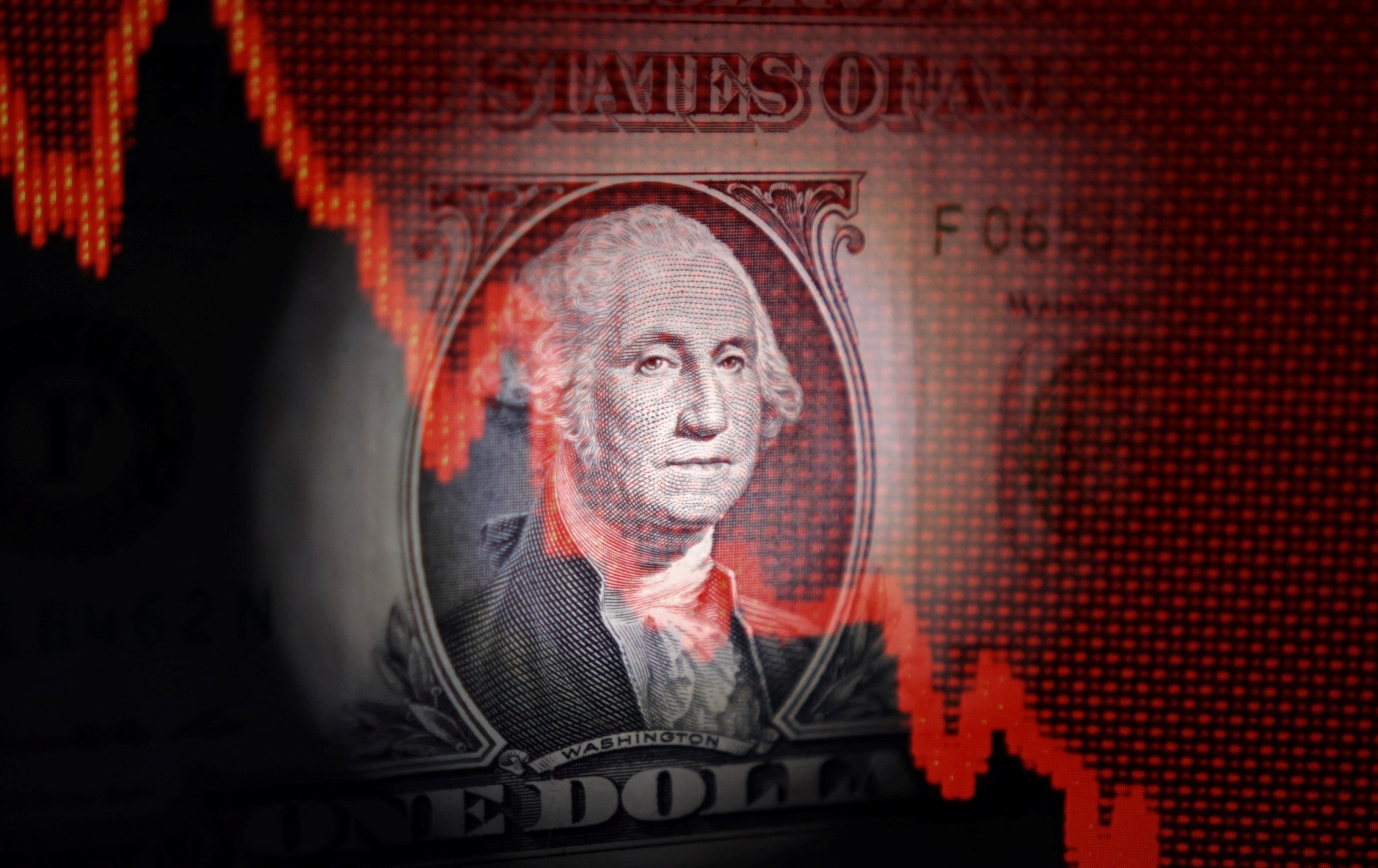
Government bonds from Tokyo to New York extended losses on Monday as rising energy prices fueled by the Iran war stoked inflation concerns and reinforced investor bets on further rate hikes by central banks worldwide.
Benchmark 10-year U.S. Treasury yields, which move inversely to prices, jumped as much as 3.6 basis points to their highest since February 2025, at 4.631%, in early Monday trading, after climbing more than 20 basis points last week.
The two-year yield, which is most sensitive to inflation and rates expectations, touched a 14-month top of 4.105%, while the 30-year U.S. Treasury yield rose to a one-year high of 5.159%.
All three were trading just below those highs by mid-morning in Europe, still enough to cast a shadow over stock markets that have surged on the AI enthusiasm of recent weeks.
The bond selloff came on the back of a climb in oil prices on Monday, with Brent crude futures at $111 a barrel, as efforts to end the Iran war appeared to have stalled following a drone strike at a nuclear power plant in the United Arab Emirates (UAE).
More than two months into the war, investors are beginning to fret about the economic fallout from the conflict, fearing high energy prices will spill over into broader price rises and require central banks to raise interest rates.
Markets are now pricing in a more than 50% chance the U.S. Federal Reserve (Fed) will raise rates by December, according to the CME FedWatch tool, to combat the rise in inflation. Before the war, investors had seen the Fed cutting rates this year.
Market ructions are top of mind for G-7 finance ministers who met in Paris on Monday.
"We are no longer in a period where public debt is not a subject," French Finance Minister Roland Lescure told reporters as he arrived at the meeting.
Kenneth Broux, head of corporate research FX and rates at Societe Generale, said to stop what he called a "slow-motion crash" in the bond market would require a retreat in oil prices, recession fears growing enough to spark a safe-haven rush to bonds, or prices falling low enough to attract buyers.
Adding to the selloff on Monday was news that Japan's government will likely issue fresh debt as part of funding for a planned extra budget to cushion the economic blow from the war, worsening already strained government finances.
Yields on the 30-year Japanese government bond (JGB) jumped more than 10 basis points (bps) to their highest on record at 4.200%, while the 10-year yield touched its highest since October 1996 at 2.800%.
DBS senior rates strategist Eugene Leow said news of the extra budget would compound current bond market anxieties.
"Sentiment was already weak heading into last week's close. Additional fiscal spending from Japan definitely worsened matters," Leow said.
"This feels like a rolling re-pricing across curves in the region as investors grapple with inflation worries."
Eurozone bonds were also under pressure, with Germany's 10- year yield, the benchmark for the currency bloc, hitting a 15-year top of 3.193%, extending last week's 14 bp gain.
Markets see an 80% chance the European Central Bank (ECB) will raise interest rates next month and are pricing three such moves by year-end. Before the war, the ECB was expected to remain on hold this year.
Monday's bond rout followed a steep selloff last week, as investors were spooked by a recent raft of hotter-than-expected inflation figures globally, particularly in the United States.
"The fact that we are now seeing data backing up inflationary fears that have been in the market since the Middle East conflict started I think is key," said Nick Twidale, chief markets analyst at ATFX Global.
Data last week showed U.S. consumer and producer prices surged in April, with similar readings seen in China, Germany and Japan.
Much emphasis had also been placed on a closely watched two-day summit between U.S. President Donald Trump and Chinese President Xi Jinping last week, but investor hopes the talks would produce a breakthrough in the Iran war fell flat.
Though the bond rout was global, many of the drivers were at least partly local in nature.
Britain last week was at the forefront of the selloff amid domestic political upheaval as Prime Minister Keir Starmer's future was called into question after poor local election results, raising investor fears he will be forced out and replaced by a more left-wing challenger.
On Monday, however, gilts were an unusual outperformer, with the 10-year yield down 4 bps to 5.14%. It jumped 26 bps last week to an 18-year high of 5.187%.