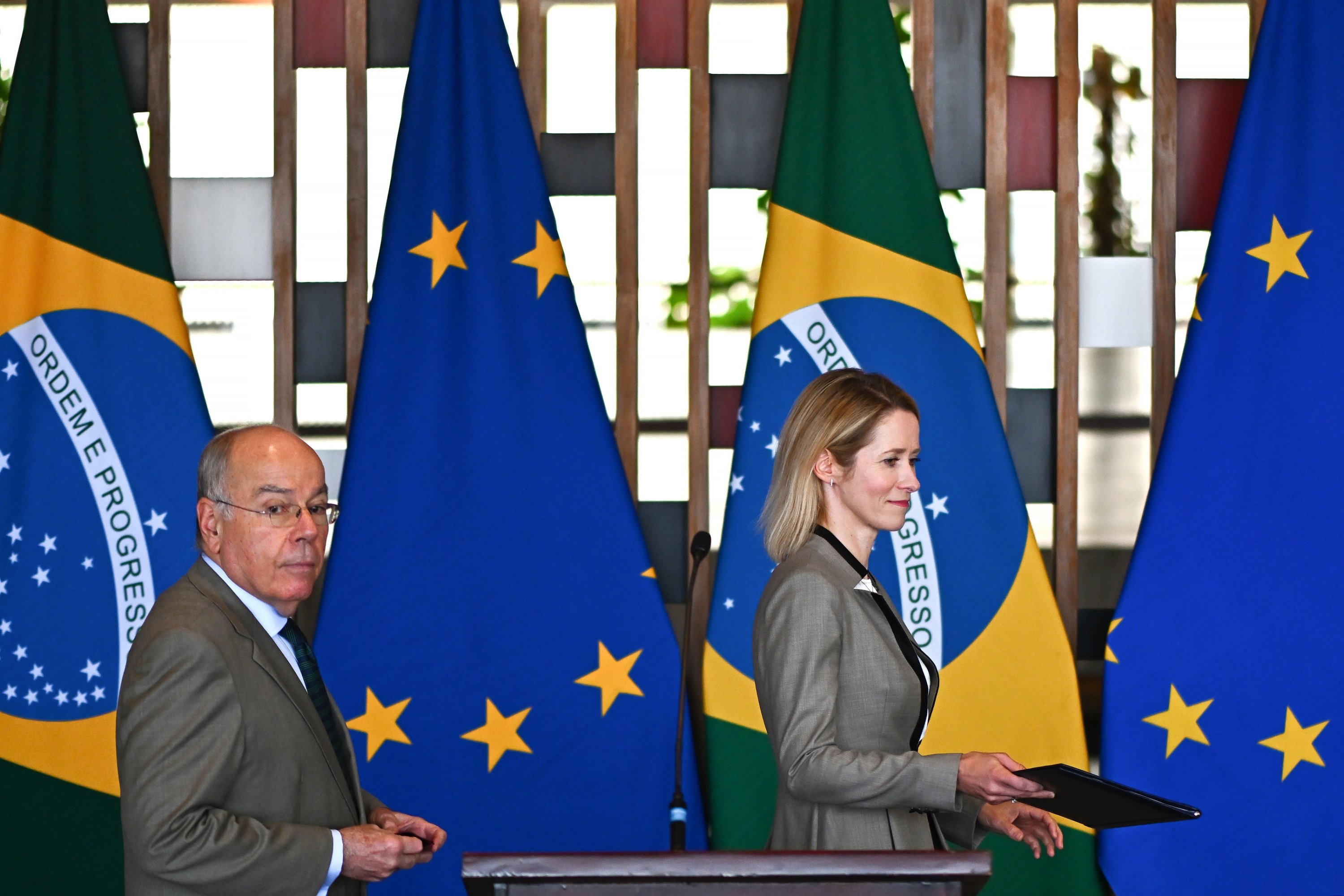
U.S. President Donald Trump's import tariffs have given a fresh impetus to stalled free trade talks worldwide, spurring prospects for alliances between partners seeking to offset lost exports to the U.S.
Since Trump's reelection last November, the European Union has struck three free trade agreements (FTAs) – with the South American bloc Mercosur, Mexico and Indonesia – and has its sights on a fourth, with India, by the end of this year.
The EU is not alone. Mercosur has sealed a free trade deal with the four-nation European Free Trade Association (EFTA) and relaunched negotiations with Canada, which were stalled in 2021.
India and New Zealand revived talks after a decade-long hiatus, while the United Arab Emirates (UAE) signed three trade agreements in a single day in January.
Brussels has been clear that it views new alliances as part of its response to the "unjustified" U.S. tariffs, which are broadly 15% on EU goods, and to Chinese oversupply and export restrictions on critical minerals that the EU needs for its green transition.
The new trade pacts may not fully compensate for losses in commerce with a more protectionist America – time will tell – but rival economies have been spurred into action nonetheless.
EU trade chief Maros Sefcovic told lawmakers last month in a debate about the one-sided EU-U.S. tariff deal struck at the end of July that the U.S., which represented 17% of EU trade last year, was "not the only game in town."
"We also need to take care of the other 83%. That means continuing our efforts to diversify our relations," he said.
The message has been taken on board by countries previously reluctant to open their markets, including India and France, whose opposition to the EU-Mercosur deal seems to have softened.
The trend has also been welcomed by World Trade Organization (WTO) Director-General Ngozi Okonjo-Iweala, provided the agreements align with WTO rules.
"Members negotiating more agreements with each other, that helps to diversify trade, it supports the WTO. It's not in competition because most of these agreements are built on our platform," she said last month.
But will new alliances offset U.S. tariffs?
In the short-term, no. The impact of U.S. tariffs is immediate, whereas the benefits of new trade agreements are years away, due to potentially lengthy approval processes and tariff cuts that are often phased over five to 10 years.
Investment to take advantage of those benefits could kick in sooner, though.
Longer term, it is unclear. New trade deals will eke out decimal points of economic growth, while EU exports to the U.S. and China, where demand for EU goods has declined, account for roughly 4% of the EU's gross domestic product (GDP). But not all of that will be lost.
Niclas Poitiers, a research fellow at the Bruegel think tank, says that average estimates for the Trump tariff's impact on EU exports imply a 0.2%-0.3% decline in GDP for the bloc. However, the impact of uncertainty on corporate investment may be less benign.
Poitiers said trade agreements have political value too by offering stable relations at a time when the U.S. is undermining the global economic order and pushing through deals that are not compliant with WTO rules.
"It's about making sure that your trading relationships are not just reliant on international rules, which are much less firm these days, but are also bound by a bilateral treaty," he said.
What may emerge is a network of deals underpinning the multilateral system, but excluding the U.S. and, to some extent, China.
Sabine Weyand, director-general of the EU executive's trade division, told a European Parliament hearing last week that the EU was presenting itself as "the reliable trading partner for the rest of the world."
Sander Tordoir, chief economist at the Center for European Reform, said Europe could lead a "rest of the band" group, but noted that it and others, such as Japan, ran trade surpluses and so needed buyers, not more sellers.
"The challenge is enormous," he said. "The U.S. has long constituted about 50% of global trade deficits, acting as a key source of incremental demand for global exports."
Therefore, the band would need to find ways to create demand for each other's exports while countering Chinese overcapacity.
For the EU, the rest of the world would be too small, and the only economy big enough to offset those of the U.S. and China was its own.
"Europe will need to stoke internal demand or face stagnation," Tordoir said.