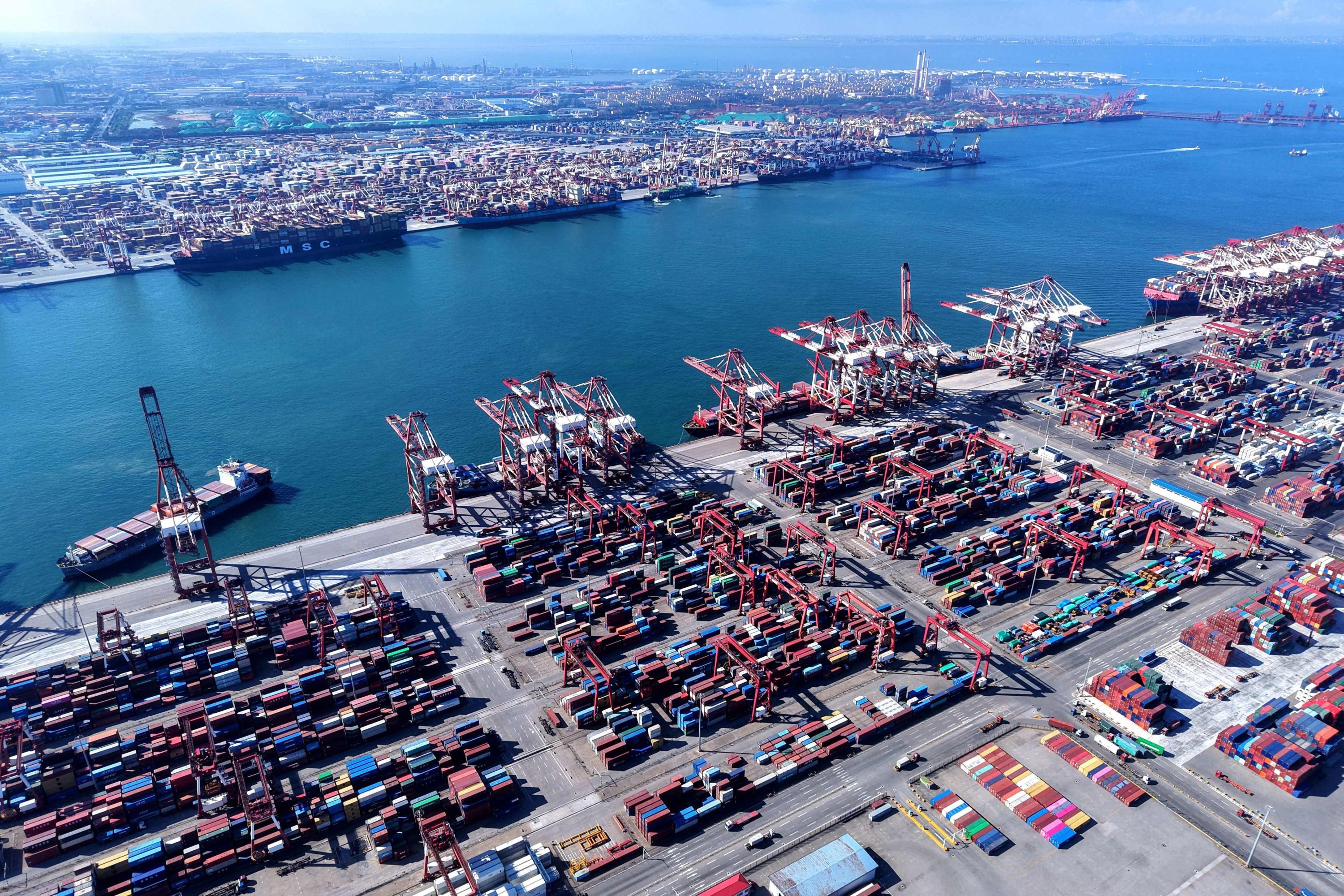
The International Monetary Fund (IMF) on Tuesday revised upward its growth projections for Türkiye and the global economy for this year and next, as U.S. President Donald Trump's protectionist trade policies have so far proven less damaging than expected.
The IMF now forecasts 3% growth for the global economy this year, it said in an update to its World Economic Outlook. That is down from 3.3% in 2024 but an improvement on the 2.8% it had forecast for 2025 back in April.
The 191-country lender, which works to promote growth, stabilize the world financial system and reduce poverty, expects world growth to come in at 3.1% next year, up a tick from the 3% it had forecast three months ago.
The IMF attributed the upgrades to strong business activity ahead of expected tariffs, lower-than-threatened U.S. tariffs, improved financial conditions – partly due to a weaker dollar – and fiscal stimulus in key economies like China, Germany and the United States.
Despite the upward revisions, the fund warned that the global economy faced major risks, including a potential rebound in tariff rates, geopolitical tensions and larger fiscal deficits that could drive up interest rates and tighten global financial conditions.
"The world economy is still hurting, and it's going to continue hurting with tariffs at that level, even though it's not as bad as it could have been," said Pierre-Olivier Gourinchas, chief economist at the IMF.
Trump's decision on April 2 – "Liberation Day,'' the president called it – to impose taxes of 10% or more on U.S. imports from most of the world's countries had been expected to be a bigger drag on global growth.
But the damage was limited, the IMF said, partly because many U.S. importers scrambled to bring in foreign goods before Trump's tariffs took effect and partly because Trump ended up suspending his biggest levies (including a 145% duty on Chinese goods).
"This modest decline in trade tensions, however fragile, has contributed to the resilience of the global economy so far," Gourinchas said at a press conference Tuesday.
"This resilience is welcome, but it is also tenuous. While the trade shock could turn out to be less severe than initially feared, it is still sizeable, and evidence is mounting that it is hurting the global economy.''
Tariffs raised $108 billion for the U.S. Treasury from October through June, nearly double the $55.6 billion they brought during the same period of the previous fiscal year.
Global growth of around 3% is below the pre-pandemic average, and the world economy would be growing faster without Trump's trade wars.
The IMF modestly upped its forecast for U.S. economic growth to 1.9% this year and 2% in 2026 when the big tax cuts Trump signed into law July 4 are expected to provide "a near-term boost.''
The Chinese economy, the world's second biggest, is expected to grow 4.8% this year, a hefty upgrade from the 4% the IMF had forecast in April. China is getting a boost from lower-than-expected U.S. tariffs and from government spending.
The 20 economies that share the euro currency are collectively expected to expand 1%, up from the 0.8% the IMF had forecast in April. But a big chunk of that growth is coming from a surge of pharmaceutical exports from Ireland, which were timed to beat Trump's expected tariffs on drugs.
Japan remains in a slow-growth rut and is expected to eke out an expansion of just 0.7% this year and 0.5% next.
In Türkiye, the IMF sees the economy growing by 3% this year, compared to its forecast of 2.7% in April.
For 2026, the fund expects Türkiye's economy to expand by 3.3%, slightly higher than the previous 3.2% forecast.
India is once again expected to be the world's fastest-growing major economy, expanding a forecast 6.4% this year and next.
Trump has pressured Japan and the European Union to accept 15% U.S. tariffs on their exports. Indonesia, Vietnam and the Philippines also agreed to accept stiff U.S. tariffs. More such deals are expected before Friday, when Trump will slap even higher tariffs on countries that don't agree to make concessions.
Gourinchas said the IMF was carefully evaluating new U.S. deals reached with the European Union and Japan over the past week, which came too late to factor into the July forecast.
"We'll have to see whether these deals are sticking, whether they're unravelled, whether they're followed by other changes in trade policy," he said.
Tariffs agreed so far in those deals were similar to the effective U.S. tariff rate on which the IMF based its latest assumptions, he added.
Staff simulations showed that global growth in 2025 would be roughly 0.2 percentage point lower if the maximum tariff rates announced in April and July were implemented, the IMF said.
Trump's protectionism is buffeting global commerce.
The IMF upgraded its forecast for growth in world trade, measured by volume, to 2.6% this year. That is up from the 1.7% it had predicted in April and reflects a surge in shipments as exporters tried to beat the tariff crunch.
But eventually, the higher U.S. levies are expected to take a toll. The IMF sees trade growing just 1.9% next year, down from the 2.5% it had forecast in April.
Gourinchas said the 2025 outlook had been helped by what he called "a tremendous amount" of front-loading as businesses tried to get ahead of the tariffs, but he warned that the stockpiling boost would not last.
"That is going to fade away," he said, adding: "That's going to be a drag on economic activity in the second half of the year and into 2026. There is going to be payback for that front loading, and that's one of the risks we face."
Trump has also unsettled financial markets by openly and repeatedly criticizing Federal Reserve Chair Jerome Powell for the Fed's reluctance to cut American interest rates. Powell has said that the central bank must wait to better understand the impact of Trump's tariffs on inflation.
That same message was delivered last week by the European Central Bank (ECB), which is also holding off on rate calls to measure the impact of Trump's tariffs.
At the press conference on Tuesday, Gourinchas spoke up in favor of keeping central banks like the Fed independent from political pressure.
"The evidence is overwhelming that independent central banks, with a narrow mandate to pursue price and economic stability, are essential'' to containing inflationary pressure, he said.
The Fed and other central banks raised rates after inflation flared up in 2021 and 2022. They managed a so-called soft landing – bringing inflation down without causing a recession.
"That central banks around the world achieved a successful 'soft landing' despite the recent surge in inflation owes a great deal to their independence and hard-earned credibility," Gourinchas said.