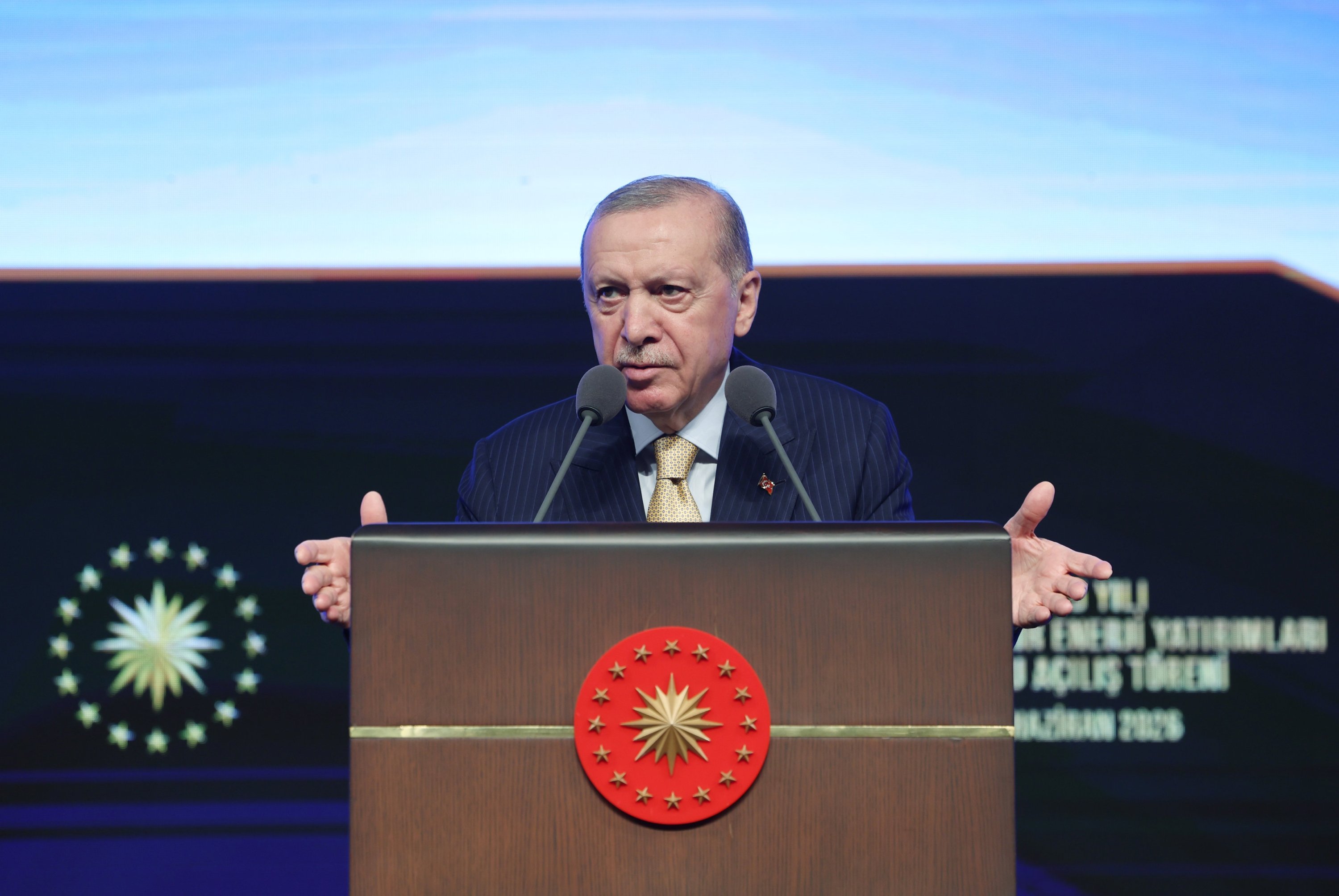
President Recep Tayyip Erdoğan said on Wednesday that the Middle East conflict and its fallout have reinforced Türkiye's strategic importance in global energy supply.
Speaking at the inauguration ceremony for renewable energy projects completed in 2025, Erdoğan highlighted the country's role as a regional energy hub and transit corridor.
Over three months into the war that started after the U.S. and Israel launched strikes on Iran, the world is facing a vast economic pain due to the severe disruption of energy supplies and other shipping.
A shaky cease-fire agreed in April still stands, but diplomacy to halt the conflict and reopen the Strait of Hormuz, a route that handled roughly a fifth of global oil and liquefied natural gas shipments before the war, is showing little sign of progress.
Erdoğan said recent developments had reaffirmed the significance of energy security for national economies and sovereignty. The crisis has "cemented Türkiye's critical role in the global energy supply," he noted, stressing that the impact of the war would continue to be felt.
The effective closure of the Strait of Hormuz has caused what the International Energy Agency (IEA) says is the biggest energy supply disruption ever. Gulf oil producers have lost around 14 million barrels per day (bpd) of supply since the end of February.
On Tuesday, IEA warned that global oil inventories could hit critical levels ahead of the peak summer demand period if stock draws continue at their current pace.
Erdoğan said the conflict drove up prices of everything from oil, gas and LNG to petroleum-derived products, including fertilizers and plastics, while various restrictions implemented to curb energy consumption recalled the days of the COVID-19 pandemic.
"Türkiye's role as a regional energy hub and crossroads is growing stronger by the day. It is very clear, especially in light of recent developments, that Türkiye is the region's key player in the energy sector," said Erdoğan.
He described energy supply security as not only a development issue but also a matter of sovereignty and national security, adding that the experiences of both the Russia-Ukraine war and the Hormuz crisis had underscored the need for diversified and secure energy sources.
The president said growing industrialization, urbanization and technological development would continue to increase global energy demand, pointing to projections that electricity consumption by AI-focused data centers could double within five years.
Türkiye's electricity consumption rose 2.1% in 2025 from a year earlier, while demand is expected to increase by at least 50% by 2035.
Erdoğan reiterated Ankara's goal of reducing dependence on imported energy through greater use of domestic and renewable resources.
Imported sources currently account for about 57% of Türkiye's energy supply. Its annual energy import bill stands at around $60 billion.
Türkiye currently ranks fifth in Europe and 11th globally in renewable energy installed capacity.
Under the National Energy Plan covering 2020-2035, Ankara aims to increase combined solar and wind power capacity from 40 gigawatts (GW) at the end of 2025 to 120 GW by 2035.
The expansion will require investments of around $80 billion and include the construction of a green transmission infrastructure to integrate additional renewable energy into the grid, Erdoğan said.
Plans also include development of 5 GW of offshore wind capacity by 2035.
Erdoğan said Türkiye's total installed electricity capacity reached 125,410 megawatts (MW) by the end of April, with renewables accounting for 62.5% of the total. Solar power alone contributed 26,770 MW.
Renewable sources generated 43.3% of Türkiye's electricity output by the end of 2025, up from 24% in 2005, when total electricity generation stood at 162 terawatt-hours (TWh). Total generation is expected to reach 363 TWh this year.
The president said 7,110 power plants entered service in 2025, representing investments of approximately $5.6 billion and adding 8,313 MW of installed capacity. Solar projects accounted for 6,063 MW and wind projects for 1,946 MW.
That marks a new record after $5 billion worth of 6,818 MW of installed capacity was added in 2024, said Energy and Natural Resources Minister Alparslan Bayraktar.
The new facilities are expected to generate 7.3 TWh annually and help avoid the need for 3.5 billion cubic meters of natural gas imports, saving an estimated $1.8 billion per year, Erdoğan said.
"We have avoided such a bill thanks to the investments we put into service today."