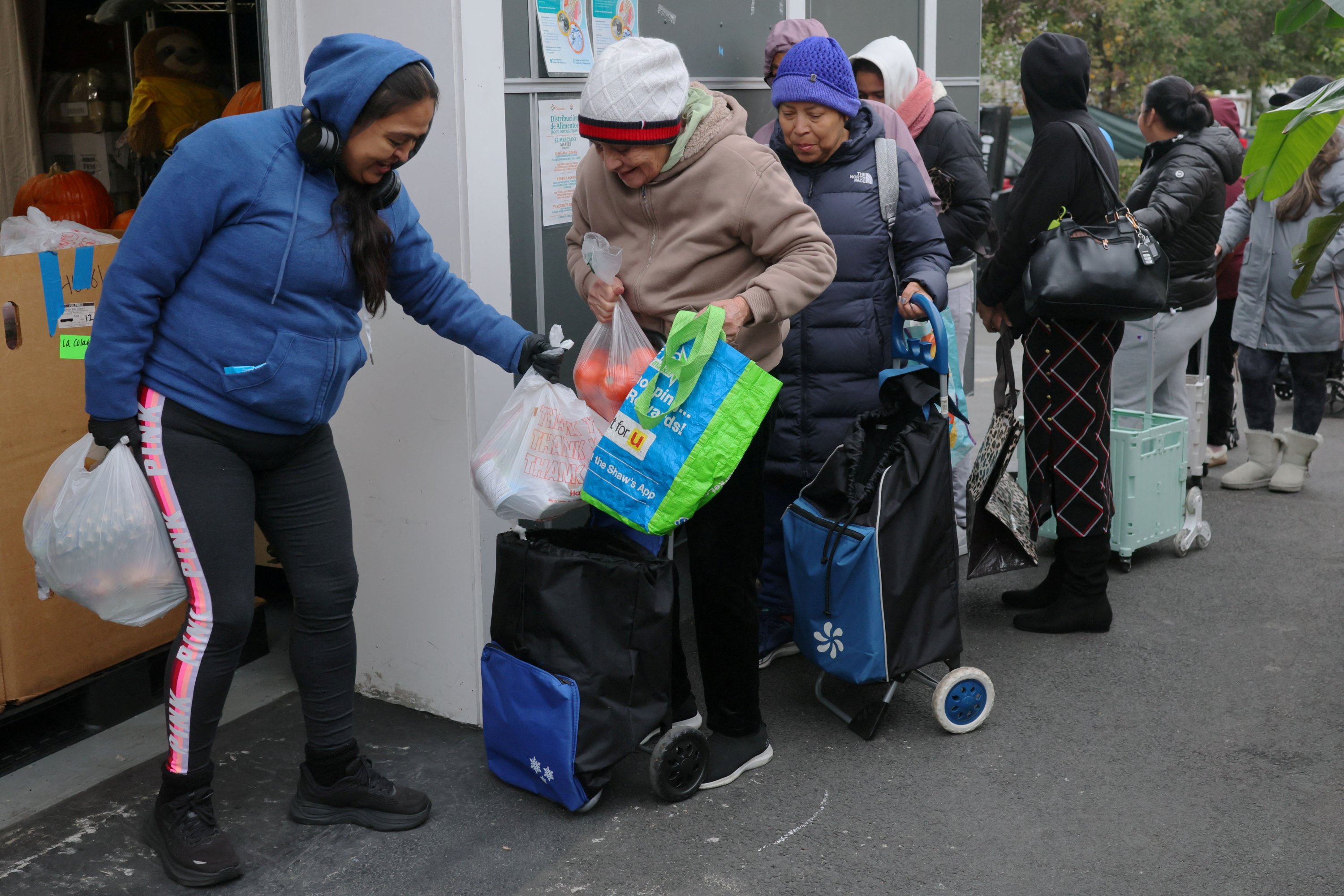
Approximately one in eight Americans receiving food stamp benefits from the U.S. government faced a threat as the main program backing them was on track to lose its funding as of Saturday due to the government shutdown, which has now entered its second month.
One such beneficiary is Eric Dunham, a 36-year-old man who became disabled after an accident and needs help from the federal Supplemental Nutrition Assistance Program (SNAP) to live.
"If I don't get food stamps, I can't eat," Dunham told Agence France-Presse (AFP), explaining that after all his expenses, he has just $24 left over per month.
"That's it," the father of two teenagers said. "The rest goes to child support."
Since the federal government closed on Oct. 1 due to ongoing budget disagreements between Republicans and Democrats in Congress, President Donald Trump's administration has announced it would no longer be able to fund SNAP as of Saturday – the first cessation since the program began six decades ago.
A federal judge stepped in Friday and ordered the government to use emergency funds to keep SNAP running, and Trump said he aimed to comply. But many recipients have had their aid disrupted amid the bureaucratic tug-of-war.
Separately, a federal court in Rhode Island on Saturday ordered the Trump administration to make full food aid benefit payments by Monday or partial payments by Wednesday, while acknowledging the "irreparable harm" that would occur without their timely payment.
Dunham – who works in the service industry, though in a reduced capacity since his accident – received some sandwiches and drinks on Saturday afternoon, distributed by Petit Beignets and Tapioca, a restaurant in northwest Houston.
"There's a lot of layoffs going around, and on top of that, we have the government shutdown and the SNAP benefits – nobody knew what was going to happen and I made sandwiches for someone who comes and has SNAP benefits, and at least can have one meal for sure," the restaurant's owner, Nhan Ngo, 37, said.
Though Dunham could not use his SNAP card to repay Ngo, he gave him a surprise hug as a show of thanks.
Supplemental Nutrition Assistance Program benefits, known as SNAP, or food stamps, provide a crucial aid to millions of low-income Americans.
Elsewhere in the city, thousands of people who did not receive their food stamps or fear they will not get them in the near future lined up in cars outside NRG Stadium, where the Houston Food Bank is distributing fruit and non-perishable food items.
The food bank's president, Brian Greene, told AFP that the SNAP stoppage affects "about 425,000 households just in the Houston area."
"So every community is trying to step up to help these families get by in the meantime."
Elsewhere, in other states, there were many facing the same issues.
For Roma Hammonds, of Chattanooga, Tennessee, food stamps have been a lifeline since taking custody of her grandchildren five years ago.
Hammonds, 60, who cannot work because of a physical disability, has relied on her $563 in monthly SNAP benefits to feed her family of four and to afford other bills like rent, she said.
"I don’t know what I’ll do," Hammonds said. Tennessee is among the vast majority of states that have said they cannot pay for the aid themselves.
Despite the judicial order to resume funding SNAP during the shutdown, "it would take several days for the states to restart the program," Greene explained. "They all had to stop because they were out of money."
The benefits gap affected Sandra Guzman, a 36-year-old mother of two, who had placed an order for her food stamps last week but was told there were none available. She had to seek food aid elsewhere in the meantime.
"This is not something extraordinary or luxurious, this is something basic, as getting food for my kids," Guzman told AFP. "I'll say food stamps represent 40% ... of my expenses."
Mary Willoughby, a 72-year-old Houston resident, waited in line outside the stadium with her granddaughter to receive food. She thinks that if the aid freeze lasts, it could cause widespread chaos.
"We need our food stamps. We need our social security. We need our Medicare ... If you cut all that out, it's going to be nothing but a big war right now because people are gonna start robbing," she said.
"We need the help."
Neither Congress nor the Trump administration has acted to fund benefits. Two federal judges on Friday ruled that the administration cannot block November SNAP benefits and must use about $5 billion in agency contingency funds to pay for them, requiring updates by Monday on compliance with their rulings.
Some Democratic-led states have blamed the Trump administration for the lapse, while some Republican-led states have blamed Democrats in Congress.
North Carolina Governor Josh Stein, a Democrat, said the administration is at fault because of its decision not to use the emergency funds.
"The administration’s refusal to use these available funds as temperatures cool and the Thanksgiving holiday approaches is a cruel abdication of the responsibility to support families and communities," Stein said in an Oct. 27 statement.
The website of Louisiana Governor Jeff Landry, a Republican, blamed Democratic Senators for withholding their votes on a spending bill.
Meanwhile, another person in line, Carolyn Guy, 51, said she found it absurd that the Trump administration was paying millions to build a new White House ballroom while claiming there was no money to fund SNAP benefits.
"Why are you taking our stuff from us? We work hard," she said.
"You can take our food stamps, but here you're getting ready to build a ballroom? Doesn't make sense to me."