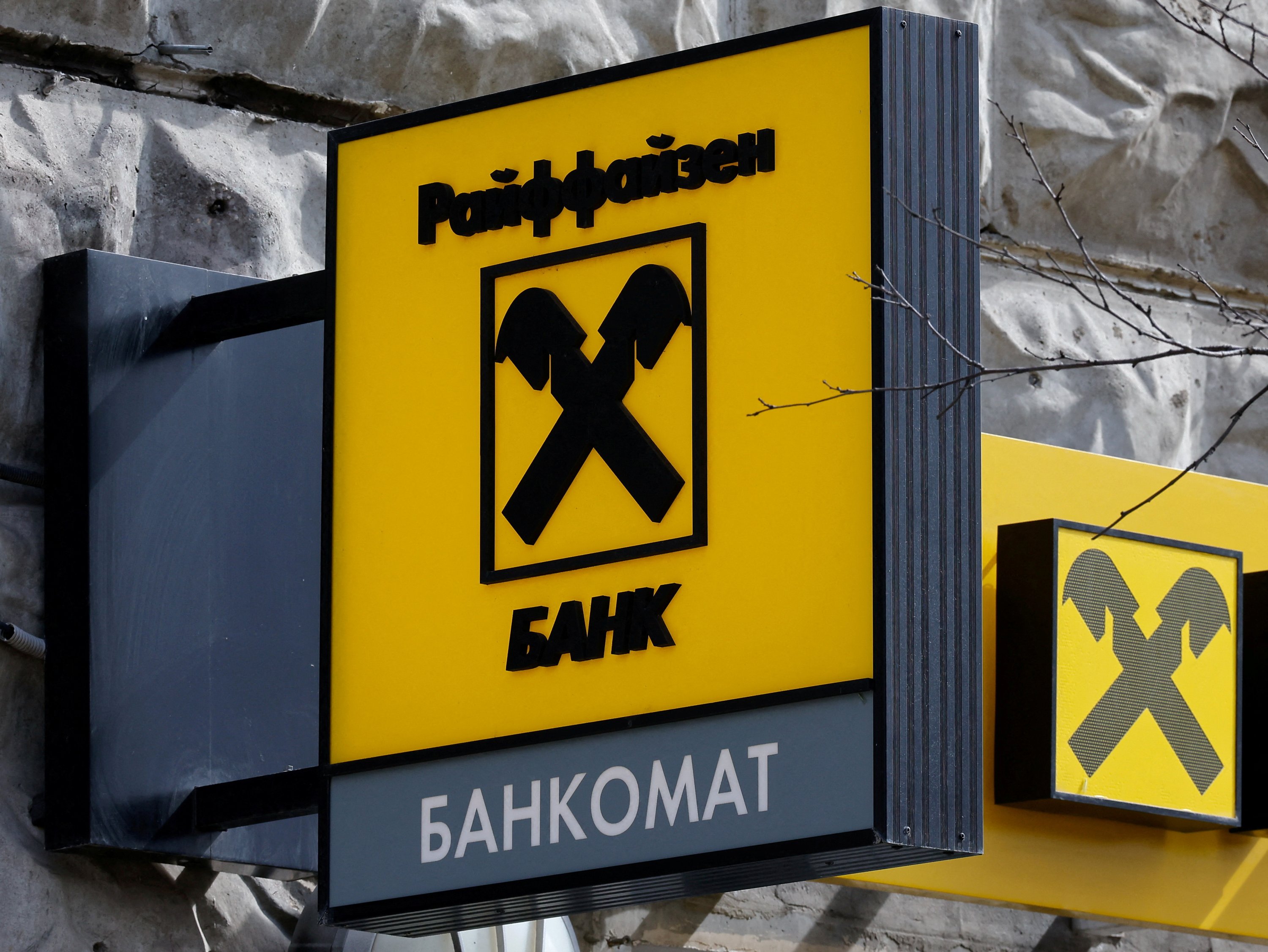
Raiffeisen Bank International (RBI) has reportedly failed in another attempt to sell a stake in its Russian business, two people familiar with the situation said on Wednesday, as Moscow seeks to maintain a key financial link to the West.
Raiffeisen's bank in Russia is the biggest lender in the country that is not subject to sanctions, which have isolated local rivals, making it of critical importance for trade payments with Russia, including gas exports to Europe.
Russian officials opposed a sale in part because they were concerned that a Russian buyer taking the stake could result in Western sanctions against RBI, the first person said.
Both spoke on condition of anonymity due to the sensitivity of the matter.
Raiffeisen has been looking to sell a stake in its Russian arm to a local buyer in the hope that Moscow would lift a block on its repatriating billions in profits from the business.
It is also under pressure from the U.S. and European Union to pare back activity in Russia due to Moscow's war in Ukraine.
A Raiffeisen spokesperson said that it was cutting its business in Russia and that any sale of its business would require Russian approval, without commenting on any recent discussions.
"RBI is negotiating about a sale of its Russian subsidiary," the spokesperson said, adding that the bank could not give a timeframe, "as numerous regulatory approvals are required, including approvals of the Russian authorities."
Chief Executive Johann Strobl had made several attempts in the past to sell a stake in the Russian business. The first person said he had visited Russia for this end.
Russia's central bank said it would not comment on any discussions with specific banks. Reuters could not establish which officials and potential buyers the RBI has talked to.
The latest sales efforts foundered as tension between Moscow and the West has been building.
European leaders have been stepping up preparations to use tens of billions of euros in assets belonging to the Russian central bank to support Ukraine.
Europe also wants to end Russian gas imports, following U.S. President Donald Trump's demand that Europe cut energy ties to Moscow. The shooting down of Russian drones over Poland has further strained relations.
Vienna, the capital of Austria and home to the RBI, has also been recently criticized by former Russian President Dmitry Medvedev, who warned of consequences should Austria abandon its neutrality.
For now, Raiffeisen remains important for Russia in terms of gas and other payments, the two people said, even as it scales back its activity.
Russia's opposition to a stake sale was grounded in a desire to maintain what remains of its economic ties with Europe, which still buys billions of euros of Russian oil and gas, albeit far less than before the war.
A third person with knowledge of Raiffeisen's work in Russia said the country's authorities sought to maintain it as a gateway for money transfers with Europe, and that the bank intended to continue operating there.
Austria and Russia have been intertwined since the Russian army's occupation of the country at the end of World War II, when it was handed back its independence on condition that it remained neutral.
Austria went on to become the first Western European country to sign a deal to buy Russian gas, and Vienna became a significant financial hub for Russia.
Raiffeisen's special status and its size – far larger than the other European banks in Russia, Italy's UniCredit, and the smaller Hungarian group OTP Bank – have allowed RBI to build up roughly 7 billion euros ($8.22 billion) in profits now stranded there.
If the West blacklisted Raiffeisen, that would throttle an important avenue for payments, further isolating Russia.
Raiffeisen processes payments for the TurkStream pipeline, Russia's only remaining route for sending gas into Europe after others were cut, the people said.
TurkStream delivered roughly 11.5 billion cubic meters (bcm) of gas in the first eight months of this year via Türkiye to European countries, including Bulgaria and Hungary.
At average market prices, that gas was worth roughly $3.8 billion, making it an essential part of Russia's gas exports.
The third person said that despite the RBI limiting outgoing euro payments, a small number of large Russian companies were allowed to make payments overseas in euros via the bank.
The Raiffeisen spokesperson said that lending, deposits and payments in Russia had been reduced, and that payments "are subject to severe restrictions and are in compliance with sanctions."
Raiffeisen has been heavily criticized by Ukrainian officials for its banking activities in Russia, which are reportedly supporting the country's war economy.
The bank is vulnerable to Russian penalties. Earlier this year, it was ordered by a Russian court to pay 2 billion euros in damages over the collapse of a complex asset swap.