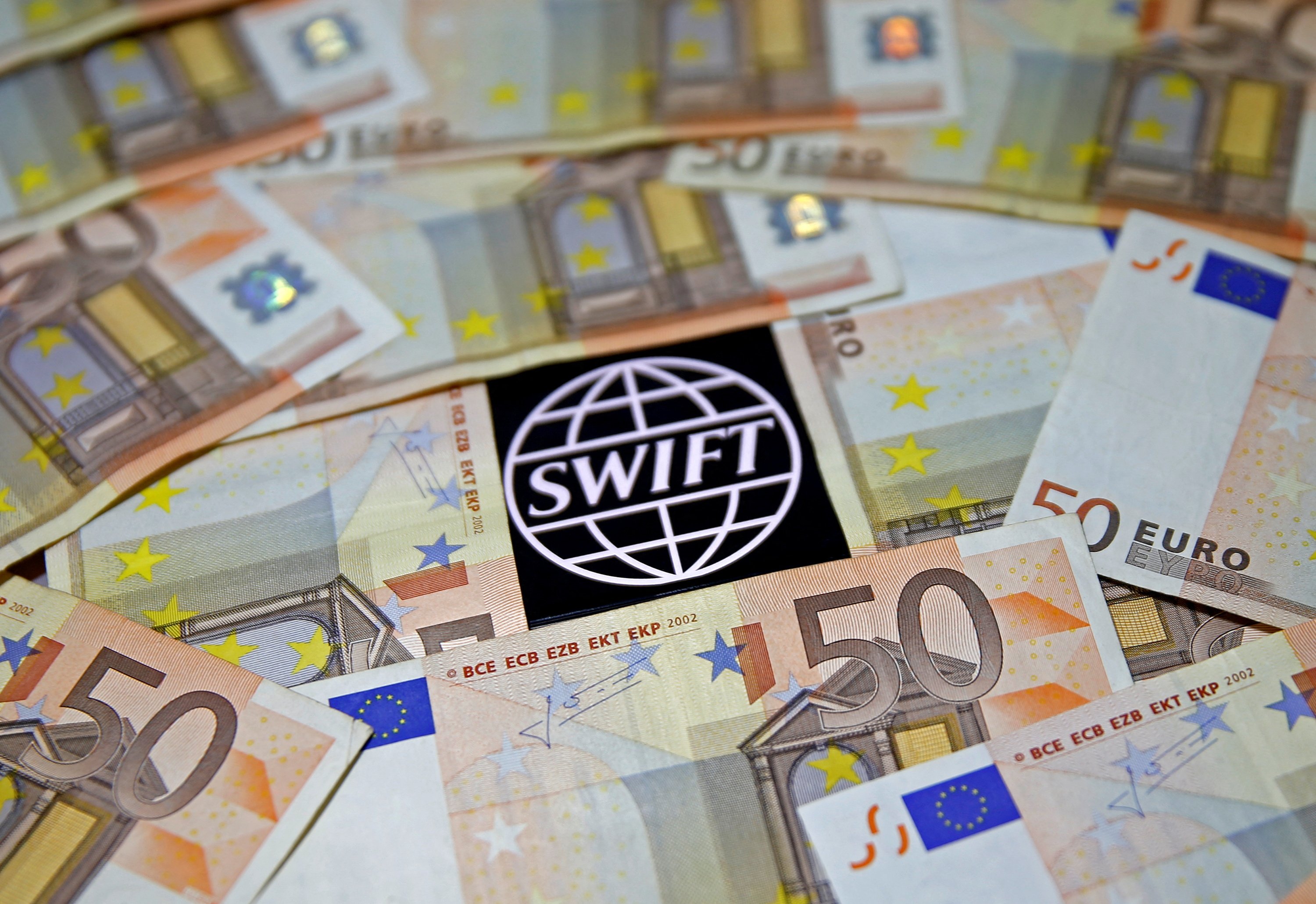
After sanctions removed several Russian banks from the SWIFT international payments network, Moscow is likely to seek alternatives, especially as Western officials threaten to expand sanctions if the Ukraine conflict continues.
Russia could in theory try to replace SWIFT's communications system that keeps international trade flowing smoothly. But any alternatives would add significant costs and risks for Russian businesses, money transfer experts said. The impact on Russia would be a reduction in imports and export volumes, at least in the short term, they added.
The Society for Worldwide Interbank Financial Telecommunication (SWIFT) is a secure messaging system for banks, which facilitates rapid cross-border payments. Senders of SWIFT's secure messages can be confident they will be acted upon, as recipients are contractually liable if they fail to respond.
Russia has become one of the top users of the system, having had a board seat since 2015 and with more than 300 Russian banks using it as their primary method of communicating with domestic and international banks.
Here is a rundown of the potential alternatives and why it is not easy to replace SWIFT:
Russian banks could move to a messaging system developed by Russia's central bank – System for Transfer of Financial Messages (SPFS). Last year, the central bank was reported as saying domestic interbank traffic could easily be transferred to this platform.
A spokesperson for the Russian Central Bank was not immediately available for comment.
But the "SWIFT analogue," as the central bank calls it, has limitations. It only operates during weekday working hours, while SWIFT operates 24 hours a day, every day. Also, SPFS messages have size limitations potentially making it less able to handle more complex transactions.
The SPFS system also lacks international connectivity.
“Currently, international services are limited to countries such as Armenia, Turkey, Uzbekistan and Kazakhstan,” analysts at Morgan Stanley said this week.
Russian banks could in theory use SPFS messaging to send international payments to a connected bank in one of the countries that belong to the network. This bank could then use SWIFT to pipe the instruction into the international banking system, said Alistair Milne, Professor of Financial Economics at Loughborough University.
But a sudden surge in transactions via such a route would be likely to attract the attention of international regulators, thereby deterring the non-Russian partner bank from continuing this activity.
Professor Markos Zachariadis of University of Manchester, author of a book on SWIFT, said even if regulators did not take action, the banks could soon find themselves ostracized by Western banks, which have grown wary of engaging in activity seen as undermining sanctions.
Another possible response to a SWIFT ban would be for Russian banks to connect to China’s CIPS payment platform. However, China’s platform can only be used for settling payments in yuan.
Analysts at Morgan Stanley said only 1.9% of international payments are made in the Chinese currency, against around 40% for U.S. dollars, which limited the effectiveness of CIPS as a method for funding cross-border trade.
Also, since CIPS itself relies on the SWIFT network for its operations, piggybacking on CIPS could also be seen as a breach of a SWIFT ban, analysts said.
Indirect CIPs participants still need to go through SWIFT to complete settlements.
A more suitable SWIFT alternative for Russian banks would be to set up bespoke, bilateral systems using phones, faxes or messaging apps with an overseas partner who would take payment from importers of Russian goods and make payments to exporters to Russia.
Such a system was created by one foreign lender when Iran was cut off from the SWIFT network by sanctions tied to its nuclear program, a former SWIFT executive familiar with the matter said.
This required a small team of people processing payments on the basis of sending two faxes and making two phone calls for each transaction.
But however effective, such systems are also prone to error and face security challenges. While SWIFT is plugged straight into a bank’s systems, faxes or WhatsApp messages may involve manual transfer of data.
Errors and the necessity for extra checks to avoid them would raise costs and could make smaller ticket transactions uneconomic, industry experts said.
“It’s not an easy workaround,” Zachariadis said.