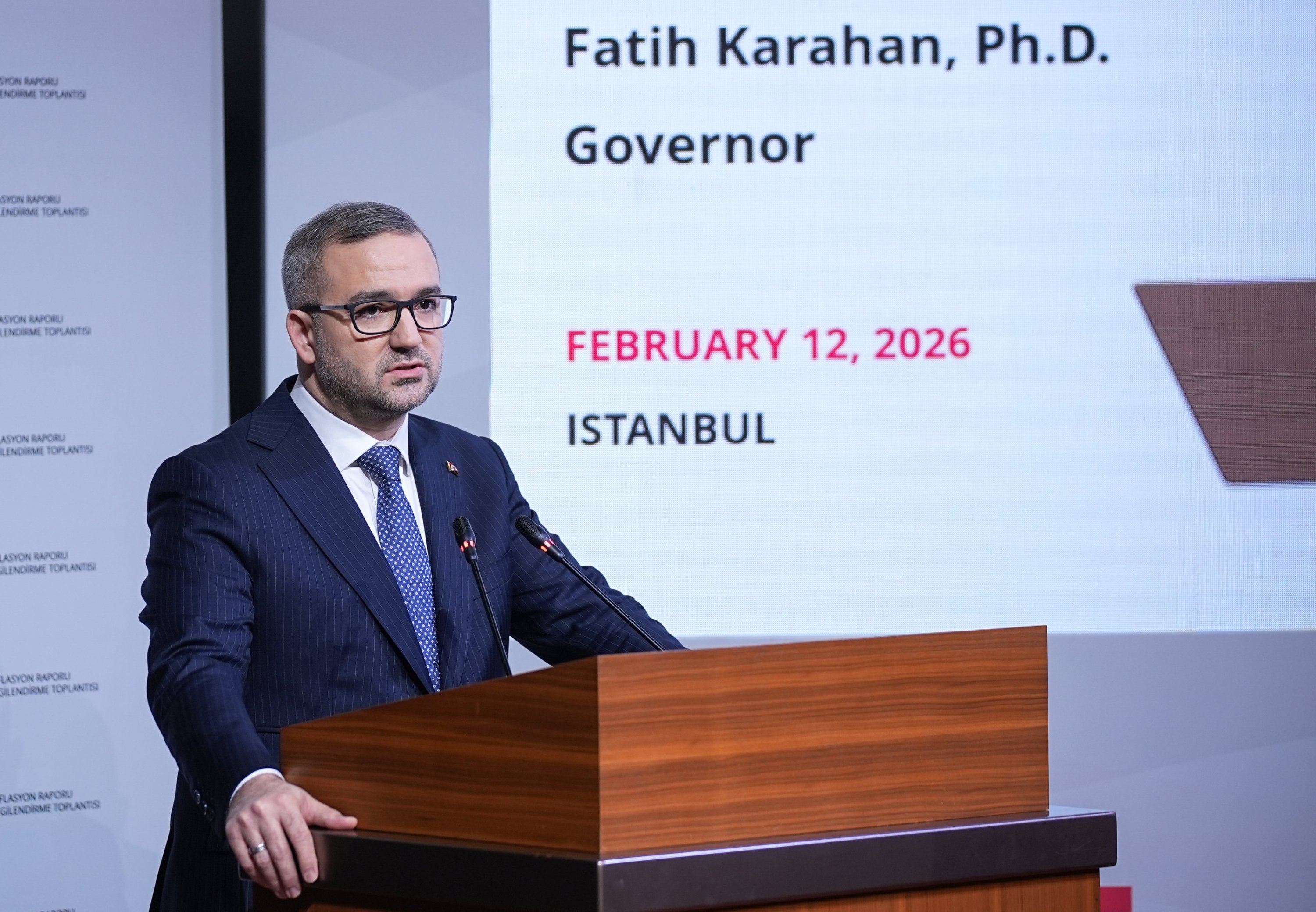
The Turkish central bank lifted its year-end inflation forecast to the 15%-21% range, while keeping its interim target at the same level of 16%, its governor announced on Thursday, while emphasizing the monetary authority's tight stance to ensure the continuation of the disinflation process.
Central Bank of the Republic of Türkiye (CBRT) Governor Fatih Karahan said in the first inflation report this year that developments show that the bank has to maintain a tight stance and that the bank was ready to use all policy tools for disinflation.
The bank lifted the forecast range for this year from the earlier announced 13% to 19%. It also left its end-2027 interim target at 9%, in a forecast range of 6%-12%. Meanwhile, it set the end-2028 interim target at 8%.
Last August, the CBRT for the first time introduced the interim targets. The bank appears to be seeking to avoid adjusting its targets, even as forecasts can change.
Presenting the central bank's quarterly inflation report in Istanbul, Karahan said the adjustment to the range was caused by a change in data calculations, energy prices and food prices.
It also comes after a jump in monthly inflation in January due to price adjustments at the start of the year. Karahan, in his presentation, particularly highlighted the impact of food prices, specifically vegetable prices, on the reading.
Last month, consumer price inflation surged nearly 5% month-over-month, while on an annual basis, it eased to 30.65%, marking the lowest since late 2021.
"As you know, food prices are significantly affected by supply-side developments related to weather conditions. In January, developments in vegetable prices were particularly noteworthy in this regard," he said.
"Vegetable prices, which had fallen sharply in November due to temperatures exceeding seasonal averages, rose significantly in January following unfavorable weather conditions," he added.
"The impact of this development will extend into February," Karahan suggested, pointing out, however, that with the supply conditions normalizing in the second quarter, they expected these effects "to reverse to a certain extent."
Starting his speech, he said that tight monetary policy "gradually yielded results in 2025," while also evaluating the global and domestic economic outlook.
On the global side, he mentioned that they continued to monitor developments related to precious metal prices, adding that non-energy commodity prices "maintained their upward trend despite recent volatility."
He also suggested that developed countries' monetary policies are closely monitored due to their wide-ranging effects.
"The Fed is expected to keep cutting rates in 2026, but the amount and timing of these cuts are still uncertain. On the other hand, markets are pricing a tighter monetary policy by the Bank of Japan," he noted.
Moreover, addressing the domestic picture, he once again underscored the impact of services inflation on the headline inflation, reiterating that "the high level of services inflation was driven by rents and education in 2025."
Pointing to the price adjustment regulations in education, he said that the regulation-implied figures for 2026 indicate that there is "a certain room for disinflation on the education side."
Moreover, he said that the contribution of consumption to growth receded significantly in the first three quarters of 2025 compared to the same period of 2023, while the contribution of investment increased.
"While the contribution of net exports turned negative during this period amid global trade uncertainties of 2025, there is a more balanced picture compared to the pre-tightening period," he added.
The governor also said that demand conditions "continue to support the disinflation process, albeit to a lesser extent," and that they expected this disinflationary outlook to last in 2026.
"We stand ready to tighten our monetary policy stance in case of a significant deviation in the inflation outlook from the interim targets," Karahan also said in his closely followed speech.
Last month, the central bank lowered its key interest rate by a less-than-expected 100 basis points to 37%, citing firming inflation, pricing behavior and expectations that threaten the disinflation process. It was the fifth consecutive easing move since last summer.
On Thursday, Karahan said that they reviewed the step size and delivered a limited cut of 100 basis points, bringing the policy rate to 37%.
He suggested that they take into account "the aspects, which are temporary or outside the scope of the monetary policy, as second-round effects from the expectations channel."
He appeared firm in delivering the message that disinflation would continue in spite of temporary fluctuations.
"Therefore, we are decisively maintaining our tight monetary policy stance to ensure the continuation of the disinflation process in line with targets," he added.
"We have always reiterated that during the disinflation process, we will maintain our tight monetary policy stance to achieve our interim targets," he also said as part of his remarks.