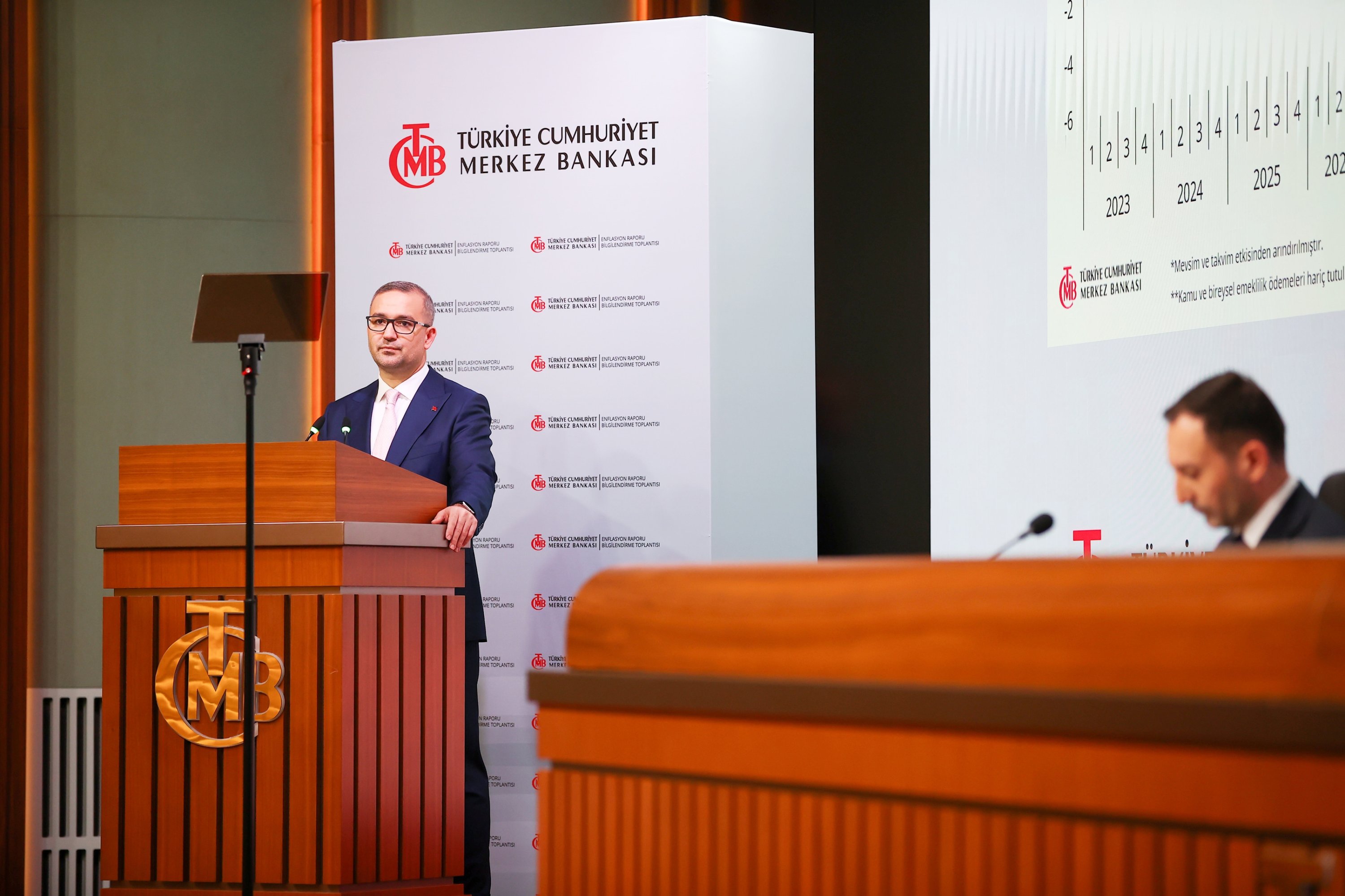
The Turkish central bank revised its inflation forecasts upward on Thursday, setting a 2026 year-end forecast of 29.5% and a 21% forecast for next year, citing effects related to the war in Iran and broader geopolitical tensions.
"Supply-side shocks caused by geopolitical developments are limiting the decline in headline inflation. The continuation of this situation keeps upside risks to the inflation outlook alive and calls for a cautious policy stance," Central Bank of the Republic of Türkiye (CBRT) Governor Fatih Karahan told a news conference while presenting the year's final inflation report.
"We have revised our year-end 2026 inflation forecast upward to 29.5%," he said.
He also said that the bank projects inflation to decline to the interim targets of 21% at end-2027, 13.5% at end-2028 and 9% at end of 2029.
Thus, the bank's year-end inflation projections for 2027 and 2028 were revised upwards by 6 percentage points to 21% and 4.5 percentage points to 13.5%.
The forecast for 2029 remained unchanged at 9%, while the bank maintained its medium-term target of stabilizing inflation at 5%.
Karahan said higher oil prices, driven by rising regional tensions and fading expectations for a normalization of energy shipments through the Strait of Hormuz, had contributed to the upward revision.
"Geopolitical developments continue to be the leading risk factor in terms of further increases in oil prices and the persistence of high price levels," he said.
Türkiye's annual inflation rate stood at 29.77% in October, according to official data.
Inflation slightly picked up from a near five-year low of 29.73% in September, while monthly consumer prices rose 2.58%, accelerating from 1.84% in September.
Talking about the global and domestic macroeconomic outlook, Karahan flagged a slowdown in the disinflation process.
"In addition to the elevated levels of food inflation in the first months of the year, supply-side pressures stemming from the geopolitical developments at the end of February led to a deceleration in the disinflation process," he said.
He also mentioned that deceleration in services inflation continues despite supply shocks, but pointed out that this diverges among subgroups, citing, for example, a higher-than-expected increase in the communications group and the increase in transport due to energy prices. Karahan also said that "disinflation continues in rents and other services."
However, he also said that fresh fruits and vegetables prices cause fluctuations in food inflation.
"While inflation in fruits remains moderate owing to favorable crop production conditions, inflation in vegetables diverges from this course," he said.
"Leading indicators suggest that the rise in vegetable prices continues in November as well," he added.
Moreover, while raising overall forecasts for inflation, he said that the bank revised its assumptions for oil prices upwards for 2026 and 2027.
"The rise in natural gas prices has been more pronounced than that of oil prices. Disruptions in energy supply, rising refinery margins, and increasing transport costs also put upward pressure on import prices. Accordingly, we have revised our import price assumptions upwards for both years," he also said.
The governor also said that the uncertainty concerning the economic outlook remains elevated "due to geopolitical developments, volatility in financial markets and commodity prices."
In addition to the impact of energy and food price developments, Karahan also said that "supply shocks pose risks in terms of inflation expectations and pricing behavior."
As for food prices, he said that the impact of the war and adverse weather conditions on international agricultural commodity and agricultural input prices remains significant.
"Moreover, price adjustments in administered items may also heighten such risks," he said.
He also said that monetary policy is not being adjusted "based on one-month data" and noted that the bank remains attentive to the risks.