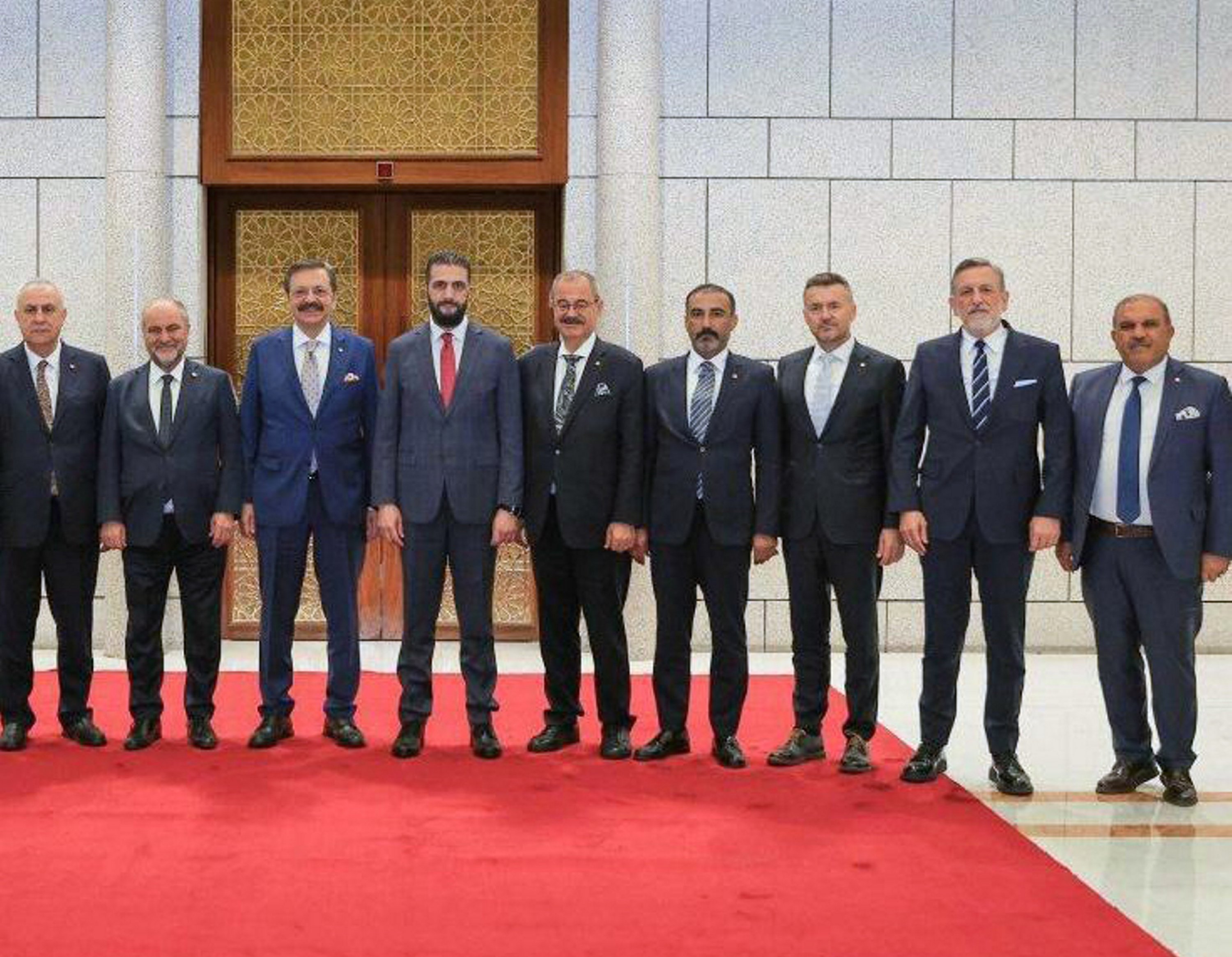
A top business delegation from Türkiye met with Syrian President Ahmad al-Sharaa in Damascus on Friday to discuss opportunities for economic cooperation and the reconstruction of the war-torn country’s industrial and commercial infrastructure.
Türkiye has supported opposition forces in Syria throughout the 13-year civil war that ended in December with the ousting of longtime dictator Bashar Assad. It is now positioning itself to play a major role in the neighboring country's rebuilding.
Turkish companies now see big opportunities after a lifting of long-standing U.S. sanctions, which severed Syria from the global financial system, cleared the way for investment in postwar reconstruction.
The delegation from the Union of Chambers and Commodity Exchanges of Türkiye (TOBB) arrived in Damascus on Thursday and attended a meeting with top officials, including Minister of Economy and Industry Nidal al-Shaar and the representatives of the Syrian business world.
On Friday, the delegation was received by al-Sharaa for a meeting that TOBB President Rifat Hisarcıklıoğlu described as "highly productive," emphasizing Türkiye's commitment to the principles of good neighborly relations.
"We discussed areas of potential commercial collaboration. Syrian authorities expressed strong interest in partnering with Turkish companies. I believe we will see a rapid advancement in bilateral trade and economic relations," Hisarcıklıoğlu said in a statement.
Ankara has pledged to help rebuild Syria's economy, including by providing natural gas. And Ziraat, Türkiye's top state bank, has said it would step in to support its banking sector when conditions are right.
The delegation engaged in a series of bilateral meetings with Syrian counterparts, focusing on restoring the country's industrial and commercial infrastructure, he noted. "We are closely following Syria's normalization process and fully support its territorial integrity and efforts to rebuild national unity," Hisarcıklıoğlu stated.
Construction, transportation and manufacturing firms from Türkiye are poised to play a major role in repairing the damage, which the U.N. estimates at nearly $1 trillion.
Hisarcıklıoğlu said that TOBB is ready to contribute to providing support to ensure the success of efforts toward economic development and help Syria's economic recovery.
"We discussed how we can contribute to Syria's reconstruction, how we can revitalize the private sector and entrepreneurship, and how we can enhance the trade volume between the two countries," Hisarcıklıoğlu said.
"Turkish companies can play a significant role in many sectors, especially infrastructure, construction, energy, food, and logistics."
The meeting with al-Sharaa came a day after Energy and Natural Resources Minister Alparslan Bayraktar said Türkiye would provide 2 billion cubic meters of natural gas to Syria each year.
Gas exports to Syria will contribute to an additional 1,300 megawatts of electricity production in the country, Bayraktar told a joint news conference with his Syrian counterpart Mohammed al-Bashir in Damascus.
Türkiye will also provide an additional 1,000 megawatts of electricity to Syria for its short-term needs, he added.
Al-Bashir said they agreed to activate a gas pipeline that connects Syria with Türkiye, with gas flows expected in June.
The two ministers discussed completing a 400-kilovolt line that links the countries, contributing to importing around 500 megawatts of electricity into Syria, to be ready by the end of the year or shortly thereafter, he added.
Cooperation also includes opening the door for Turkish companies to invest in mining, phosphate, electricity generation and electricity distribution in Syria.
Hisarcıklıoğlu emphasized that the Turkish business community can share its expertise, particularly in organized industrial zones (OIZs) and the modernization of land border gates, and that joint efforts can be undertaken in these areas.
"We have tremendous experience in OIZs. Since the 1990s, OIZs have spread across Anatolia, accelerating the industrialization process. Today, there are more than 400 OIZs throughout Türkiye. Companies located in these zones account for 45% of total industrial production and provide employment to approximately 2.7 million people. Thanks to this OIZ model, Türkiye has become an industrial country," he explained.
Hisarcıklıoğlu added that land border gates in Türkiye were modernized by the chamber and the commodity exchange community and that the project was selected by the United Nations as the best worldwide and presented as a model.
"Our land border gates, which now operate more efficiently and effectively, have seen a sharp increase in traffic volume, while freight costs for our exporting companies have decreased. We want to bring all these experiences to Syria. Technical work is needed for this. In bilateral meetings, we conveyed the need to establish a working group on this matter," he said.
Hisarcıklıoğlu emphasized that transportation activities between Türkiye and Syria have recently gained momentum, and trade in the region has been revitalized.
In the first five months of 2025, 110,000 shipments were made from Türkiye to Syria, marking a 60% increase compared to the same period last year, he noted.
"There are over 30,000 companies established by Syrians in Türkiye, 6,000 of which operate in the manufacturing sector," Hisarcıklıoğlu said.
He noted that bilateral trade between Türkiye and Syria had dropped from $2.5 billion to $486 million during the civil war. But it has rebounded to $2.5 billion, despite the challenges of war, thanks to the contributions of Syrian-founded businesses in Türkiye, he added.
As of 2024, Türkiye became Syria's largest trading partner, with Syrian entrepreneurs playing a major role in this development, according to Hisarcıklıoğlu.
"This creates a significant advantage for deeper cooperation between Türkiye and Syria in the new period," he added.