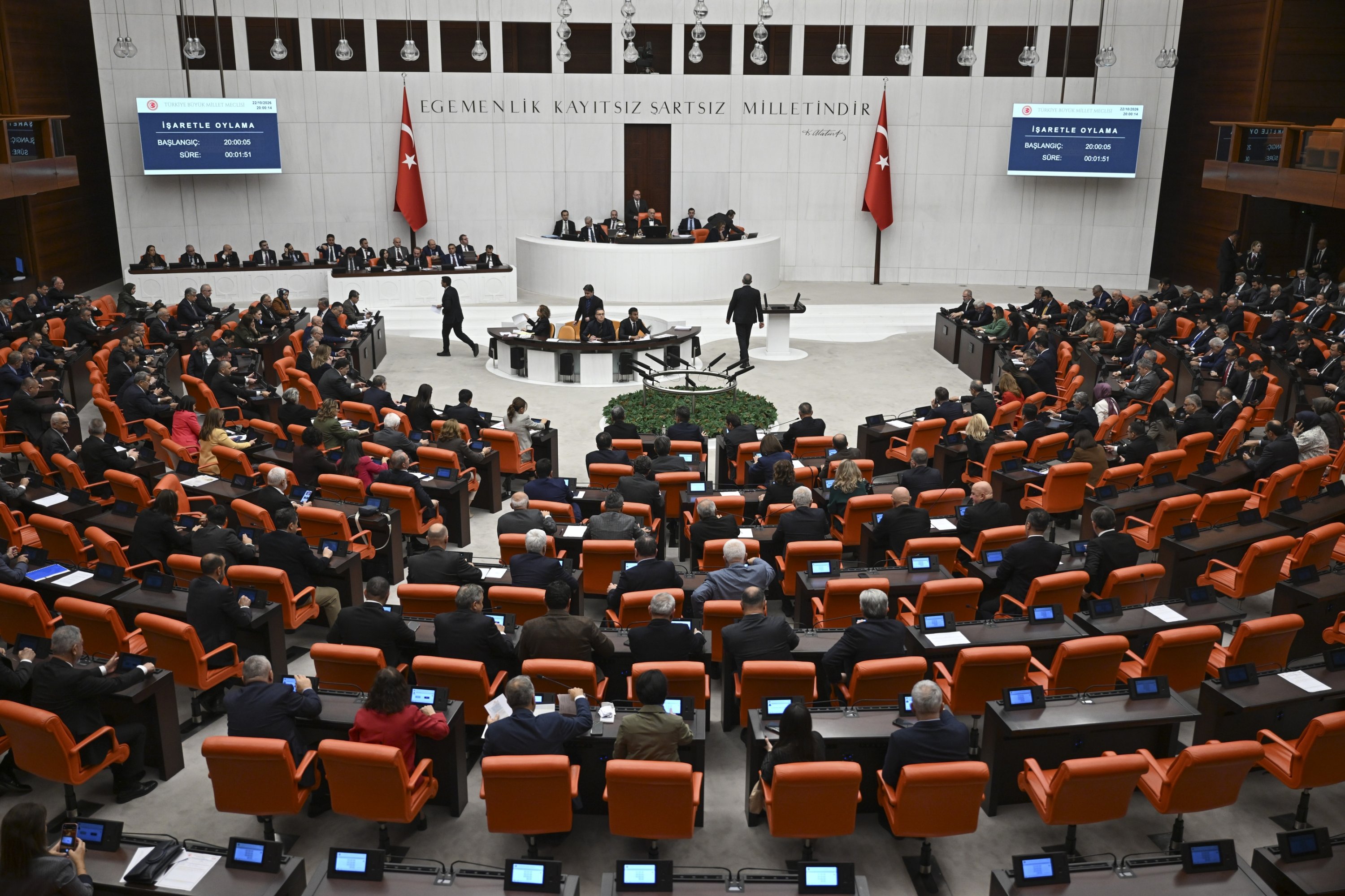
Türkiye's Parliament on Thursday passed a law governing the liquidation of certain funds caught up in last month's turmoil, allowing interim payments of up to TL 1 million ($20,000) to investors.
It also creates a mechanism to recover losses from those behind the scandal, seize their assets and distribute the recovered money to investors.
President Recep Tayyip Erdoğan said on Wednesday that payments to investors in the funds being wound down would pick up speed once the bill takes effect.
The scandal broke over a month ago, after several investment funds said they were unable to satisfy redemption demands, prompting prosecutors to open an investigation into allegations of widespread market manipulation.
Regulators placed seven firms managing 131 funds into liquidation, affecting nearly half a million individual investors. The Justice Ministry says more than 80 people have been arrested.
The law covers funds whose liquidation the Capital Markets Board (SPK) ordered on Sept. 17 and which have not been fully liquidated when the law is published. It does not set up a general or permanent liquidation regime for other investment funds.
Earlier on Thursday, a statement following a meeting of the Fund Coordination Board, a body created to oversee the liquidation process, said 84 of the funds have been settled, with TL 49.7 billion paid out to 55,755 accounts.
For funds designated by the SPK, according to the law, interim payments will be based on each investor's "net investment amount."
The interim payment cannot exceed the net investment amount calculated without indexation. In funds other than money market funds, the total value of the investor's fund units at the end of the previous day will also act as a ceiling.
If the cash available cannot cover everyone's calculated amounts, the SPK can set methods to make sure as many investors as possible receive payments.
The law does not mean every investor will definitely receive TL 1 million or that all losses will be covered. Payments will depend on each investor's net investment, the fund's resources and procedures set by the SPK.
The law addresses how losses from assets unlawfully taken out of the funds will be recovered. Money, securities, goods, rights and receivables taken from fund assets can be treated as unlawfully removed if the transfer breached regulations.
The same applies if it appeared lawful but served no real economic purpose for the fund. This covers loans, advances, collateral, transfers, sales, repo transactions and similar deals with related parties, controlling shareholders, managers or third parties.
The portfolio management company that founded or manages the fund will be primarily liable. If the loss cannot be collected from the company in whole or in part, or it is clear it cannot be, the people and legal entities named by the SPK, as well as those found to have acted with them, can be held personally liable. Leaving a post does not remove liability for actions and decisions taken while in it.
In investigations into acts linked to the funds, assets can be seized under the Criminal Procedure Code. Money and securities that can legally be returned directly to a fund can be returned to the fund or to a recovery account by order of a prosecutor, judge or court.
For assets that cannot be transferred directly, such as real estate, the Savings Deposit Insurance Fund (TMSF) can be appointed as trustee. The TMSF can sell or liquidate these assets without waiting for the outcome of the case.
Assets that a court orders confiscated, and that came from the fund or cover its losses, can be passed to the fund or its recovery account without being recorded as Treasury revenue.
Treasury and Finance Minister Mehmet Şimşek said this week that anyone who did not voluntarily return profits obtained through market-disrupting activities would face legal proceedings.
The TMSF will set up a separate recovery account for each fund, held apart from its own assets and usable only for that fund's liquidation and investor payments. The money cannot be used for other purposes, pledged as collateral, or seized, even for public debts.
After necessary costs, the remaining money goes to the liquidating institution if liquidation is still under way. If liquidation has finished, it goes to the Investor Compensation Center (YTM) to be paid to fund holders named by the SPK. The YTM will pay in proportion to unit ownership. Amounts below a minimum payment set by the SPK will be carried forward and added to later distributions until they reach the minimum.
The SPK will determine losses, responsible parties and their liability for each fund and notify the TMSF. The TMSF can then begin collection from those people's assets under the law on collecting public receivables. Istanbul administrative courts will have jurisdiction over resulting cases.
Fund holders will be identified by reconciling records with the Central Registry Agency (MKK).
Investors whose units were blocked because orders sent to the TEFAS electronic platform on or before Sept. 17 could not be carried out, because the fund defaulted or did not publish a unit price, will also be covered.