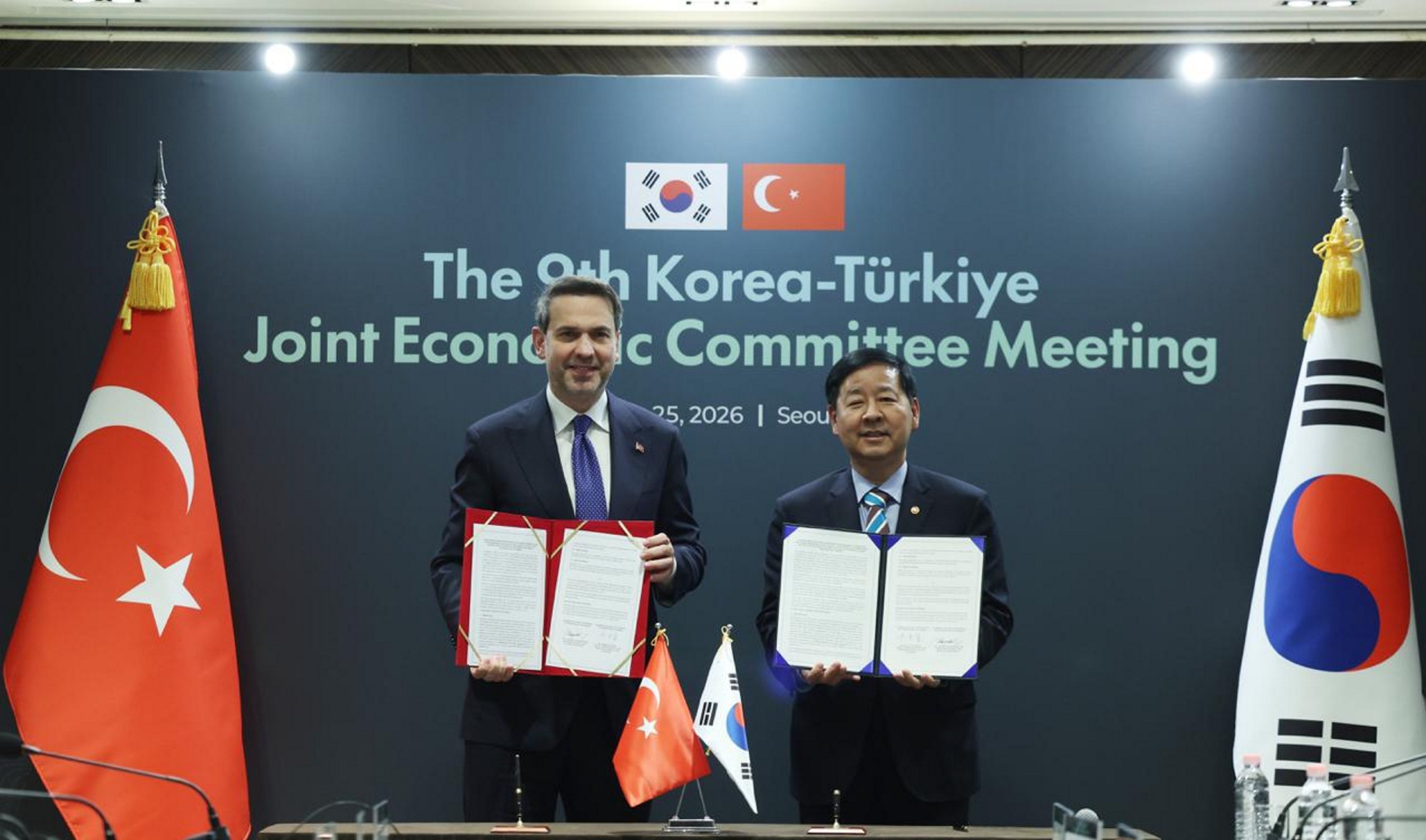
Türkiye is keen to deepen cooperation with South Korea in nuclear power, artificial intelligence, semiconductors, battery technologies and renewable energy, Energy and Natural Resources Minister Alparslan Bayraktar said on Wednesday.
Bayraktar was speaking in Seoul on the sidelines of the Türkiye-South Korea Joint Economic Commission meeting, which he co-chaired with South Korea's Deputy Prime Minister and Finance Minister Koo Yun-cheol.
Opening the meeting, Bayraktar said the relationship between the two countries rests not only on trade and diplomacy but also on shared history and strong people-to-people ties.
He said bilateral trade reached $11 billion in 2025 and that South Korea's investment stock in Türkiye stands at about $1.9 billion.
Bayraktar said South Korean President Lee Jae-myung's recent visit to Türkiye and his talks with President Recep Tayyip Erdogan had given fresh momentum to relations.
"Supporting this political will with concrete projects in the economic field should be our common goal," he said.
The minister described Türkiye as a competitive production and export hub for South Korean companies, pointing to its young and skilled workforce, large domestic market and access to the European Union through the customs union, as well as to the Middle East, North Africa and Central Asia.
He said Ankara wants to expand cooperation in energy, transportation, infrastructure, defense, science and technology.
"We prioritize the development of joint projects in strategic areas such as nuclear energy, artificial intelligence, semiconductors, battery technologies, critical minerals, innovation and renewable energy," he said.
The two sides signed the protocol of the Joint Economic Commission meeting after the talks.
During his visit, Bayraktar also met executives from major South Korean energy and mining companies and industrial groups at a roundtable where he outlined Türkiye's long-term energy plans.
He reiterated Türkiye's goal of reaching 20 gigawatts of nuclear power capacity by 2050 and noted that four reactors are currently under construction.
"We are a growing market and our demand is constantly increasing," he said. "The current construction is being carried out by a Russian company, but within the scope of our nuclear vision, we are in very close and intensive talks with KEPCO for new reactors."
During the visit, Bayraktar also met Kim Dong-cheol, chief executive of the Korea Electric Power Corporation.
He added that Türkiye is closely monitoring developments in small modular reactors, or SMRs, and signaled further discussions on their potential role in the country's energy transition.
Bayraktar also encouraged cooperation beyond the two countries' borders. "With Turkish companies, Türkiye and Korea can collaborate in the Middle East, Africa, and Central Asia," he said. "This way, we can combine our strengths to act jointly in different countries and regions."
On the sidelines of the meeting, Bayraktar held talks with South Korea's Minister of Climate, Energy and Environment Kim Sung-hwan.
In a post on Turkish social media platform NSosyal, he said that they reviewed existing partnerships and explored new opportunities in renewable energy, nuclear power and electricity transmission infrastructure.
"We agreed on a working agenda that will reflect the experience of both countries, primarily focusing on supply diversity to strengthen energy supply security and potential collaborations in third countries," he said.
Bayraktar also met South Korea's Trade, Industry and Energy Minister Kim Jung-kwan to discuss cooperation in nuclear energy and critical minerals.
He said Türkiye sees nuclear power as a key pillar of its energy supply security in line with its 2053 net-zero emissions target.
"We evaluated areas of joint work that will strengthen technical cooperation in nuclear technologies, engineering capacity and local industry contributions," he said.
"We also discussed concrete cooperation options that will enhance the complementary capacities of the two countries in the field of critical minerals," he said.