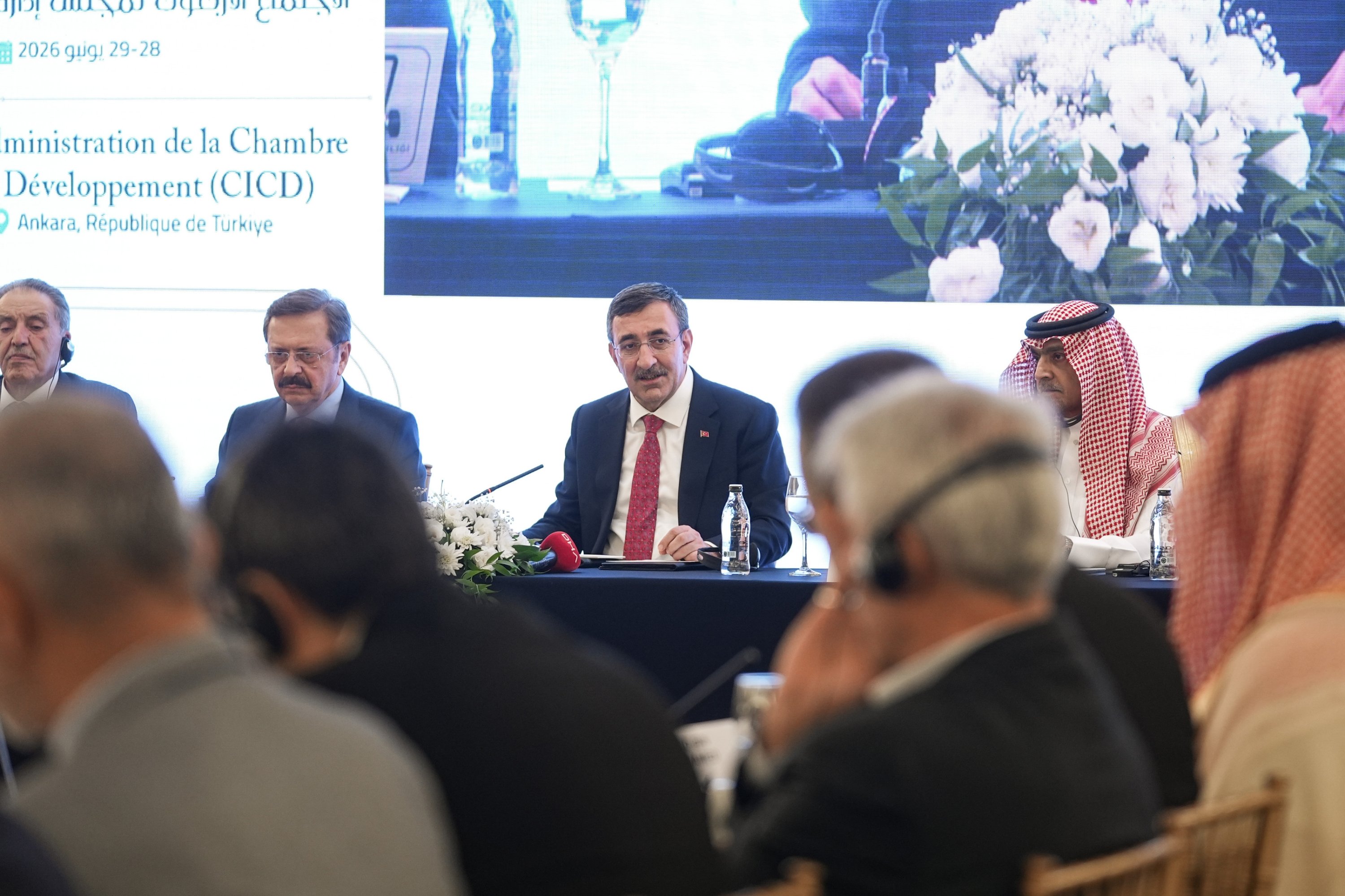
Türkiye on Monday urged for closer economic cooperation among Islamic countries, saying stronger production partnerships, investment collaboration, logistics, connectivity and integration are needed to boost their share of global trade.
"We need to increase the share Islamic countries receive from the world economy and trade. This will happen not only through efforts we make individually, but also through what we do together," Vice President Cevdet Yılmaz said.
Yılmaz was speaking at an event held as part of the Islamic Chamber of Commerce and Development meetings in Ankara.
The event, hosted by the Union of Chambers and Commodity Exchanges of Türkiye (TOBB), brought together chamber representatives from 20 Islamic countries.
Yılmaz said the global economy is facing challenges including geopolitical tensions, rising protectionism, supply chain changes, financing constraints, digitalization and the green transition.
He said the Organization of Islamic Cooperation (OIC), which has 57 members, accounts for nearly one-fifth of the world's population but only 10%-11% of global goods trade, highlighting significant untapped potential.
"This picture needs to change," he said. "In this context, we need more production partnerships, more cooperation in investments, logistics, connectivity and integration."
Yılmaz said Türkiye has played a leading role in advancing economic and commercial cooperation within the OIC.
Türkiye's economy grew from $238 billion in 2002 to more than $1.6 trillion in 2025, he said. He added that the country's exports of goods and services reached $396 billion last year and are expected to exceed $400 billion this year.
Türkiye's trade volume with OIC member countries reached $118 billion last year, while OIC member states have invested $27.3 billion in Türkiye since 2003, he said. Türkiye's direct investments in OIC countries totaled $15.2 billion over the same period.
Yılmaz said mutual investments should be increased to place trade relations on a stronger foundation.
He also pointed to the work of the Standing Committee for Economic and Commercial Cooperation of the OIC (COMCEC), chaired by Turkish President Recep Tayyip Erdoğan, saying it has supported economic and commercial cooperation among Islamic countries for more than 40 years.
Under COMCEC, 155 technical working group meetings have been held, 119 research reports have been prepared, and 209 projects have been supported, he said.
Yılmaz added that 38 projects have been implemented in Palestine under the COMCEC Al-Quds Program, while the COMCEC Syria Program will be implemented this year.
Yılmaz said Islamic countries have not yet reached their target of increasing intra-OIC trade to 25%.
"In fact, even this 25% is low. We need to target much more," he noted.
He said the OIC Preferential Trade System is one of the most important tools for reaching that goal, while the long-term objective should be to establish a free trade area among Islamic countries.
Yılmaz also underlined the importance of strengthening the OIC Arbitration Center for the fair and independent resolution of trade and investment disputes.
He said the world is moving from a low-cost production model toward resilient economic structures, making ties with nearby and friendly countries more important.
"In this important transformation process, we must increase our cooperation and turn this environment to our advantage," he said.
Yılmaz said Türkiye is also working to improve its investment climate and strengthen the Istanbul Financial Center (IFC), particularly through participation and Islamic finance instruments.
He welcomed a memorandum of understanding signed between TOBB and the Federation of Saudi Chambers, saying Türkiye and Saudi Arabia have positive economic and political relations.