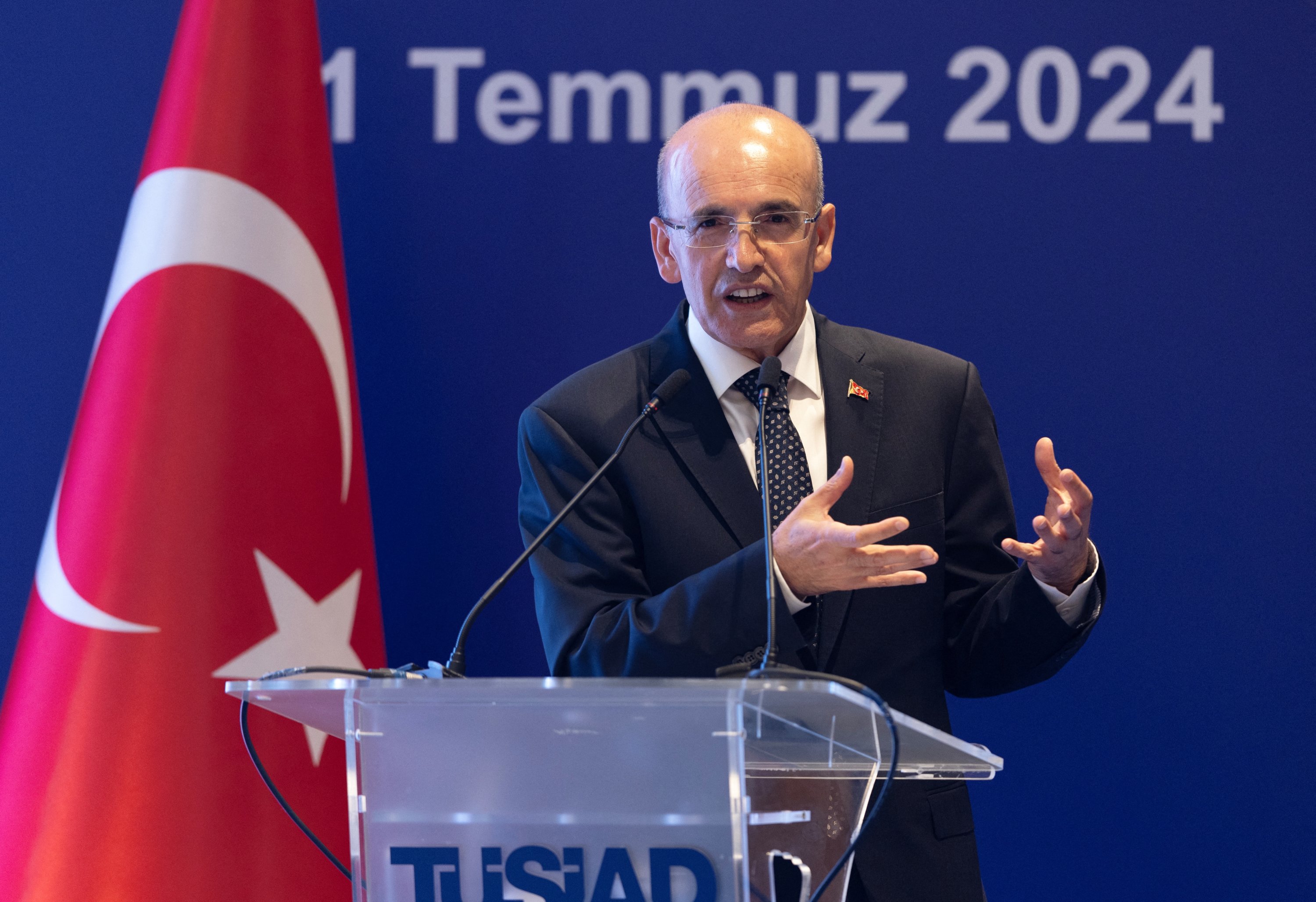
Türkiye can turn the recent wave of global tariffs into an opportunity, Treasury and Finance Minister Mehmet Şimşek said, citing limited trade exposure to the U.S. and falling oil prices as factors that may help the country stand out among emerging markets.
In an interview with the Financial Times, Şimşek said Türkiye, as an energy importer, is poised to benefit from narrowing current account deficits, which would help boost foreign reserves and support anti-inflation efforts.
“These are all constructive developments,” Şimşek said and added: “Once the dust settles, we hope – and we believe – that Türkiye will be viewed by investors as more resilient compared to other fragile markets.”
While U.S. President Donald Trump’s administration recently imposed a 10% baseline tariff on Turkish exports, Şimşek said the country is relatively well positioned. He noted that Türkiye’s $1.3 trillion economy relies heavily on trade with countries that have free trade agreements, such as those in the European Union, the Middle East, Central Asia and North Africa.
According to Şimşek, roughly 80% of Türkiye’s trade is conducted with these partners, while trade with the United States accounts for only about 5% of Türkiye’s total.
The finance minister also stressed that slowing global growth and tight domestic monetary policy are generating disinflationary effects, which align with Türkiye’s goals of taming inflation.
“Price stability, predictability, and an improved investment climate are my priorities,” he said, adding that Türkiye’s economic stability depends on the continuation of structural reforms.
Trade Minister Ömer Bolat called the tariffs on Türkiye the "best of the worst," given higher levies on other countries, but still said that the government wanted to negotiate with the U.S. to lift the new levies.
Turkish exports to the U.S. were $16.7 billion in 2024, according to the Office of U.S. Trade Representative. It imports a similar level of goods and services from America.
This level is dwarfed by exports to the EU, which, President Recep Tayyip Erdoğan said in January, reached $108.7 billion last year.