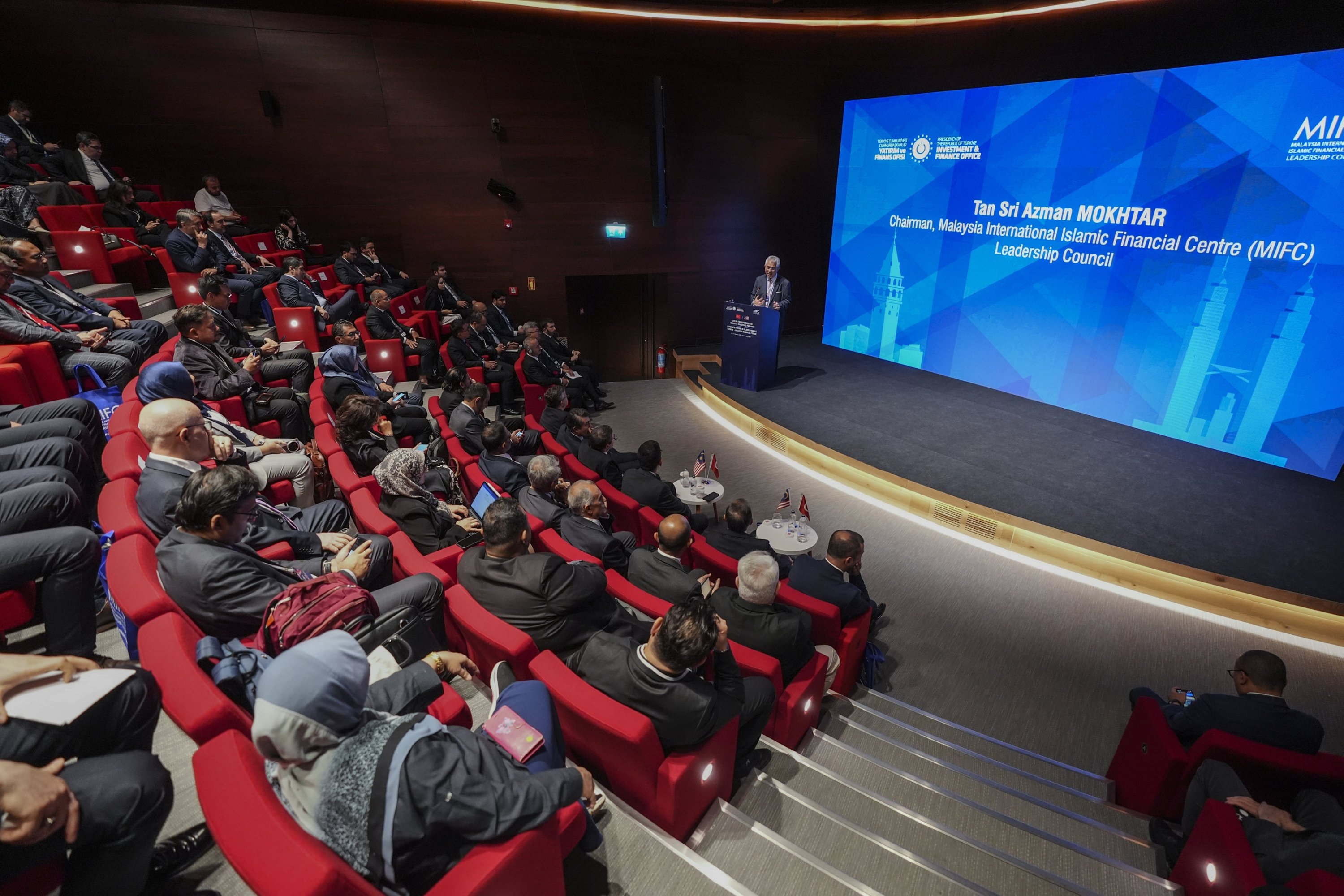
Türkiye and Malaysia can and should work together in a time when the world is seeking more direction and clarity, the chairperson of a Malaysian center focusing on Islamic finance said in an interview published on Tuesday.
"Türkiye and Malaysia can and should work together in a time when the world is seeking more direction and clarity. We are in a phase where we must continue to build and strengthen our relations," said Tan Sri Azman Mokhtar, the chairperson of Malaysia International Islamic Financial Centre (MIFC) Leadership Council (MLC).
Speaking to Anadolu Agency (AA), Mokhtar emphasized Türkiye's significance, both in its region and globally, explaining that they aim to advance the strong economic, financial, and investment ties between Türkiye and Malaysia.
"The Future of Islamic Finance: Türkiye-Malaysia Business Forum" was held recently in cooperation with the Presidency's Investment Office and MIFC MLC.
As part of the program, more than 20 senior financial representatives operating in areas such as Islamic banking, capital markets and takaful (Islamic insurance) came to Türkiye, along with heads of regulatory and supervisory institutions.
The program focused on promoting the Istanbul Financial Center (IFC), showcasing investment opportunities in Türkiye, strengthening public-private cooperation and evaluating investment prospects through one-on-one meetings.
Islamic finance, which has emerged in recent years as an alternative model, continues to grow and is expanding its influence, especially in the Gulf countries, Southeast Asia and Africa.
Due to its promotion of financial inclusion in developing countries and its foundation on ethical principles, Islamic finance is expected to become more widespread across broader geographies in the future. Türkiye stands out as a key part of this growing trend.
Legal reforms in participation finance, the establishment of new participation financial institutions, and the aim of turning Istanbul Financial Center into a global hub are all strengthening Türkiye's Islamic finance ecosystem.
As of 2024, participation banking holds an 8.5% share in the country's banking sector, and this is expected to reach double digits in the coming years.
Additionally, initiatives such as participation-based insurance, sukuk issuance (Islamic bonds) and the diversification of interest-free financial products support Türkiye's goal of becoming a regional Islamic finance center.
In his remarks to AA, Mokhtar noted that trade between the two countries exceeds $5 billion (TL 200.87 billion), adding, however, that there is room to "grow this even further."
"Our relationship is truly strong," he said.
Mokhtar explained that in Malaysia, Islamic finance constitutes almost half of the banking system and two-thirds of the capital markets.
Highlighting Türkiye’s significance regionally and globally, Mokhtar added: "Malaysia currently holds the chairmanship of the Association of Southeast Asian Nations (ASEAN). Türkiye and Malaysia can and should work together in a time when the world is seeking more direction and clarity. We are in a process where we must continue to build and strengthen our relations.”
He also mentioned witnessing the development of the Istanbul Financial Center closely and recalled opening an office in Istanbul during his time as CEO of Khazanah Nasional to invest in Türkiye and the region, a branch that is still active today.
Moreover, he drew attention to Türkiye's regional influence and its role in participation finance.
"Türkiye is not just about Türkiye. It is a bridge economy for Central Asia, Africa, the Middle East and North Africa. There is serious potential in the participation finance," he remarked.
"Much of this potential is already being realized. As Malaysia, we will continue to be part of this bridge, just as we are in our own region," he added.
Mokhtar emphasized that the global financial world is searching for direction, with ongoing issues and instability in monetary policy, climate initiatives, and environmental, social and governance (ESG) efforts.
He said that Islamic finance is rooted in social justice, and that they have transformed this tradition into a modern framework.
Highlighting the system’s growth potential, he added: "Islamic finance is growing much faster than the global financial system today, but in percentage terms, we are still relatively small. That means there is plenty of room for growth."