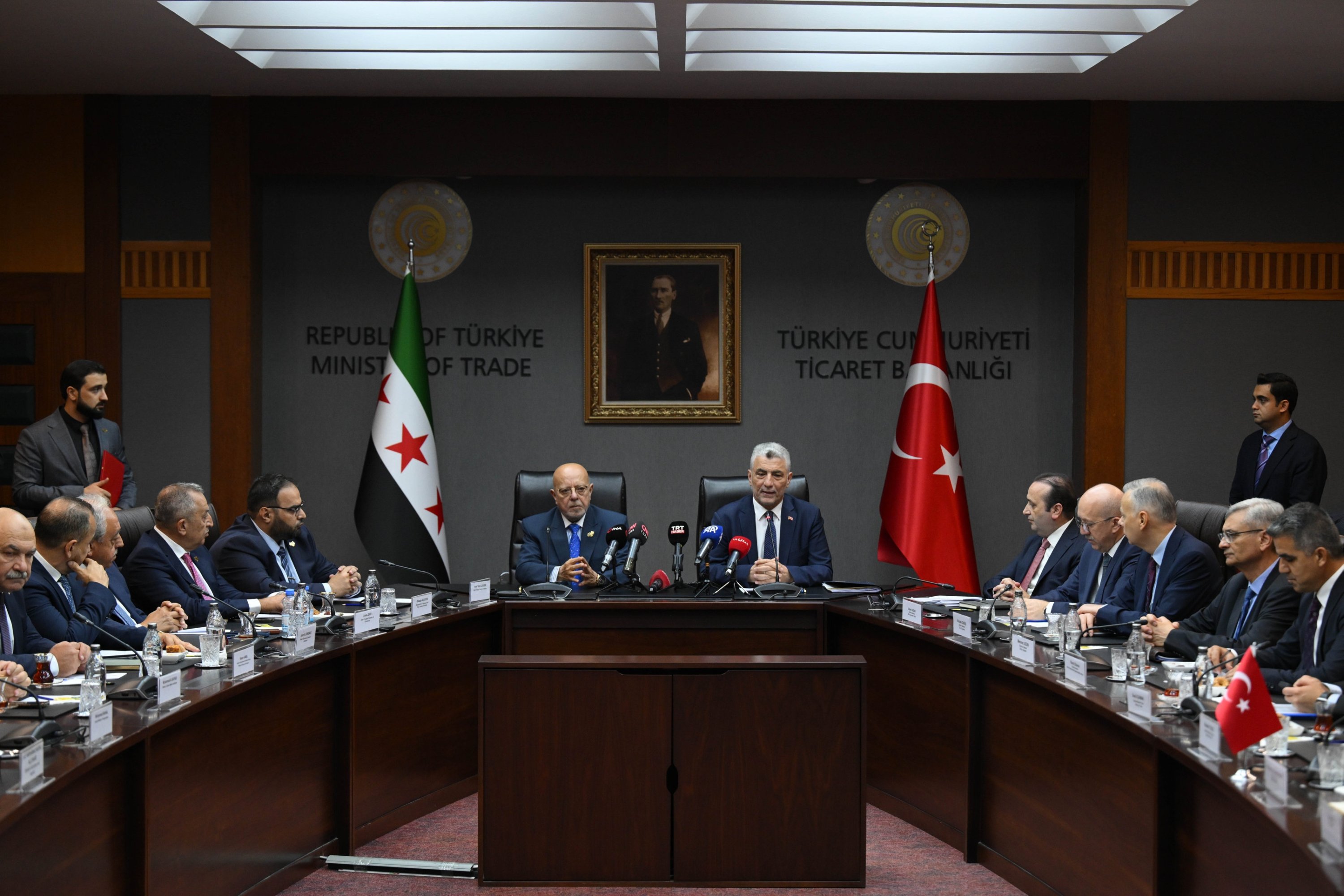
Turkish banks are preparing to launch operations in Syria in the near future, Trade Minister Ömer Bolat said Tuesday, as Türkiye adds momentum to efforts to help its neighbor recover its war-torn economy.
Bolat also emphasized the growing pace in talks aimed at involving Turkish contractors in Syria's rebuilding process.
He was speaking alongside Syrian Economy and Industry Minister Mohammad Nidal al-Shaar at the signing ceremony of the founding protocol of the Türkiye-Syria Joint Economic and Trade Committee (JETCO) in Ankara.
Ankara, which supported opposition forces in Syria throughout the 13-year civil war that ended in December with the ousting of longtime dictator Bashar Assad, has now become one of the new government's main foreign allies while positioning itself to be a major player in the country's reconstruction.
"Turkish and Syrian businesspeople are coming together today and tomorrow under the coordination of TOBB and DEIK," Bolat said, referring to the Union of Chambers and Commodity Exchanges of Türkiye and the Foreign Economic Relations Board.
"The Türkiye-Syria Business Council is being reestablished, and its founding agreement will be signed tomorrow between Turkish and Syrian institutions at DEIK," he noted.
Bolat said preparations are underway for Turkish financial institutions to enter the Syrian market. "Our banks are also preparing to begin operations in Syria in the short term," he added.
His announcement comes days after representatives from Türkiye's Treasury and banking sector reportedly met with Syrian officials in Damascus to explore potential cooperation in banking, insurance and public finance.
Before the Syrian civil war, Türkiye's largest lender, Ziraat Bank, had been in talks to establish a bank in Syria with a local partner in 2010, but those plans were suspended with the onset of the conflict. Currently, no Turkish banks operate in Syria.
Following the ousting of Assad, Ziraat Bank General Manager Alpaslan Çakar had told Reuters that the bank would be ready to take on responsibility in Syria if conditions allowed.
Broader reconstruction-focused talks are ongoing between Türkiye and the Syrian interim government, particularly in sectors such as energy and infrastructure, as part of efforts to stabilize and rebuild the country.
"Turkish entrepreneurs led by contractors are eager to play an active role in the reconstruction of Syria, including infrastructure, superstructure and social housing," Bolat said. "Discussions between business communities and contractors from both countries are accelerating."
Speaking at a separate meeting following the ceremony, Bolat said they were taking modernization steps to facilitate border crossings with Syria, accelerate trade and enhance security.
He said Türkiye is ready to make the strongest contributions to Syria's recovery, expressing belief that Turkish companies, with their expertise and experience in manufacturing, infrastructure, banking and construction, will take the lead in Syria.
"Our firms are ready to undertake Syria's transportation infrastructure and rebuilding projects, especially those involving public-private partnerships and build-operate-transfer models," Bolat said.
The JETCO meetings, which Bolat said will now be held at regular intervals, will bring together the business communities of both countries on an institutional platform. He also emphasized that they are ready to begin negotiations to establish a comprehensive economic partnership agreement between the two nations.
Regarding his meeting with al-Shaar, Bolat noted that they discussed customs regime practices and transportation activities in detail.
"From now on, our trucks will no longer need to transfer cargo or swap trailers at the Syrian border. In the coming period, Aleppo will become a strong logistics hub. Syria's transportation corridors will be reactivated. We are entering a new era where transit transport to Gulf countries will resume, and both our countries will benefit from emerging areas of cooperation in trade," he said.
"We approach our customs collaboration with the same strategic vision, taking modernization steps that ease border crossings, speed up trade and enhance security, and we are improving the customs gates opening to Syria."
Bolat also drew attention to the importance of the energy-related step and noted Saturday's launch of gas exports to Syria.
Deliveries of Azerbaijan's gas through Türkiye are expected to reach around 6 million cubic metres (mcm) per day. The current delivery plan foresees exports of 1.2 billion cubic meters annually. Türkiye said there was potential to supply up to 2 bcm per year in the first phase.
The gas will be used to restart power plants in Syria with a combined capacity of 1,200 megawatts.
The Türkiye-Syria Natural Gas Pipeline will meet the electricity needs of 5 million households, said Bolat, stressing the will to further develop cooperation with joint energy and power plant projects in the period ahead.