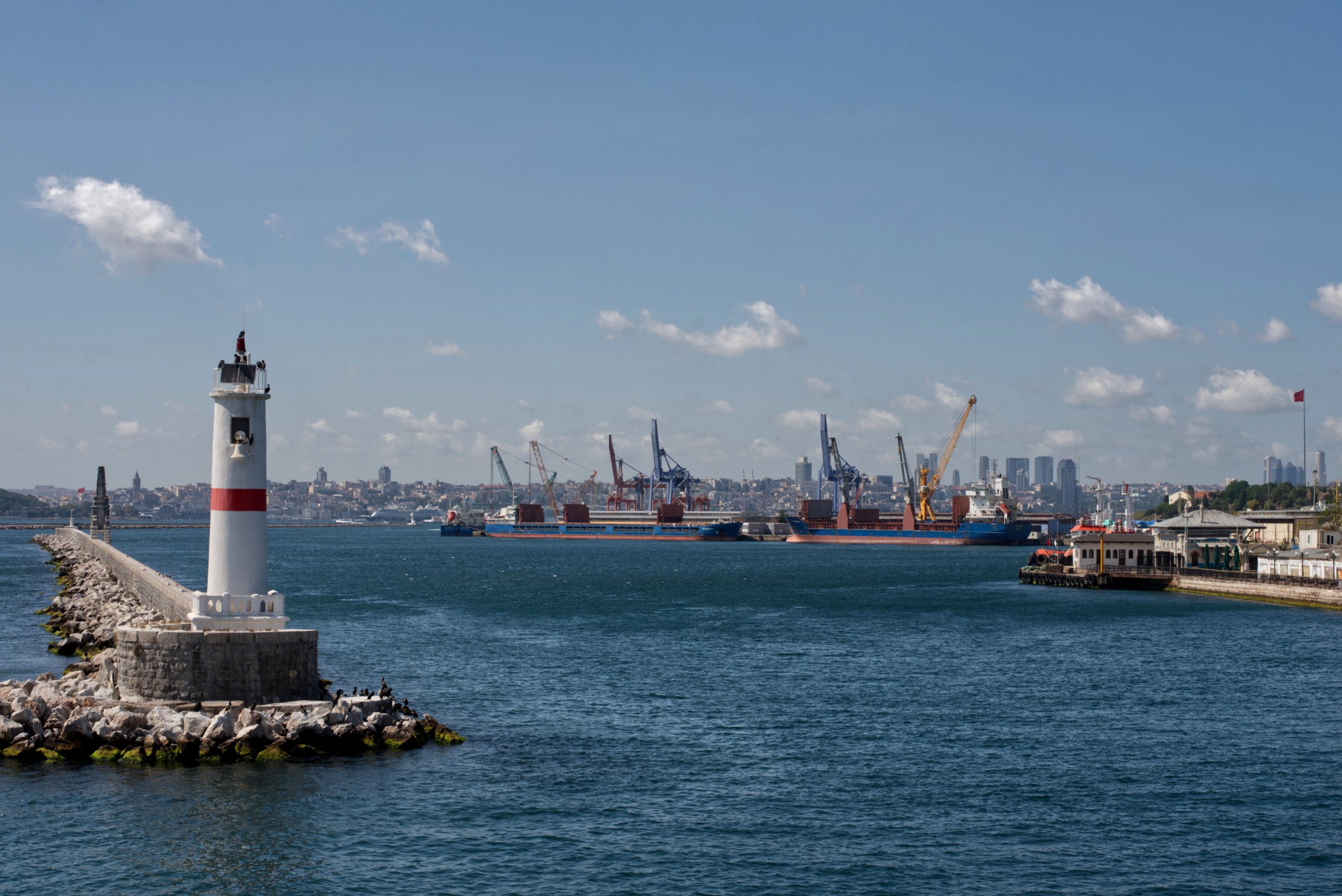
The United Arab Emirates (UAE) was the country where Türkiye increased its exports the most in value terms in the first half of the year, with shipments rising 64.5% to nearly $3.3 billion, according to a report Thursday.
Türkiye’s total exports from January to June rose 4.1% year-over-year to $131.4 billion, Anadolu Agency (AA) reported, citing data from the Turkish Exporters Assembly (TIM).
In June alone, exports increased 8% from a year earlier to $20.5 billion.
The automotive sector led all industries in export value during the first half, with $19.99 billion in sales. It was followed by chemicals and chemical products at $15.76 billion and the electrical-electronics sector at $8.33 billion.
Exports to the UAE increased by $1.28 billion compared to the same period last year, rising from $1.98 billion to $3.26 billion – a 64.5% jump. That marked the largest increase in value among all export markets.
Germany followed with an increase of $804.8 million, the U.K. with $685 million, Slovenia with $643.6 million, and Italy with $479 million.
In total, exports during the first half amounted to $9.72 billion to Germany, $6.56 billion to the U.K., $6.4 billion to Italy and $1.74 billion to Slovenia.
Türkiye's top 10 export markets in the first half were Germany, the U.K., Italy, the U.S., Spain, France, Iraq, Romania, the Netherlands and the UAE.
The jewelry sector was the leading Turkish exporter to the UAE, with $1.81 billion in shipments during the six-month period. Other top sectors included chemicals and chemical products ($250 million), electrical and electronics ($135.6 million), steel ($94.6 million), grains and pulses ($87.5 million), and ready-to-wear and apparel ($66.7 million).
Istanbul-based companies accounted for the largest share of exports to the UAE, totaling $1.63 billion. They were followed by companies in Çorum with $1.06 billion, Izmir with $72.2 million and Ankara with $69.7 million.
Mehmet Ali Akarca, head of the Turkey-UAE Business Council at the Foreign Economic Relations Board (DEIK), said the figures reflect the strong level of economic cooperation between the two countries.
“The growth is not only the result of commercial potential but also of strengthening diplomatic relations and mutual trust,” he told AA.
Akarca noted that the increase in exports was supported by the Comprehensive Economic Partnership Agreement (CEPA), which came into effect in 2023.
“With CEPA, the reduction in customs tariffs and elimination of technical barriers have simplified trade procedures,” he said.
He added that the UAE’s strategic geographic location, strong infrastructure and business-friendly environment make it a valuable trade hub.
“Despite having a population of just 10 million, the UAE plays a key role in global trade. Turkish firms are increasingly establishing offices there,” he said.
Cities like Dubai and Abu Dhabi, Akarca noted, serve as gateways to Asian, European and African markets, offering major logistical advantages with their modern ports, air cargo hubs and free trade zones.
He also said that the UAE’s role as a re-export center helps boost demand for Turkish goods in the Middle East, Africa and South Asia.
Looking ahead, Akarca said sectors such as digital technologies, health care, food, construction and defense are expected to gain importance in Turkish exports to the UAE.
“During our sectoral delegation visit for digital technologies last year, we saw strong interest in artificial intelligence, cybersecurity, fintech and software,” he said. “There’s also growing demand for food security and health care services, creating long-term partnership opportunities.”
He added: “The defense sector is also on the rise due to evolving geopolitical dynamics and technological transformation.”