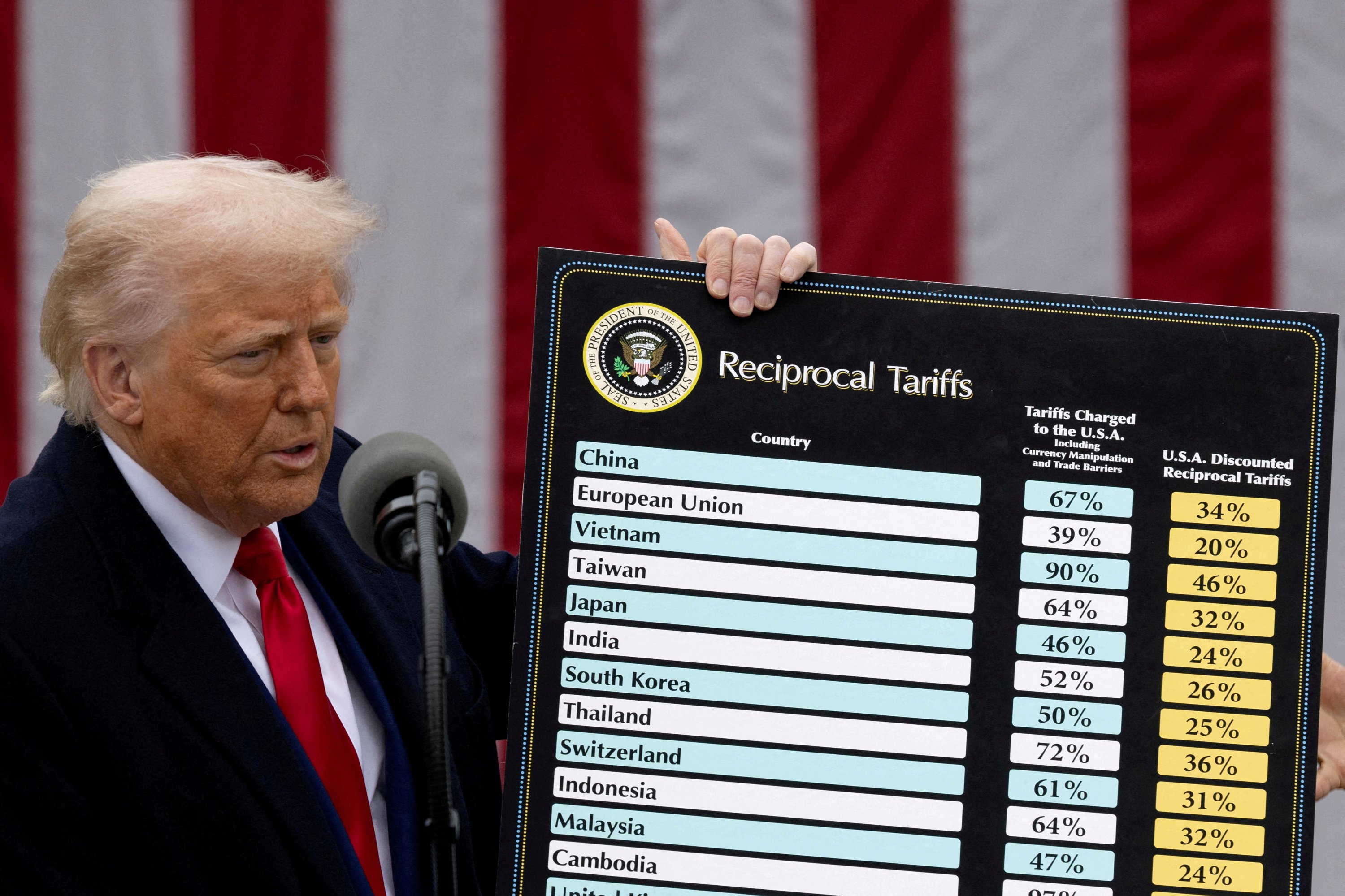
The U.S. is nearing the completion of several trade agreements and will inform other countries of increased tariff rates by Wednesday, with the new rates scheduled to take effect on Aug. 1, President Donald Trump said on Sunday.
Trump's remarks came as his administration steps up pressure on trading partners to quickly make new deals before the Wednesday deadline, with plans to start sending letters warning countries that higher tariffs could kick in as of next month.
Since taking office, Trump has set off a global trade war that has roiled financial markets and sent policymakers scrambling to protect their economies through efforts such as deals with the United States and other countries.
In April, Trump unveiled a base tariff rate of 10% on most countries and additional duties ranging up to 50%, although he later delayed the effective date for all but 10% until July 9. The new date offers countries a three-week reprieve.
Trump, whose remarks to reporters on Sunday came just before his return to Washington from a weekend of golfing in New Jersey, had flagged the Aug. 1 date earlier, but it was unclear if all tariffs would increase then.
He said he would send out letters starting Monday – "could be 12, could be 15" – to foreign governments reflecting planned tariffs for each.
"We've made deals also," Trump told reporters. "So we'll get to have a combination of letters, and some deals have been made."
He and his advisers have declined to say which countries would receive the letters.
Asked to clarify, Commerce Secretary Howard Lutnick told reporters the higher tariffs would take effect on Aug. 1, but Trump was "setting the rates and the deals right now."
In a posting on his Truth Social website, Trump later said the U.S. would start delivering tariff letters from 12 p.m. EST (4 p.m. GMT) on Monday.
In a separate post, he rolled out a wholly new tariff policy, calling for countries "aligning themselves with the anti-American policies" of the BRICS developing nations to be charged an extra 10% tariff, with no exceptions to be granted.
The first BRICS summit in 2009 was attended by leaders from Brazil, China, India and Russia, with South Africa joining later, while Egypt, Ethiopia, Indonesia, Iran, Saudi Arabia and the United Arab Emirates (UAE) were included last year.
Trump has close ties to leaders of some of those countries, such as Saudi Arabia and the UAE, and has been touting the prospect of a trade deal with India for weeks.
On Sunday, BRICS leaders condemned attacks on Gaza and Iran, called for reforms to global institutions and warned that the rise in tariffs threatened global trade.
It was not immediately clear if Trump's tariff threat would derail trade talks with India, Indonesia and other BRICS nations, however.
Earlier on Sunday, U.S. Treasury Secretary Scott Bessent told CNN's "State of the Union" that several big trade agreements would be announced in the next days, adding that European Union talks had made good progress.
Trump would also send letters to 100 smaller countries with which the United States does not have much trade, notifying them of higher tariff rates, he added.
"President Trump's going to be sending letters to some of our trading partners saying that if you don't move things along, then on Aug.1 you will boomerang back to your April 2 tariff level," Bessent said.
"So I think we're going to see a lot of deals very quickly."
Kevin Hassett, who heads the White House National Economic Council, told CBS's "Face the Nation" program that there might be wiggle room for countries engaged in earnest negotiations.
"There are deadlines, and there are things that are close, and so maybe things will push back past the deadline," Hassett said, adding that Trump would decide.
Stephen Miran, chair of the White House Council of Economic Advisers, told ABC News' "This Week" program that countries needed to make concessions to get lower tariff rates.
"I hear good things about the talks with Europe. I hear good things about the talks with India," Miran said. "And so I would expect that a number of countries that are in the process of making those concessions ... might see their date rolled."
Bessent told CNN the Trump administration was focused on 18 important trading partners that account for 95% of the U.S. trade deficit. But he said there had been "a lot of foot-dragging" among countries in finalizing trade deals.
Thailand, keen to avert a 36% tariff, is now offering greater market access for U.S. farm and industrial goods and more purchases of U.S. energy and Boeing jets, Finance Minister Pichai Chunhavajira told Bloomberg News on Sunday.
India and the United States are likely to make a final decision on a mini trade deal in the next 24 to 48 hours, local Indian news channel CNBC-TV18 reported on Sunday, with average tariffs of 10% on Indian goods shipped to the U.S., it said.
Hassett told CBS News that framework agreements already reached with Britain and Vietnam offered guidelines for other countries. He said Trump's pressure was prompting countries to move production to the United States.
The Vietnam deal was "fantastic," Miran said.
"It's extremely one-sided. We get to apply a significant tariff to Vietnamese exports. They're opening their markets to ours, applying zero tariff to our exports."