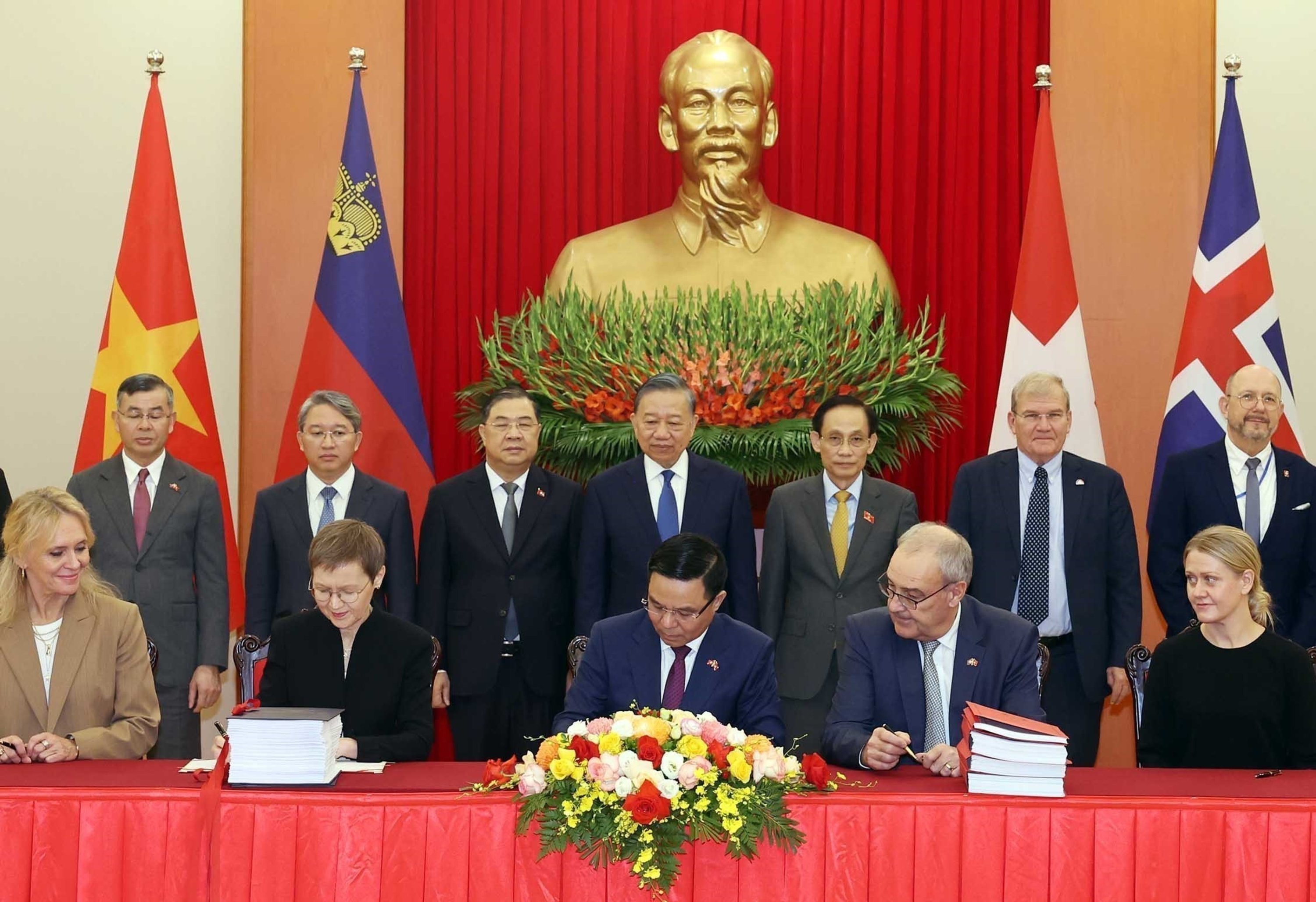
Vietnam and four European nations outside the EU bloc inked a free trade agreement (FTA) in Hanoi on Sunday, seeking to diversify their markets and strengthen cooperation as U.S. tariff pressures and tensions continue to disrupt global commerce.
The deal, between Southeast Asia's fastest-growing economy and the European Free Trade Association (EFTA), which includes Iceland, Liechtenstein, Norway and Switzerland, eliminates or reduces customs duties, including on imports of industrial, fish and agricultural products.
The deal was signed in the capital in the presence of Vietnam's top leader To Lam and representatives of EFTA governments.
Vietnam said the agreement showed the parties' resolve to "reinforce the rules-based trading system amid continued volatility in the global economy," according to a government statement.
It was also expected to help Vietnam "diversify its import and export markets" and "integrate more deeply into global value chains," the government said.
Vietnam and EFTA concluded negotiations in July, more than a decade after the free trade talks officially began in 2012.
The parties relaunched negotiations in September last year, after they had stalled since 2018.
The agreement followed a global trade-disrupting tariff blitz by the U.S. under President Donald Trump, which has left Vietnam with a hefty tax on its U.S. exports amid ongoing negotiations with Washington.
Experts say the new deal reflected a shared initiative to diversify commercial ties and reduce reliance on major trading partners.
"As the U.S. increasingly exerts trade pressure on European countries, the agreement is a joint effort to turn economic integration into greater strategic autonomy and to develop alternative commercial relationships rather than relying exclusively on their largest partners," history and politics scholar Do Dinh Lam Khang told Agence France-Presse (AFP).
For Vietnam, closer ties with EFTA economies could support its ambition to move into higher-value-added activities, Khang added.
The agreement covers trade in goods and services, intellectual property rights, trade remedies and sustainable development, among other areas, both parties say.
Bilateral trade between the EFTA and Vietnam last year was valued at 4.8 billion euros ($5.4 billion), according to the association.
Electrical and mechanical machinery, fish and pharmaceutical products were the EFTA nations' top exports to Vietnam last year.
Machinery, footwear and apparel were manufacturing hub Vietnam's major exports to the EFTA.
The association was created as a counterpart to the European Economic Community (EEC), precursor of the European Union, which its four member states are close to, but have not joined.