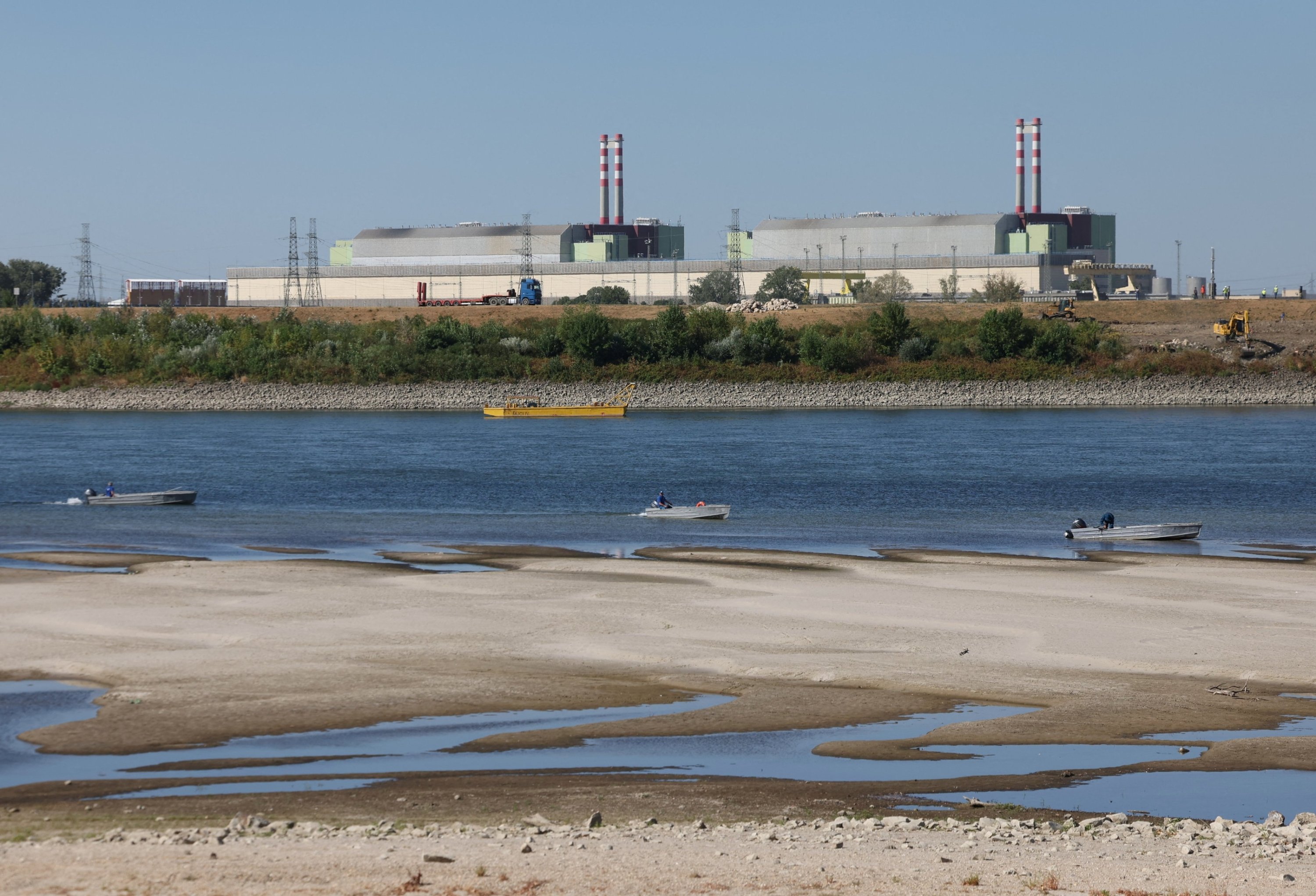
Severe droughts and record-low river levels are disrupting Eastern European nuclear generation, forcing Romania to shut down its last working reactor and straining Hungary's capacity to keep its plant online, sparking broader debate on how to adapt atomic energy to an increasingly extreme climate.
Reliance on river water for cooling nuclear reactors has long been an issue and has repeatedly led to reduced power output in the summer months, especially in France, which is more dependent on nuclear power than any other country.
But the extremity of drought and heat this year in Europe, which has experienced more warming than any other continent, has added urgency to a debate about adaptation.
Hungary was forced to cut its 2-gigawatt Paks nuclear plant's output to just over 10% earlier this month, barely escaping a full shutdown for the first time in 44 years. It is now operating at 25% of its capacity.
Romania's state-owned Nuclearelectrica shut down its last working reactor on Thursday after efforts to divert cooling water to the plant were not enough.
Nuclear power plants have the advantage of generating baseload power without carbon emissions, meaning they have a role in avoiding fossil fuel burning and tackling climate change.
Romania and Hungary are both committed to expanding their nuclear production as a source of ample, domestic power, but that means finding a way to cool reactors that depends less on river water levels.
Diana Urge-Vorsatz, a professor at the Central European University in Vienna, said scientific modelling showed the trend was for Central and Eastern Europe to become drier.
"This is not only due to less rains, but because the soil moisture and groundwater levels have dropped over the past years, and less precipitation and more heat waves exacerbate soil drying," she said.
At a conference last year of the Hungarian Hydrological Society, water engineers already warned that "flow patterns may become more extreme and volatile" on the Danube, one of Europe's longest rivers.
Now governments are seeking solutions under pressure as the emergency output cuts at Hungary's and Romania's nuclear plants have forced them to ask companies and households to cut power consumption.
Among the measures proposed, Hungarian Prime Minister Peter Magyar said on Wednesday his government would build what he referred to as a riverbed sill – a submerged, dam-like structure – to raise water levels. Also, two barges could be sunk on Friday to lift water levels to try to avert a shutdown, as the river is expected to shrink further in the coming days.
The country is also reviewing the designs for the planned Paks 2 nuclear expansion that rely on the Danube for cooling. The former government of Viktor Orban selected Russia's Rosatom for the work without a tender in 2014.
Romania's Nuclearelectrica operates two 706-megawatt reactors that account for a fifth of the country's power production. They use Canadian CANDU technology that relies on heavy water, in which the hydrogen in water is replaced with a heavier isotope, to slow neutrons.
The four reactors of Hungary's Paks plant, which generate around half of Hungary's power, are Russian-made pressurised water reactors.
Both technologies pump water from the Danube for cooling and then release the water back into the river.
In contrast, Czech and Slovak nuclear power plants use wet cooling towers, which need less water, with the steam evaporated in the process emitted to the atmosphere.
Scientists have raised the idea of hybrid cooling that would supplement river cooling with towers.
Attila Aszodi, professor and nuclear expert at the Budapest University of Technology and Economics, said, however, it was unlikely to be economical to retrofit a cooling tower to the original Paks reactors.
"I don't think that for the remaining 20-plus years, I mean, the remaining lifetime of the Paks 1 power plant, it would be economical to install a large cooling tower," Aszodi told Reuters. "A new evaluation of the cooling methods available on the site is definitely necessary."
In neighboring Romania, the country's only nuclear plant sits on a river branch called the Old Danube, which intersects with Bala, another branch.
In 2024, the government approved a project worth 1.02 billion lei ($225 million) to lift the riverbed of the Bala branch to manage the water flow.
The proposed solution includes moving the intersection of the branches further upstream, raising the riverbed sill on the deeper Bala arm.
The project has been delayed, and the government has given no information on when it could be completed. Asked about the impact of low Danube river levels on plans to add two more reactors, Nuclearelectrica told Reuters studies showed the Bala project would ensure that four reactors could function at full capacity.
Eugenia Gusilov, director of the Romania Energy Center think tank, agreed it was feasible, adding alternative cooling methods could be considered before works start.
"Building Units 3 and 4 still makes sense if the necessary hydrotechnical works are done," she said.