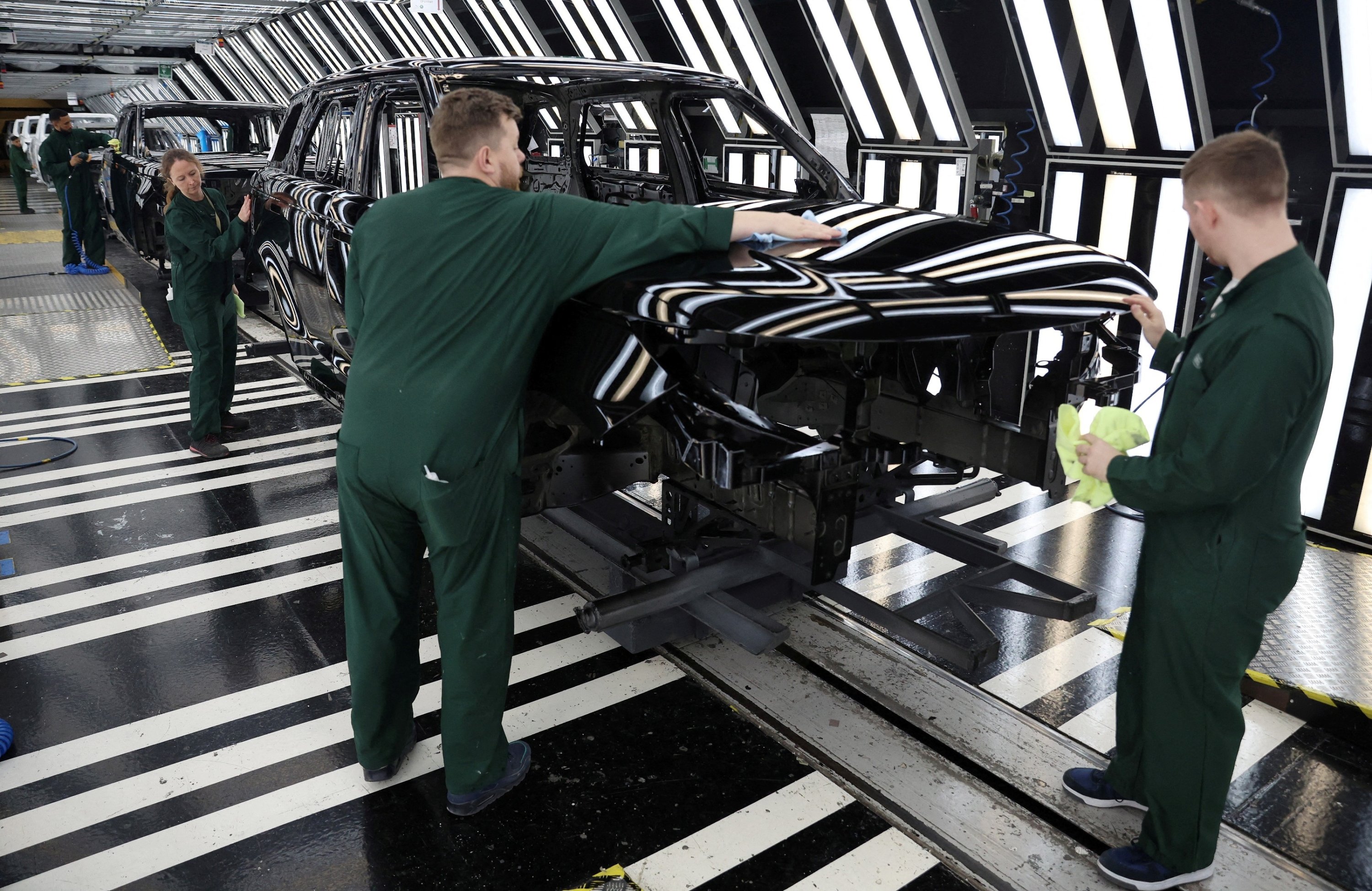
British luxury carmaker Jaguar Land Rover announced Monday it would cut around 4,000 roles over the next two years, or about 10% of its global workforce, in a further blow to Europe's automobile industry.
The company revealed its voluntary redundancy scheme just days after the German car giant Volkswagen announced 50,000 new job cuts.
It follows months of turmoil caused by a cyberattack on the British carmaker and U.S. President Donald Trump's sector-wide tariffs.
The world's biggest carmakers across Europe, the United States and Japan are also facing strong competition from Chinese manufacturers, as well as the need to invest heavily as the industry shifts toward electric vehicles.
"The automotive industry faces significant challenges, with technological change amidst intense competition and ongoing geopolitical uncertainty," JLR's CEO PB Balaji said in the statement, which also said it would target cost savings of 1.7 billion pounds ($2.3 billion).
"Over the next 12 months, we will launch five new products, continue to leverage the strength of our brands and renew our focus on North America, amongst other markets, to help us deliver double-digit revenue growth," Balaji added.
The vast majority of JLR employees – around 34,000 people – are based in the U.K.
In an earlier statement Monday, JLR identified management roles as those at risk, while local media reports said most of the cuts would be in the U.K.
U.K. Business Minister Jonathan Reynolds is scheduled to meet with the company's management this week.
Reynolds told the BBC that while he wanted to mitigate job losses, the business environment for carmakers was "challenging" in the U.K. and across Europe.
"If this is about making sure over time that the workforce is right to make the business as competitive as possible, that's the conversation we need to have," Reynolds said Sunday.
The job cuts would be a setback for Prime Minister Andy Burnham, who took office six weeks ago, and has repeatedly said he wants to "reindustrialize" Britain.
"We recognize this will be difficult news for colleagues affected, and are committed to supporting everyone with care, fairness and respect," Balaji said.
"Together, these actions will help build a stronger, more competitive JLR for all our stakeholders."
The restructuring comes a year after a major cyberattack halted JLR's production in Britain and severely affected its finances.
Owned by India's Tata Motors, JLR was forced to halt production for more than a month, costing the company 260 million pounds, according to its latest estimate.
Hit also by U.S. tariffs, the carmaker posted a loss of 244 million pounds for its fiscal year ending in March, compared with a net profit of 1.8 billion pounds in 2024-25.
"We must further simplify our organisation, improve efficiency, and build greater resilience," JLR said Monday.
Seeking to move on from the cyberattack, the company last week opened orders for its new fully electric Range Rover.
Last week, Volkswagen said its management and unions had agreed to axe a total of 100,000 jobs by the end of the decade, the biggest-ever restructuring in the global auto industry.
The company said it had approved a plan involving the reduction of around 50,000 jobs, on top of 50,000 already agreed earlier this year.